Imperial College, Hammersmith Campus, London, UK.
Eur Radiol. 2012 May;22(5):1023-32. doi: 10.1007/s00330-011-2340-y. Epub 2011 Dec 31.
To evaluate intra- and interobserver reproducibility of shear wave elastography (SWE) for breast masses.
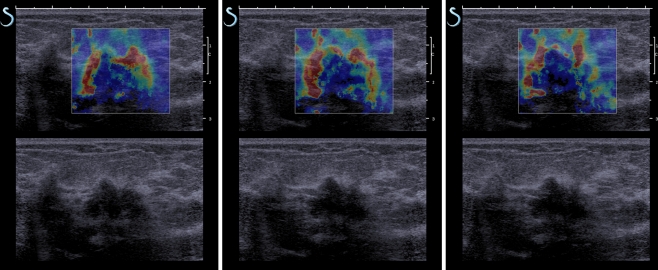
For intraobserver reproducibility, each observer obtained three consecutive SWE images of 758 masses that were visible on ultrasound. 144 (19%) were malignant. Weighted kappa was used to assess the agreement of qualitative elastographic features; the reliability of quantitative measurements was assessed by intraclass correlation coefficients (ICC). For the interobserver reproducibility, a blinded observer reviewed images and agreement on features was determined.
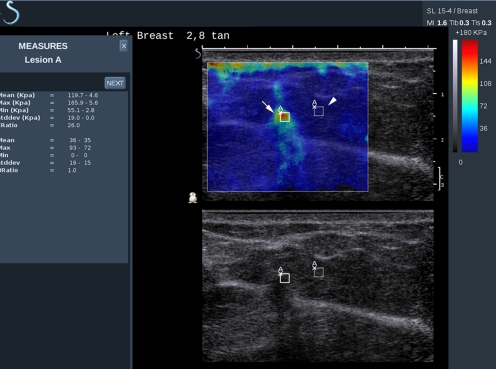
Mean age was 50 years; mean mass size was 13 mm. Qualitatively, SWE images were at least reasonably similar for 666/758 (87.9%). Intraclass correlation for SWE diameter, area and perimeter was almost perfect (ICC ≥ 0.94). Intraobserver reliability for maximum and mean elasticity was almost perfect (ICC = 0.84 and 0.87) and was substantial for the ratio of mass-to-fat elasticity (ICC = 0.77). Interobserver agreement was moderate for SWE homogeneity (κ = 0.57), substantial for qualitative colour assessment of maximum elasticity (κ = 0.66), fair for SWE shape (κ = 0.40), fair for B-mode mass margins (κ = 0.38), and moderate for B-mode mass shape (κ = 0.58), orientation (κ = 0.53) and BI-RADS assessment (κ = 0.59).
SWE is highly reproducible for assessing elastographic features of breast masses within and across observers. SWE interpretation is at least as consistent as that of BI-RADS ultrasound B-mode features.
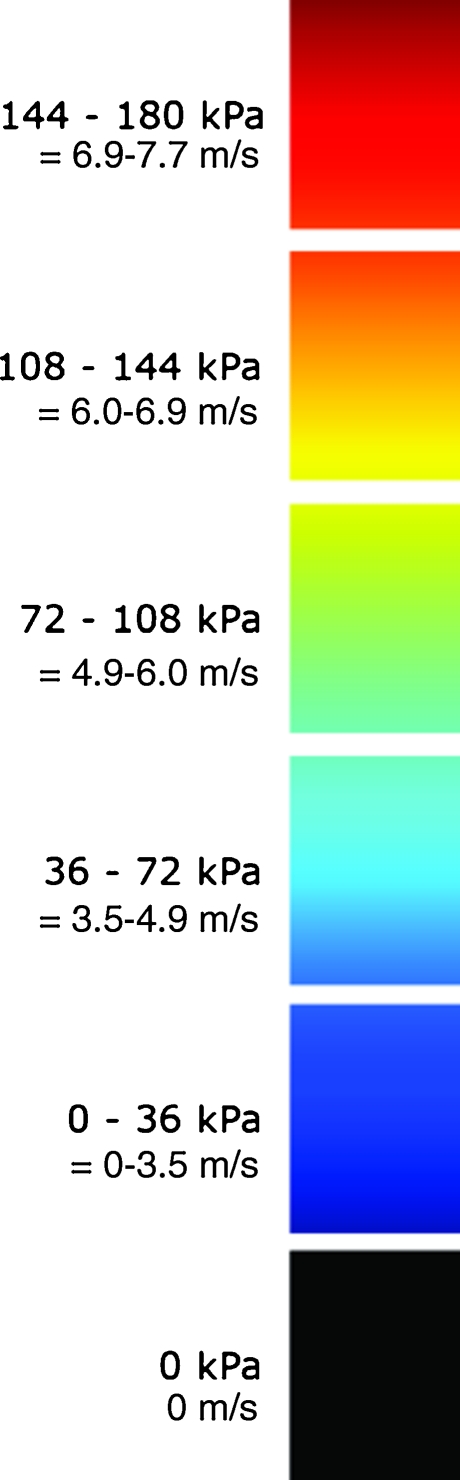
• Shear wave ultrasound elastography can measure the stiffness of breast tissue • It provides a qualitatively and quantitatively interpretable colour-coded map of tissue stiffness • Intraobserver reproducibility of SWE is almost perfect while intraobserver reproducibility of SWE proved to be moderate to substantial • The most reproducible SWE features between observers were SWE image homogeneity and maximum elasticity.
评估剪切波弹性成像(SWE)在乳腺肿块中的内、观察者间可重复性。
对于观察者内的可重复性,每个观察者对 758 个在超声上可见的乳腺肿块获得了三个连续的 SWE 图像。其中 144 个(19%)为恶性。采用加权kappa 评估定性弹性特征的一致性;采用组内相关系数(ICC)评估定量测量的可靠性。对于观察者间的可重复性,一位盲法观察者回顾了图像并确定了对特征的一致性。
平均年龄为 50 岁;平均肿块大小为 13 毫米。在定性方面,至少有 666/758 个(87.9%)的 SWE 图像至少相当相似。SWE 直径、面积和周长的组内相关几乎为完美(ICC≥0.94)。最大和平均弹性的观察者内可靠性几乎为完美(ICC=0.84 和 0.87),而肿块与脂肪弹性比的可靠性较高(ICC=0.77)。观察者间的 SWE 均匀性的一致性为中等(κ=0.57),最大弹性的定性颜色评估的一致性为较高(κ=0.66),SWE 形状的一致性为较低(κ=0.40),B 型肿块边缘的一致性为较低(κ=0.38),B 型肿块形状的一致性为中等(κ=0.58),B 型肿块取向的一致性为中等(κ=0.53),BI-RADS 评估的一致性为中等(κ=0.59)。
SWE 对评估乳腺肿块的弹性特征具有高度的可重复性,无论是在观察者内还是观察者间。SWE 的解释至少与 BI-RADS 超声 B 型特征的解释一样一致。
• 剪切波超声弹性成像可测量乳腺组织的硬度• 它提供了组织硬度的定性和定量可解释的彩色编码图• SWE 的观察者内可重复性几乎为完美,而 SWE 的观察者内可重复性为中等至高• 观察者间最具可重复性的 SWE 特征是 SWE 图像均匀性和最大弹性。