Institute for Maternal and Child Health IRCCS Burlo Garofolo and European School for Maternal Newborn Child and Adolescent Health, Trieste, Italy.
PLoS One. 2011;6(12):e28763. doi: 10.1371/journal.pone.0028763. Epub 2011 Dec 22.
Progress in maternal and neonatal mortality has been slow in many countries despite increasing access to institutional births, suggesting deficiencies in the quality of care. We carried out a systematic assessment of the quality of maternal and newborn care in three CEE/CIS countries, using an innovative approach to identify priority issues and promote action.
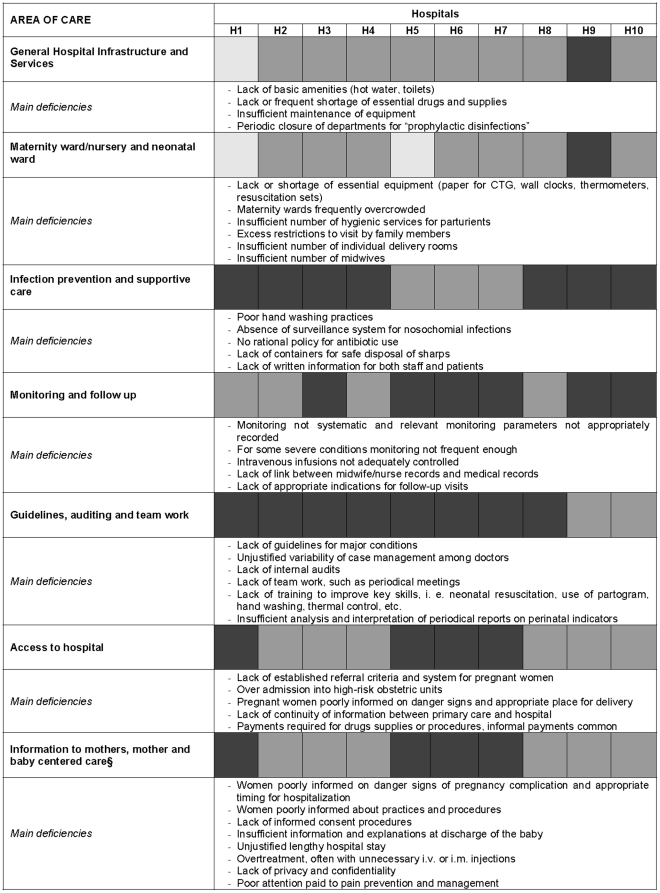
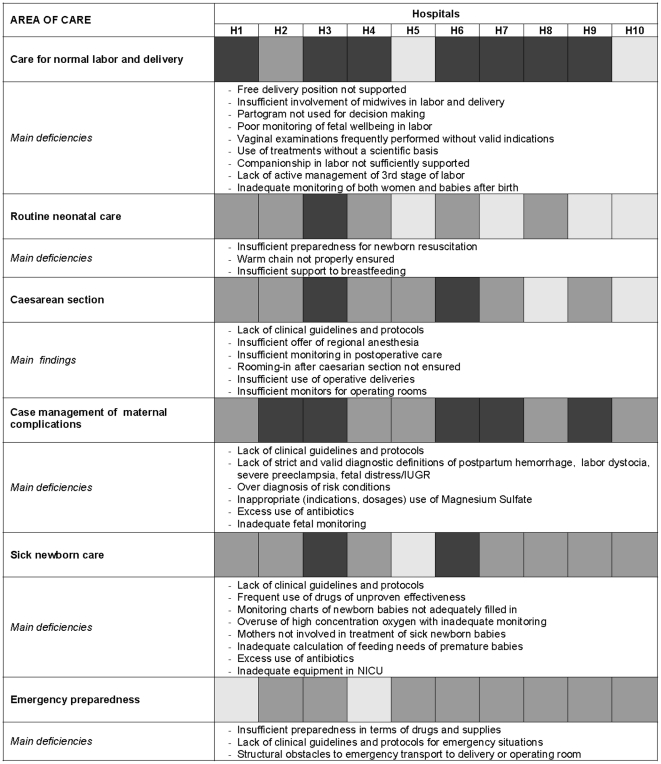
A standard-based tool, covering over 400 items grouped in 13 main areas ranging from support services to case management, was used to assess a sample of ten maternity hospitals in Albania, Kazakhstan and Turkmenistan. Sources of information were visit to services, medical records, observation of cases, and interviews with staff and mothers. A score (range 0 to 3) was attributed to each item and area of care. The assessment was carried out by a multidisciplinary team of international and national professionals. Local managers and staff provided the necessary information and were involved in discussing the findings and the priority actions.
Quality of care was found to be substandard in all 13 areas. The lowest scores (between one and two) were obtained by: management of normal labour, delivery, obstetric complications and sick babies; infection prevention; use of guidelines and audits; monitoring and follow-up. Neonatal care as a whole scored better than obstetric care. Interviewed mothers identified lack of information, insufficient support during labour and lack of companionship as main issues. Actions to improve quality of care were identified at facility as well as at central level and framed according to main health system functions.
Quality of care is a key issue to improve maternal and neonatal outcomes, particularly in countries such as CEE/CIS where access to institutional births is nearly universal. Approaches that involve health professionals and managers in comprehensive, action-oriented assessments of quality of care are promising and should be further supported.
尽管越来越多的人能够获得机构分娩,但许多国家的孕产妇和新生儿死亡率仍然缓慢上升,这表明护理质量存在缺陷。我们采用一种创新方法,对三个中东欧和独联体国家的母婴护理质量进行了系统评估,以确定优先问题并推动采取行动。
采用一种基于标准的工具,涵盖了 400 多项指标,分为 13 个主要领域,包括支持服务和病例管理,对阿尔巴尼亚、哈萨克斯坦和土库曼斯坦的 10 家产科医院进行了抽样评估。信息来源包括服务访问、医疗记录、病例观察、以及对工作人员和产妇的访谈。对每个护理项目和领域都给予了 0 至 3 的评分。评估由一个由国际和国内专业人员组成的多学科团队进行。当地管理人员和工作人员提供了必要的信息,并参与了讨论调查结果和优先行动。
在所有 13 个领域,护理质量都被认为不达标。得分最低(1 到 2 分)的领域包括:正常分娩、分娩、产科并发症和患病婴儿的管理;感染预防;使用指南和审计;监测和随访。新生儿护理的整体得分优于产科护理。接受访谈的产妇认为主要问题是缺乏信息、分娩期间缺乏支持和缺乏陪伴。已确定在医疗机构和中央层面采取行动,以改善护理质量,并根据主要卫生系统职能制定框架。
护理质量是改善母婴结局的关键问题,特别是在中东欧和独联体等国家,这些国家几乎所有人都能够获得机构分娩。涉及卫生专业人员和管理人员全面参与以行动为导向的护理质量评估的方法很有前景,应该得到进一步支持。