Graduate School of Science and Technology, Ehime University, Matsuyama, Ehime, Japan.
PLoS One. 2011;6(12):e29349. doi: 10.1371/journal.pone.0029349. Epub 2011 Dec 28.
Asymmetry in animal bodies and behavior has evolved several times, but our knowledge of their linkage is limited. Tanganyikan scale-eating cichlids have well-known antisymmetry in their bodies and behavior; individuals open their mouths leftward (righty) or rightward (lefty), and righties always attack the right flank of the prey, whereas lefties attack the left. This study analyzed the morphological asymmetry in a scale-eating characiform, Exodon paradoxus, and its behavioral handedness.
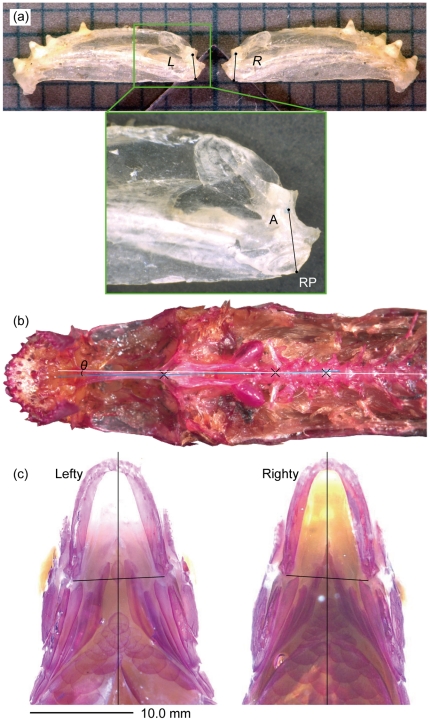
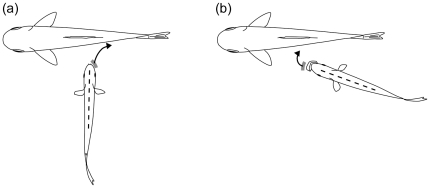
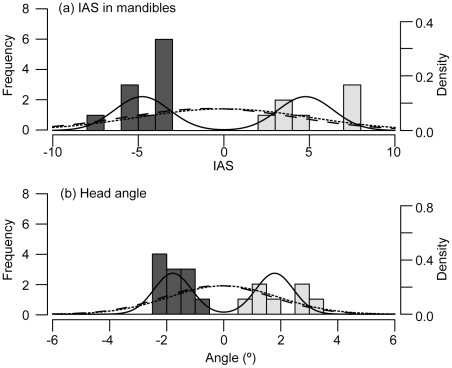
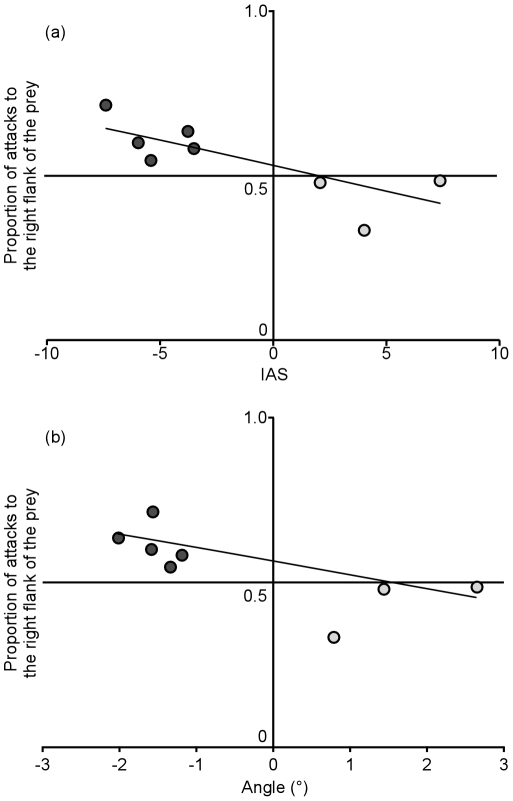
METHODOLOGY/PRINCIPAL FINDINGS: Each eight E. paradoxus was observed for 1-h with a prey goldfish in an aquarium to detect the behavioral handedness. Following the experiment, the lateral differences in the mandibles and head-inclination of these eight and ten additional specimens were analyzed. Both measurements on the morphology showed a bimodal distribution, and the laterality identified by these two methods was always consistent within a given individual, indicating that the characin has morphological antisymmetry. Furthermore, this laterality significantly corresponded to behavioral handedness; that is, lefties more often rasped scales from the right flank of the prey and vice versa. However, the correlation between laterality and handedness is the opposite of that in the cichlids. This is due to differences in the feeding apparatus and technique. The characin has cuspids pointing forward on the external side of the premaxilla, and it thrusts its dominant body side outward from its body axis on the flank of the prey to tear off scales. By contrast, the cichlids draw their dominant body side inward toward the axis or rotate it to scrape or wrench off scales with the teeth lined in the opened mouth.
CONCLUSIONS/SIGNIFICANCE: This study demonstrated that the antisymmetry in external morphology and the corresponding behavioral handedness have evolved in two lineages of scale-eating fishes independently, and these fishes adopt different utilization of their body asymmetry to tear off scales.
动物身体和行为的不对称性已经进化了多次,但我们对它们之间联系的了解是有限的。坦干伊喀慈鲷科的食鳞片鱼在身体和行为上具有明显的不对称性;个体的嘴向左(右撇子)或向右(左撇子)张开,右撇子总是攻击猎物的右侧,而左撇子则攻击左侧。本研究分析了食鳞片的鲇形目鱼类 Exodon paradoxus 的形态不对称性及其行为的手性。
方法/主要发现:在水族馆中,用一条金鱼作为猎物,对每 8 条 E. paradoxus 进行了 1 小时的观察,以检测其行为的手性。实验结束后,分析了这 8 条鱼和另外 10 条鱼的下颌骨和头部倾斜的侧向差异。这两种测量方法的结果均呈双峰分布,且在给定个体中,两种方法确定的偏侧性始终一致,表明鲇形目鱼类具有形态上的不对称性。此外,这种偏侧性与行为手性显著相关;即左撇子更常从猎物的右侧刮鳞片,反之亦然。然而,偏侧性与手性的相关性与慈鲷科的相反。这是由于摄食器官和技术的差异所致。鲇形目鱼类的上颌骨外侧有向前的尖牙,它们将主导的身体侧向外突出,从猎物的侧翼撕开鳞片。相比之下,慈鲷科鱼类则将主导的身体向身体轴线内侧或向轴线旋转,用张开的嘴内的牙齿刮擦或扭下鳞片。
结论/意义:本研究表明,外部形态的不对称性和相应的行为手性已经在两个食鳞片鱼类的谱系中独立进化,这些鱼类利用身体不对称性的不同方式来撕鳞片。