International Centre for Genetic Engineering and Biotechnology, Cape Town Component, Observatory, Cape Town, South Africa.
PLoS One. 2011;6(12):e29366. doi: 10.1371/journal.pone.0029366. Epub 2011 Dec 27.
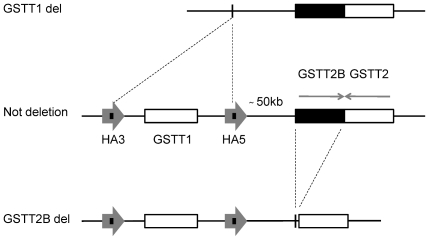
Polymorphisms in the Glutathione S-transferase genes are associated with altered risks in many cancers, but their role in oesophageal cancer is unclear. Recently a 37-kb deletion polymorphism of GSTT2B that reduces expression of GSTT2 has been described. We evaluated the influence of the GSTT1 and GSTT2B deletion polymorphisms, and the GSTP1 Ile105Val polymorphism (rs1695) on susceptibility to oesophageal squamous cell carcinoma (OSCC) in the Black and Mixed Ancestry populations of South Africa.
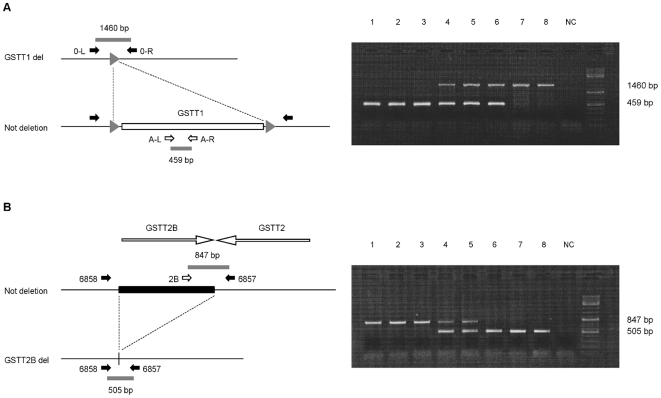
The GSTT1, GSTT2B and GSTP1 variants were genotyped in 562 OSCC cases and 907 controls, and tested for association with OSCC and for interaction with smoking and alcohol consumption. Linkage disequilibrium (LD) between the deletions at GSTT1 and GSTT2B was determined, and the haplotypes tested for association with OSCC. Neither the GSTT1 deletion nor the GSTP1 Ile105Val polymorphism was associated with OSCC risk in the Black or Mixed Ancestry populations. The GSTT2B deletion was not associated with OSCC risk in the Black population, but was associated with reduced risk of OSCC in the Mixed Ancestry population (OR=0.71; 95% CI 0.57-0.90, p=0.004). Case-only analysis showed no interaction between the GST polymorphisms and smoking or alcohol consumption. LD between the neighboring GSTT1 and GSTT2B deletions was low in both populations (r(2)(Black)=0.04; r(2)(MxA)=0.07), thus these deletions should be assessed independently for effects on disease risk.
Although there was no association between the GSTT1 deletion polymorphism or the GSTP1 Ile105Val polymorphism with OSCC, our results suggest that the presence of the recently described GSTT2B deletion may have a protective effect on the risk of OSCC in the Mixed Ancestry South African population. This is the first report of the contribution of the GSTT2B deletion to cancer risk.
谷胱甘肽 S-转移酶基因的多态性与许多癌症的风险改变有关,但它们在食管癌中的作用尚不清楚。最近,描述了 GSTT2B 的一个 37kb 缺失多态性,该多态性降低了 GSTT2 的表达。我们评估了 GSTT1 和 GSTT2B 缺失多态性以及 GSTP1 Ile105Val 多态性(rs1695)对南非黑人和混血人群食管癌易感性的影响。
在 562 例食管癌病例和 907 例对照中,对 GSTT1、GSTT2B 和 GSTP1 变体进行了基因分型,并检测了它们与食管癌的相关性以及与吸烟和饮酒的相互作用。确定了 GSTT1 和 GSTT2B 缺失之间的连锁不平衡(LD),并检测了与食管癌相关的单倍型。GSTT1 缺失或 GSTP1 Ile105Val 多态性均与黑人和混血人群的食管癌风险无关。GSTT2B 缺失与黑人人群的食管癌风险无关,但与混血人群的食管癌风险降低相关(OR=0.71;95%CI 0.57-0.90,p=0.004)。仅病例分析显示 GST 多态性与吸烟或饮酒之间无相互作用。两种人群中 GSTT1 和 GSTT2B 缺失之间的 LD 均较低(r(2)(Black)=0.04;r(2)(MxA)=0.07),因此这些缺失应独立评估对疾病风险的影响。
尽管 GSTT1 缺失多态性或 GSTP1 Ile105Val 多态性与食管癌无关,但我们的结果表明,最近描述的 GSTT2B 缺失的存在可能对南非混血人群食管癌的风险具有保护作用。这是 GSTT2B 缺失对癌症风险贡献的首次报道。