Dept. of Neurosurgery, Stanford University School of Medicine, USA.
Exp Neurol. 2012 Mar;234(1):136-43. doi: 10.1016/j.expneurol.2011.12.030. Epub 2011 Dec 27.
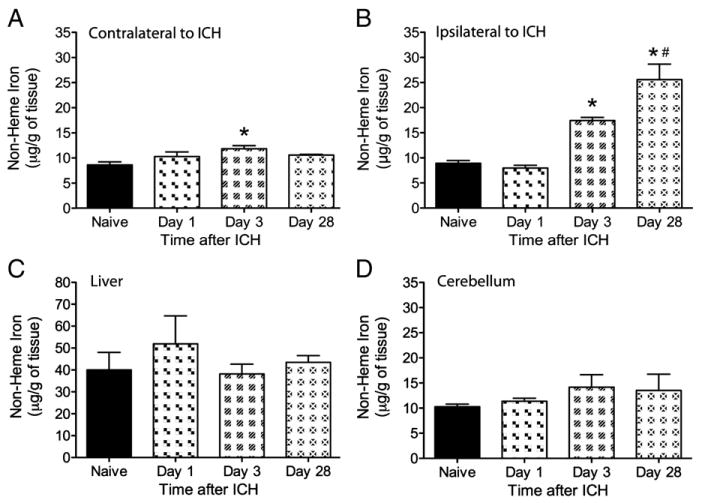
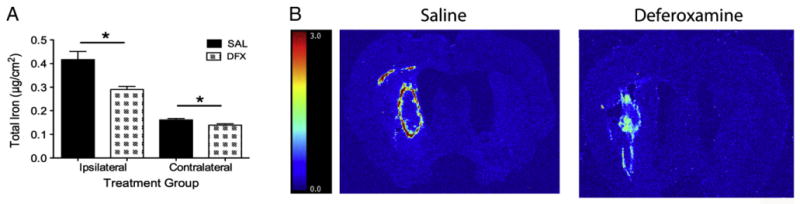
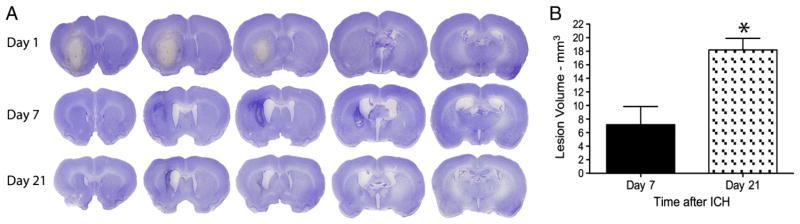
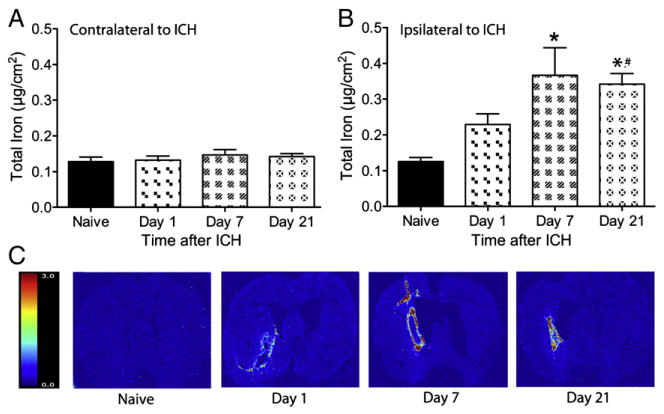
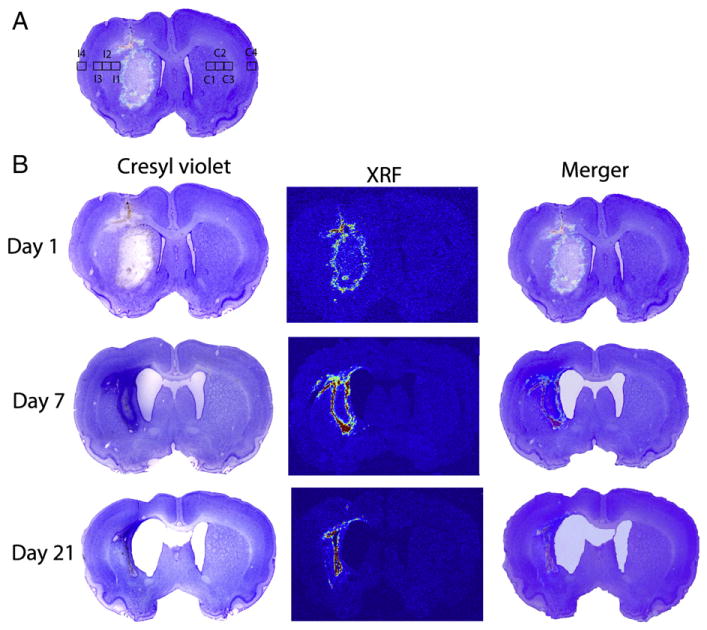
Iron-mediated free radical damage contributes to secondary damage after intracerebral hemorrhage (ICH). Iron is released from heme after hemoglobin breakdown and accumulates in the parenchyma over days and then persists in the brain for months (e.g., hemosiderin). This non-heme iron has been linked to cerebral edema and cell death. Deferoxamine, a ferric iron chelator, has been shown to mitigate iron-mediated damage, but results vary with less protection in the collagenase model of ICH. This study used rapid-scanning X-ray fluorescence (RS-XRF), a synchrotron-based imaging technique, to spatially map total iron and other elements (zinc, calcium and sulfur) at three survival times after collagenase-induced ICH in rats. Total iron was compared to levels of non-heme iron determined by a Ferrozine-based spectrophotometry assay in separate animals. Finally, using RS-XRF we measured iron levels in ICH rats treated with deferoxamine versus saline. The non-heme iron assay showed elevations in injured striatum at 3 days and 4 weeks post-ICH, but not at 1 day. RS-XRF also detected significantly increased iron levels at comparable times, especially notable in the peri-hematoma zone. Changes in other elements were observed in some animals, but these were inconsistent among animals. Deferoxamine diminished total parenchymal iron levels but did not attenuate neurological deficits or lesion volume at 7 days. In summary, ICH significantly increased non-heme and total iron levels. We evaluated the latter and found it to be significantly lowered by deferoxamine, but its failure to attenuate injury or functional impairment in this model raises concern about successful translation to patients.
铁介导的自由基损伤导致脑出血(ICH)后的继发性损伤。血红蛋白分解后,铁从血红素中释放出来,并在数天内在实质中积累,然后在大脑中持续数月(例如含铁血黄素)。这种非血红素铁与脑水肿和细胞死亡有关。去铁胺是一种三价铁螯合剂,已被证明可以减轻铁介导的损伤,但在胶原酶诱导的 ICH 模型中,其保护作用较差。本研究使用快速扫描 X 射线荧光(RS-XRF),一种基于同步加速器的成像技术,在胶原酶诱导的 ICH 后大鼠三个存活时间点空间映射总铁和其他元素(锌、钙和硫)。总铁与通过 Ferrozine 分光光度法测定的非血红素铁水平进行比较。最后,使用 RS-XRF 我们测量了用去铁胺与生理盐水治疗的 ICH 大鼠的铁水平。非血红素铁测定法显示,ICH 后 3 天和 4 周时损伤纹状体中的非血红素铁水平升高,但 1 天时没有升高。RS-XRF 还在可比时间检测到明显增加的铁水平,尤其是在血肿周围区域。在一些动物中观察到其他元素的变化,但这些变化在动物之间不一致。去铁胺降低了总实质铁水平,但在 7 天时并未减轻神经功能缺损或病变体积。总之,ICH 显著增加了非血红素和总铁水平。我们评估了后者,发现去铁胺显著降低了后者,但它未能减轻该模型中的损伤或功能障碍,这引起了对成功转化为患者的关注。