Section of Cell and Developmental Biology, Division of Biology, University of California San Diego, La Jolla, California, United States of America.
PLoS Genet. 2011 Dec;7(12):e1002424. doi: 10.1371/journal.pgen.1002424. Epub 2011 Dec 29.
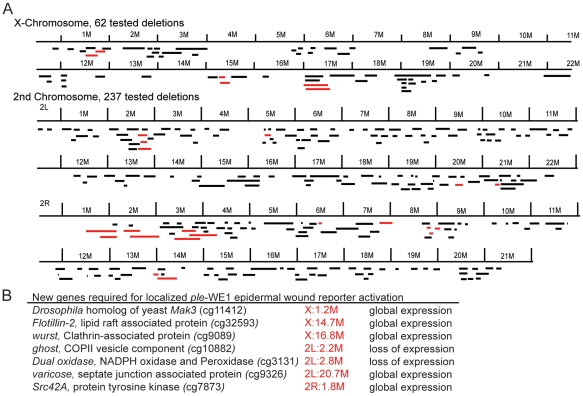
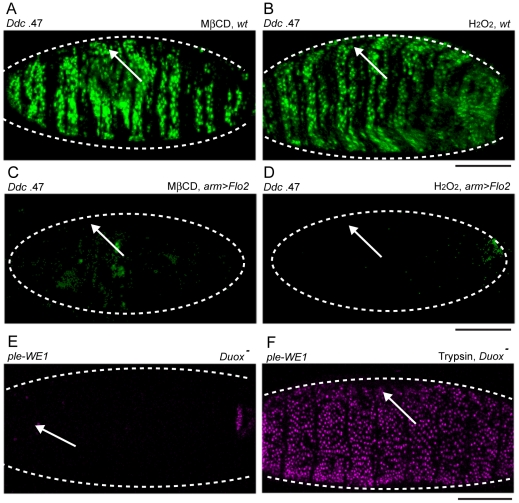
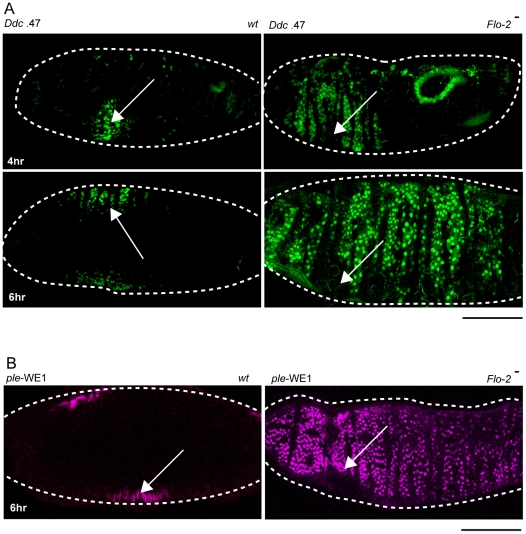
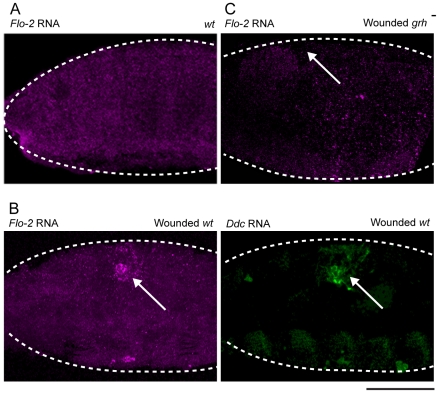
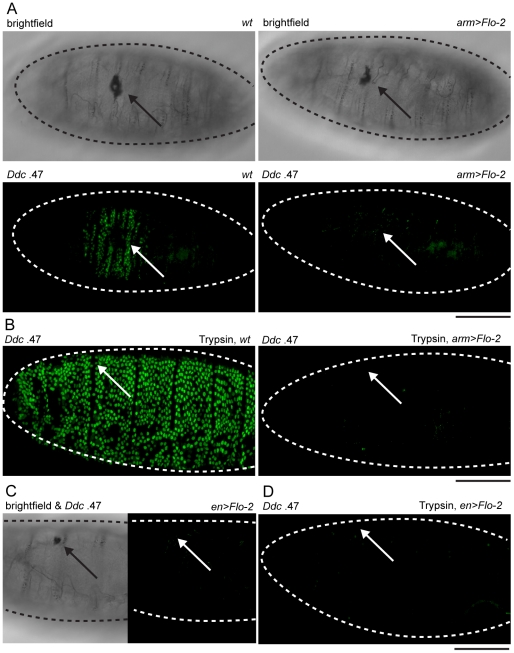
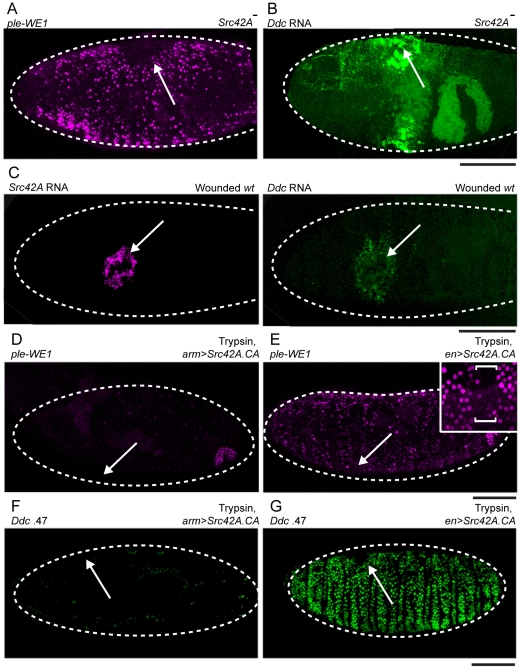
The epidermis is the largest organ of the body for most animals, and the first line of defense against invading pathogens. A breach in the epidermal cell layer triggers a variety of localized responses that in favorable circumstances result in the repair of the wound. Many cellular and genetic responses must be limited to epidermal cells that are close to wounds, but how this is regulated is still poorly understood. The order and hierarchy of epidermal wound signaling factors are also still obscure. The Drosophila embryonic epidermis provides an excellent system to study genes that regulate wound healing processes. We have developed a variety of fluorescent reporters that provide a visible readout of wound-dependent transcriptional activation near epidermal wound sites. A large screen for mutants that alter the activity of these wound reporters has identified seven new genes required to activate or delimit wound-induced transcriptional responses to a narrow zone of cells surrounding wound sites. Among the genes required to delimit the spread of wound responses are Drosophila Flotillin-2 and Src42A, both of which are transcriptionally activated around wound sites. Flotillin-2 and constitutively active Src42A are also sufficient, when overexpressed at high levels, to inhibit wound-induced transcription in epidermal cells. One gene required to activate epidermal wound reporters encodes Dual oxidase, an enzyme that produces hydrogen peroxide. We also find that four biochemical treatments (a serine protease, a Src kinase inhibitor, methyl-ß-cyclodextrin, and hydrogen peroxide) are sufficient to globally activate epidermal wound response genes in Drosophila embryos. We explore the epistatic relationships among the factors that induce or delimit the spread of epidermal wound signals. Our results define new genetic functions that interact to instruct only a limited number of cells around puncture wounds to mount a transcriptional response, mediating local repair and regeneration.
表皮是大多数动物最大的器官,也是抵御入侵病原体的第一道防线。表皮细胞层的破裂会引发各种局部反应,在有利的情况下会导致伤口愈合。许多细胞和遗传反应必须局限于靠近伤口的表皮细胞,但这是如何调节的仍知之甚少。表皮伤口信号因子的顺序和层次结构也仍然不清楚。果蝇胚胎表皮提供了一个极好的系统来研究调节伤口愈合过程的基因。我们开发了各种荧光报告器,可提供靠近表皮伤口部位的伤口依赖性转录激活的可见读数。对改变这些伤口报告器活性的突变体的大规模筛选,已鉴定出七个新基因,这些基因对于激活或限制伤口诱导的转录反应所需,其作用限于围绕伤口部位的一小部分细胞。在限制伤口反应传播所需的基因中,有果蝇 Flotillin-2 和 Src42A,两者在伤口部位周围均被转录激活。Flotillin-2 和组成型激活的 Src42A 也足以在高水平过表达时抑制表皮细胞中的伤口诱导转录。需要激活表皮伤口报告器的一个基因编码双氧化酶,该酶可产生过氧化氢。我们还发现四种生化处理(丝氨酸蛋白酶、Src 激酶抑制剂、甲基-β-环糊精和过氧化氢)足以在果蝇胚胎中全局激活表皮伤口反应基因。我们探讨了诱导或限制表皮伤口信号传播的因素之间的上位关系。我们的结果定义了新的遗传功能,这些功能相互作用,仅指示围绕穿刺伤口的有限数量的细胞启动转录反应,介导局部修复和再生。