Department of Internal Medicine, Gangnam Severance Hospital, Yonsei University College of Medicine, Seoul, Korea.
Cancer Res Treat. 2011 Dec;43(4):236-43. doi: 10.4143/crt.2011.43.4.236. Epub 2011 Dec 27.
The aims of this study are to find out whether the sequence of chemotherapeutic regimens including second- and third-line taxane and irinotecan influences the survival of patients with unresectable gastric carcinoma and to identify clinical characteristics of patients with improved response.
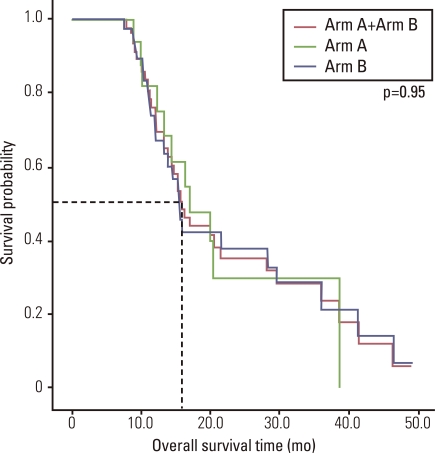
Fifty gastric carcinoma patients who were treated by third-line sequential chemotherapy between November 2004 and July 2010 were enrolled in this study. Their overall survival (OS) and time to progression (TTP) were set up as primary and secondary end points. For the sequence of chemotherapy regimen, two arms were used. Arm A was defined as 5-fluorouracil (5-FU)+cisplatin (FP) or folinic acid, 5-FU and oxaliplati (FOLFOX), followed by folinic acid, 5-FU and irinotecan (FOLFIRI), and paclitaxel or docetaxel plus 5-FU, with or without epirubicin. Arm B was defined as FP or FOLFOX, followed by paclitaxel or docetaxel plus 5-FU, and FOLFIRI.
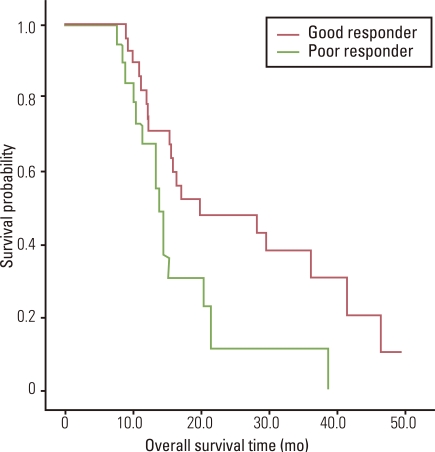
The median OS of all patients was 16.0 months (95% confidence interval, 13.6 to 18.3 months), which is longer than historical control of patients who did not receive third-line chemotherapy. The sequence of second and third-line regimen, including irinotecan and taxane, did not present significant difference in OS or TTP after failure of 5-FU with platinum chemotherapy. In survival analysis of patients' clinicopathologic characteristics, poor prognosis was shown in patients with poorly differentiated histologic features, elevated serum carcinoembryonic level, and shorter TTP of first line chemotherapy.
It is possible for patients to respond differently to chemotherapy due to differences in clinical features and underlying gene expression profiles. Development of individualized chemotherapy regimens based on gene expression profiles is warranted.
本研究旨在探讨含二线和三线紫杉烷类和伊立替康化疗方案的顺序是否影响不可切除胃癌患者的生存,并确定反应改善患者的临床特征。
本研究纳入了 2004 年 11 月至 2010 年 7 月期间接受三线序贯化疗的 50 例胃癌患者。他们的总生存期(OS)和无进展生存期(TTP)分别作为主要和次要终点。对于化疗方案的顺序,使用了两个方案。方案 A 定义为氟尿嘧啶(5-FU)+顺铂(FP)或亚叶酸钙、5-FU 和奥沙利铂(FOLFOX),随后是亚叶酸钙、5-FU 和伊立替康(FOLFIRI),紫杉醇或多西他赛加 5-FU,联合或不联合表柔比星。方案 B 定义为 FP 或 FOLFOX,随后是紫杉醇或多西他赛加 5-FU,以及 FOLFIRI。
所有患者的中位 OS 为 16.0 个月(95%置信区间,13.6 至 18.3 个月),长于未接受三线化疗的患者的历史对照。在氟尿嘧啶联合铂类化疗失败后,二线和三线方案中包括伊立替康和紫杉烷类药物的顺序,在 OS 或 TTP 方面没有显著差异。在患者临床病理特征的生存分析中,组织学分化差、血清癌胚抗原水平升高和一线化疗 TTP 较短的患者预后较差。
由于临床特征和潜在基因表达谱的差异,患者对化疗的反应可能不同。有必要根据基因表达谱制定个体化的化疗方案。