Arthritis and Tissue Degeneration Program, Hospital for Special Surgery, New York, NY 10065, USA.
J Exp Med. 2012 Feb 13;209(2):319-34. doi: 10.1084/jem.20111566. Epub 2012 Jan 16.
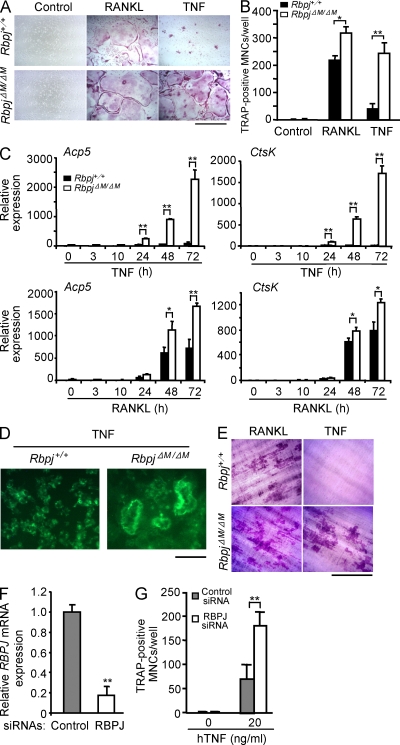
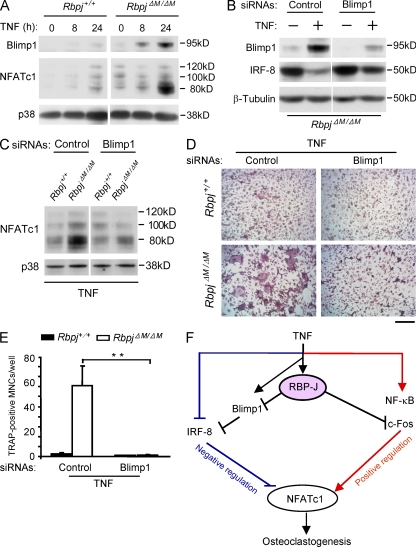
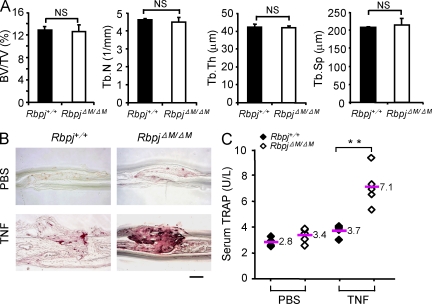
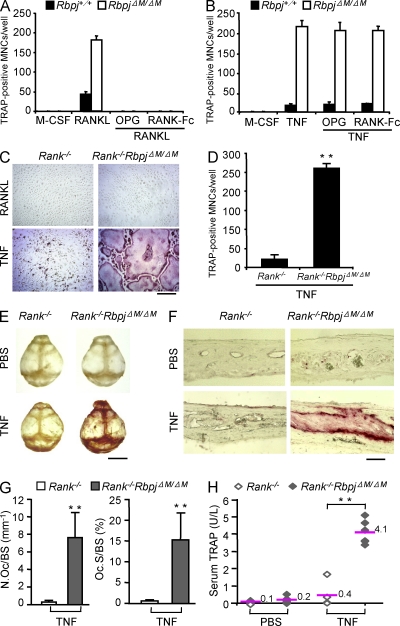
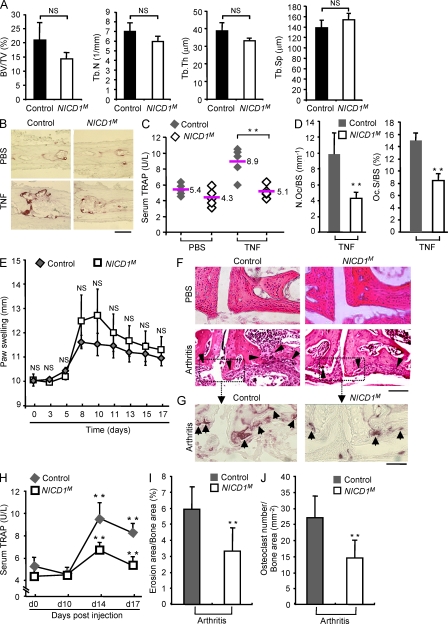
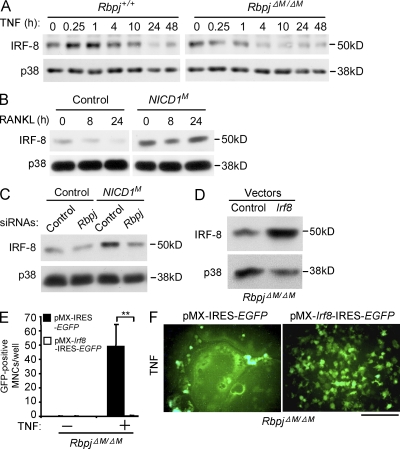
Tumor necrosis factor (TNF) plays a key role in the pathogenesis of inflammatory bone resorption and associated morbidity in diseases such as rheumatoid arthritis and periodontitis. Mechanisms that regulate the direct osteoclastogenic properties of TNF to limit pathological bone resorption in inflammatory settings are mostly unknown. Here, we show that the transcription factor recombinant recognition sequence binding protein at the J(κ) site (RBP-J) strongly suppresses TNF-induced osteoclastogenesis and inflammatory bone resorption, but has minimal effects on physiological bone remodeling. Myeloid-specific deletion of RBP-J converted TNF into a potent osteoclastogenic factor that could function independently of receptor activator of NF-κB (RANK) signaling. In the absence of RBP-J, TNF effectively induced osteoclastogenesis and bone resorption in RANK-deficient mice. Activation of RBP-J selectively in osteoclast precursors suppressed inflammatory osteoclastogenesis and arthritic bone resorption. Mechanistically, RBP-J suppressed induction of the master regulator of osteoclastogenesis (nuclear factor of activated T cells, cytoplasmic 1) by attenuating c-Fos activation and suppressing induction of B lymphocyte-induced maturation protein-1, thereby preventing the down-regulation of transcriptional repressors such as IRF-8 that block osteoclast differentiation. Thus, RBP-J regulates the balance between activating and repressive signals that regulate osteoclastogenesis. These findings identify RBP-J as a key upstream negative regulator of osteoclastogenesis that restrains excessive bone resorption in inflammatory settings.
肿瘤坏死因子 (TNF) 在类风湿关节炎和牙周炎等疾病的炎症性骨吸收和相关发病机制中发挥关键作用。调节 TNF 对破骨细胞直接生成特性的机制,以限制炎症环境中的病理性骨吸收,在很大程度上尚不清楚。在这里,我们表明,转录因子重组识别序列结合蛋白在 J(κ) 位点(RBP-J)强烈抑制 TNF 诱导的破骨细胞生成和炎症性骨吸收,但对生理骨重塑的影响最小。RBP-J 的髓样特异性缺失将 TNF 转化为一种有效的破骨细胞生成因子,可独立于核因子 κB 受体激活剂 (RANK) 信号发挥作用。在缺乏 RBP-J 的情况下,TNF 可有效地在 RANK 缺陷型小鼠中诱导破骨细胞生成和骨吸收。RBP-J 在破骨细胞前体中的选择性激活抑制了炎症性破骨细胞生成和关节炎性骨吸收。从机制上讲,RBP-J 通过减弱 c-Fos 激活并抑制 B 淋巴细胞诱导成熟蛋白-1 的诱导,来抑制破骨细胞分化的转录抑制剂(如 IRF-8)的下调,从而抑制破骨细胞生成的主调控因子(激活 T 细胞的核因子,胞质 1)的诱导。因此,RBP-J 调节了调节破骨细胞生成的激活和抑制信号之间的平衡。这些发现确定了 RBP-J 作为破骨细胞生成的关键上游负调节因子,可限制炎症环境中的过度骨吸收。