Department of Biology, College of Natural Sciences (RINS) and Applied Life Science (BK 21), Gyeongsang National University, Jinju, 660-701, Republic of Korea.
BMC Neurosci. 2012 Jan 19;13:11. doi: 10.1186/1471-2202-13-11.
Exposure to ethanol during early development triggers severe neuronal death by activating multiple stress pathways and causes neurological disorders, such as fetal alcohol effects or fetal alcohol syndrome. This study investigated the effect of ethanol on intracellular events that predispose developing neurons for apoptosis via calcium-mediated signaling. Although the underlying molecular mechanisms of ethanol neurotoxicity are not completely determined, mitochondrial dysfunction, altered calcium homeostasis and apoptosis-related proteins have been implicated in ethanol neurotoxicity. The present study was designed to evaluate the neuroprotective mechanisms of metformin (Met) and thymoquinone (TQ) during ethanol toxicity in rat prenatal cortical neurons at gestational day (GD) 17.5.
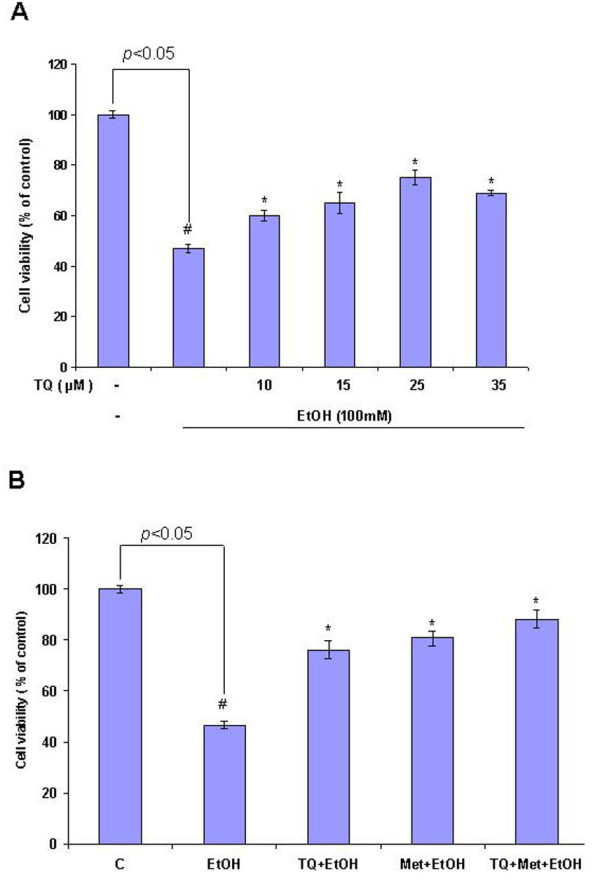
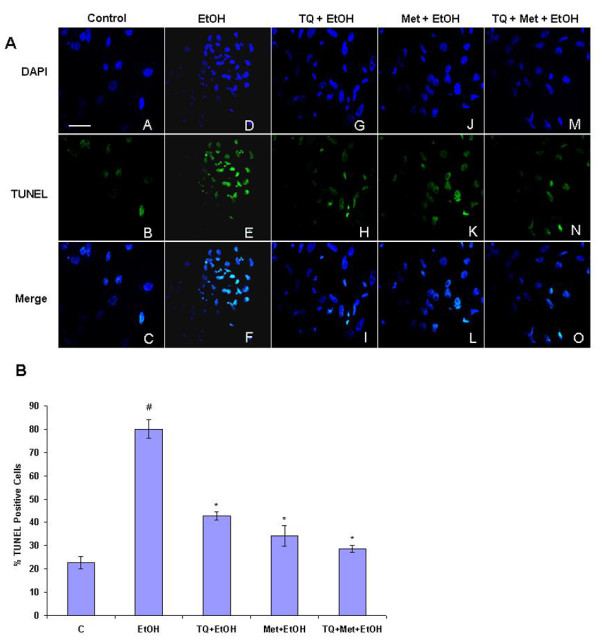
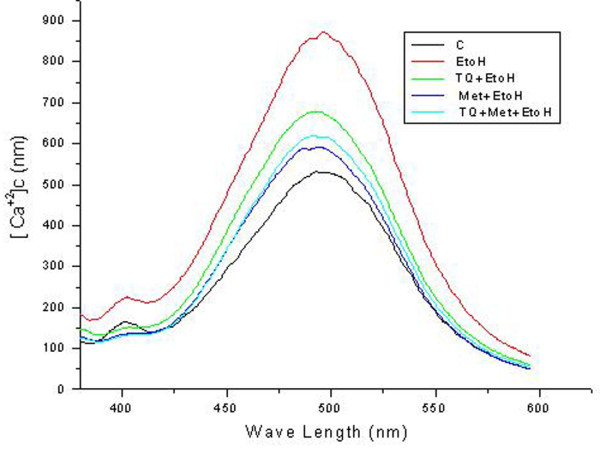
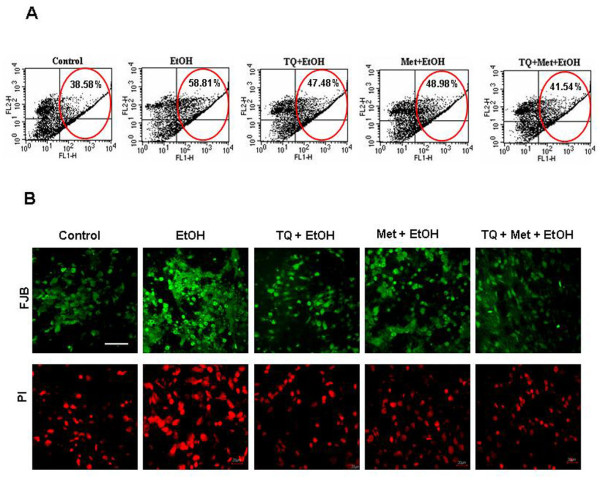
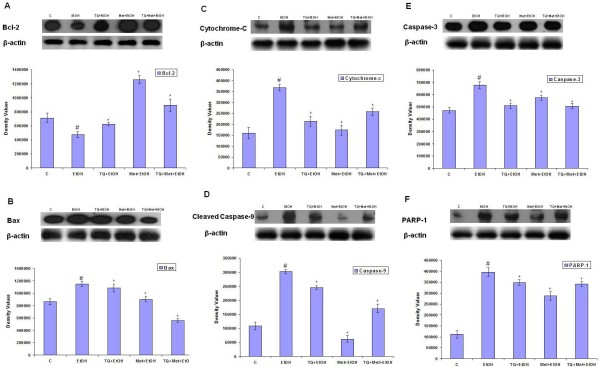
We found that Met and TQ, separately and synergistically, increased cell viability after ethanol (100 mM) exposure for 12 hours and attenuated the elevation of cytosolic free calcium [Ca²⁺]c. Furthermore, Met and TQ maintained normal physiological mitochondrial transmembrane potential (ΔψM), which is typically lowered by ethanol exposure. Increased cytosolic free [Ca²⁺]c and lowered mitochondrial transmembrane potential after ethanol exposure significantly decreased the expression of a key anti-apoptotic protein (Bcl-2), increased expression of Bax, and stimulated the release of cytochrome-c from mitochondria. Met and TQ treatment inhibited the apoptotic cascade by increasing Bcl-2 expression. These compounds also repressed the activation of caspase-9 and caspase-3 and reduced the cleavage of PARP-1. Morphological conformation of cell death was assessed by TUNEL, Fluoro-Jade-B, and PI staining. These staining methods demonstrated more cell death after ethanol treatment, while Met, TQ or Met plus TQ prevented ethanol-induced apoptotic cell death.
These findings suggested that Met and TQ are strong protective agents against ethanol-induced neuronal apoptosis in primary rat cortical neurons. The collective data demonstrated that Met and TQ have the potential to ameliorate ethanol neurotoxicity and revealed a possible protective target mechanism for the damaging effects of ethanol during early brain development.
在早期发育过程中接触乙醇会通过激活多种应激途径引发严重的神经元死亡,并导致神经紊乱,如胎儿酒精效应或胎儿酒精综合征。本研究探讨了乙醇通过钙介导的信号转导对易发生细胞凋亡的发育神经元的细胞内事件的影响。尽管乙醇神经毒性的潜在分子机制尚未完全确定,但线粒体功能障碍、钙稳态失衡和与凋亡相关的蛋白已被牵连到乙醇神经毒性中。本研究旨在评估二甲双胍(Met)和百里醌(TQ)在妊娠第 17.5 天(GD)大鼠产前皮质神经元乙醇毒性中的神经保护机制。
我们发现 Met 和 TQ 分别和协同作用,可增加乙醇(100mM)暴露 12 小时后的细胞活力,并减轻细胞浆游离钙[Ca²⁺]c的升高。此外,Met 和 TQ 维持正常的生理线粒体跨膜电位(ΔψM),而乙醇暴露会降低线粒体跨膜电位。乙醇暴露后细胞浆游离[Ca²⁺]c的增加和线粒体跨膜电位的降低显著降低了关键抗凋亡蛋白(Bcl-2)的表达,增加了 Bax 的表达,并刺激细胞色素-c从线粒体释放。Met 和 TQ 处理通过增加 Bcl-2 的表达抑制了凋亡级联反应。这些化合物还抑制了 caspase-9 和 caspase-3 的激活,并减少了 PARP-1 的切割。通过 TUNEL、Fluoro-Jade-B 和 PI 染色评估细胞死亡的形态构象。这些染色方法表明,乙醇处理后细胞死亡更多,而 Met、TQ 或 Met+TQ 可预防乙醇诱导的凋亡性细胞死亡。
这些发现表明,Met 和 TQ 是对抗原代大鼠皮质神经元中乙醇诱导的神经元凋亡的有效保护剂。综合数据表明,Met 和 TQ 具有减轻乙醇神经毒性的潜力,并揭示了早期大脑发育过程中乙醇损伤的潜在保护靶机制。