Plant Ecology and Evolution, Department of Ecology and Genetics, Evolutionary Biology Centre, Uppsala University, Uppsala, Sweden.
PLoS One. 2012;7(1):e30015. doi: 10.1371/journal.pone.0030015. Epub 2012 Jan 19.
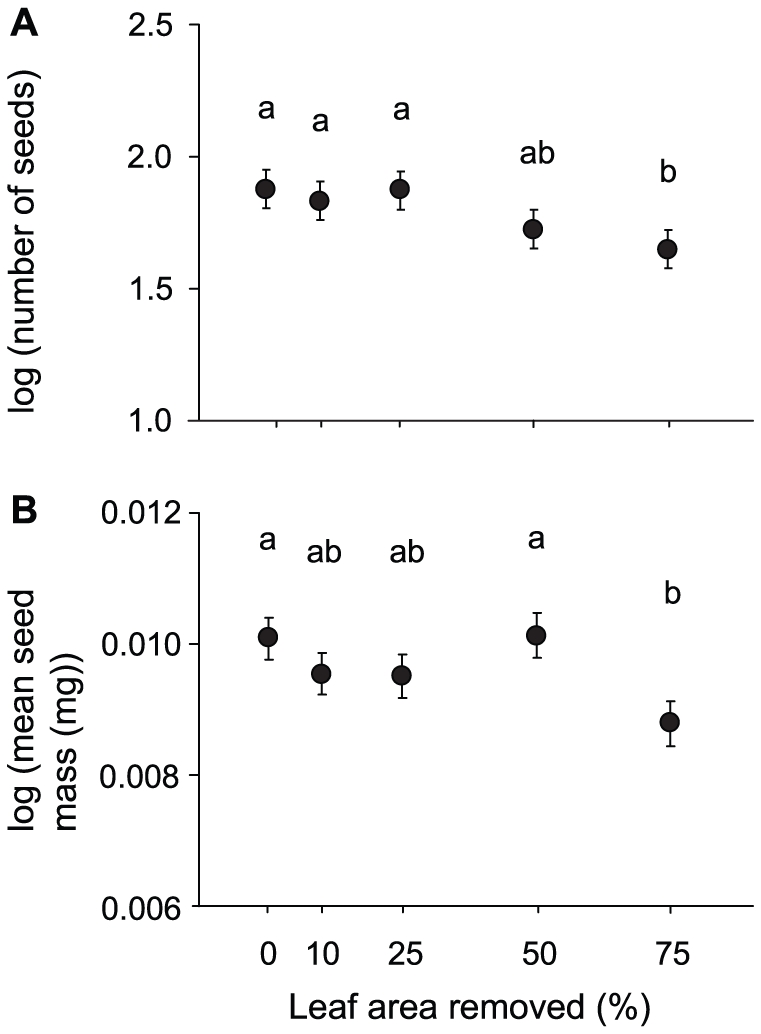
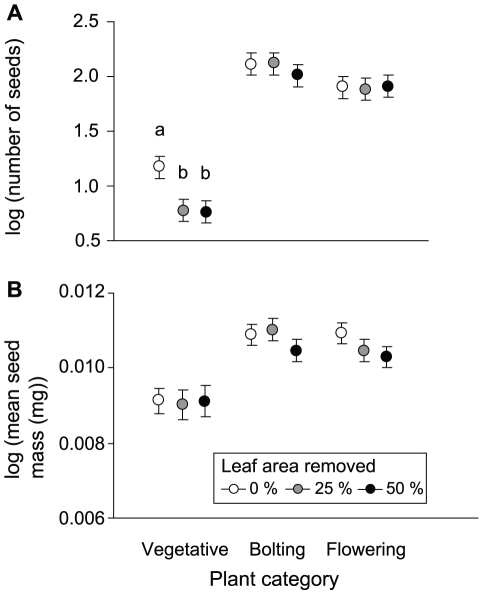
The effect of herbivory on plant fitness varies widely. Understanding the causes of this variation is of considerable interest because of its implications for plant population dynamics and trait evolution. We experimentally defoliated the annual herb Arabidopsis thaliana in a natural population in Sweden to test the hypotheses that (a) plant fitness decreases with increasing damage, (b) tolerance to defoliation is lower before flowering than during flowering, and (c) defoliation before flowering reduces number of seeds more strongly than defoliation during flowering, but the opposite is true for effects on seed size.
METHODOLOGY/PRINCIPAL FINDINGS: In a first experiment, between 0 and 75% of the leaf area was removed in May from plants that flowered or were about to start flowering. In a second experiment, 0, 25%, or 50% of the leaf area was removed from plants on one of two occasions, in mid April when plants were either in the vegetative rosette or bolting stage, or in mid May when plants were flowering. In the first experiment, seed production was negatively related to leaf area removed, and at the highest damage level, also mean seed size was reduced. In the second experiment, removal of 50% of the leaf area reduced seed production by 60% among plants defoliated early in the season at the vegetative rosettes, and by 22% among plants defoliated early in the season at the bolting stage, but did not reduce seed output of plants defoliated one month later. No seasonal shift in the effect of defoliation on seed size was detected.
CONCLUSIONS/SIGNIFICANCE: The results show that leaf damage may reduce the fitness of A. thaliana, and suggest that in this population leaf herbivores feeding on plants before flowering should exert stronger selection on defence traits than those feeding on plants during flowering, given similar damage levels.
食草对植物适应性的影响差异很大。了解这种差异的原因具有重要意义,因为它会影响植物种群动态和性状进化。我们在瑞典的一个自然种群中对一年生草本拟南芥进行了实验性的去叶处理,以检验以下三个假设:(a) 植物适应性随损伤程度的增加而降低;(b) 在开花前,植物对去叶的耐受性低于开花期;(c) 开花前去叶对种子数量的影响大于开花期,但对种子大小的影响则相反。
方法/主要发现:在第一个实验中,5 月份对即将开花或已经开花的植物,去除 0 至 75%的叶片面积。在第二个实验中,在两个时间点之一,从植物上移除 0、25%或 50%的叶片面积,这两个时间点分别是 4 月中旬植物处于营养生长的莲座期或抽薹期,或 5 月中旬植物处于开花期。在第一个实验中,种子产量与去除的叶片面积呈负相关,在最高损伤水平下,平均种子大小也降低。在第二个实验中,在莲座期去除 50%的叶片面积,会使早期去叶的植物的种子产量减少 60%,而使早期抽薹的植物的种子产量减少 22%,但不会减少一个月后去叶的植物的种子产量。未检测到去叶对种子大小的影响有季节性变化。
结论/意义:结果表明,叶片损伤可能会降低拟南芥的适应性,并表明在这个种群中,开花前以植物为食的食草动物应该比开花期以植物为食的食草动物对防御性状施加更强的选择压力,因为在类似的损伤水平下。