Department of Ecology and Coastal Management, Instituto de Ciencias Marinas de Andalucía, Consejo Superior de Investigaciones Científicas, Puerto Real, Cadiz, Spain.
PLoS One. 2012;7(1):e30436. doi: 10.1371/journal.pone.0030436. Epub 2012 Jan 19.
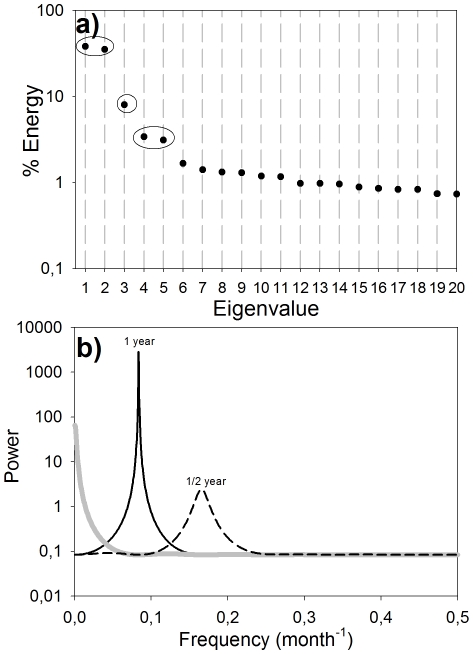
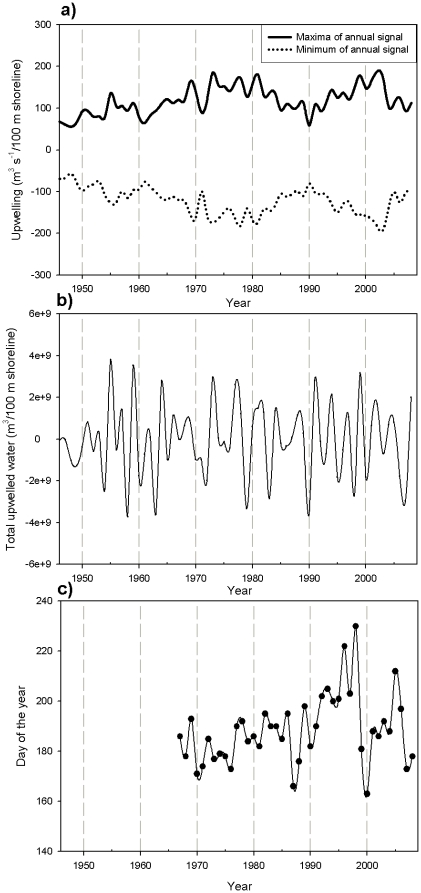
The high biological production of the California Current System (CCS) results from the seasonal development of equatorward alongshore winds that drive coastal upwelling. While several climatic fluctuation patterns influence the dynamics and biological productivity of the CCS, including the El Niño-Southern Oscillation (ENSO), the Pacific Decadal Oscillation index (PDO) and the North Pacific Gyre Oscillation (NPGO), the mechanisms of interaction between climatic oscillations and the CCS upwelling dynamics have remained obscure. Here, we use Singular Spectral Analysis (SSA) to reveal, for the first time, low-frequency concordance between the time series of climatic indices and upwelling intensity along the coast of western North America. Based on energy distributions in annual, semiannual and low-frequency signals, we can divide the coast into three distinct regions. While the annual upwelling signal dominates the energy spectrum elsewhere, low-frequency variability is maximal in the regions south of 33°N. Non-structured variability associated with storms and turbulent mixing is enhanced at northerly locations. We found that the low-frequency signal is significantly correlated with different climatic indices such as PDO, NPGO and ENSO with the correlation patterns being latitude-dependent. We also analyzed the correlations between this upwelling variability and sea surface temperature (SST) and sea level pressure (SLP) throughout the North Pacific to visualize and interpret the large-scale teleconnection dynamics in the atmosphere that drive the low-frequency coastal winds. These results provide new insights into the underlying mechanisms connecting climatic patterns with upwelling dynamics, which could enhance our prediction and forecast capabilities of the effects of future oceanographic and climatic variability in the CCS.
加利福尼亚海流系统(CCS)的高生物生产力源自季节性发展的沿赤道向岸风,这些风驱动沿海涌升流。尽管包括厄尔尼诺-南方涛动(ENSO)、太平洋年代际振荡指数(PDO)和北太平洋涛动(NPGO)在内的几种气候波动模式会影响 CCS 的动态和生物生产力,但气候波动与 CCS 涌升流动力之间的相互作用机制仍不清楚。在这里,我们首次使用奇异谱分析(SSA)揭示了气候指数时间序列与北美西海岸涌升强度之间的低频一致性。基于年度、半年和低频信号中的能量分布,我们可以将海岸分为三个不同的区域。虽然年度涌升信号在其他地方主导着能量谱,但在 33°N 以南的区域低频变化最大。与风暴和湍流动混合相关的非结构化变化在较北的位置增强。我们发现,低频信号与不同的气候指数如 PDO、NPGO 和 ENSO 显著相关,相关模式随纬度而异。我们还分析了这种涌升变化与整个北太平洋海面温度(SST)和海平面压力(SLP)之间的相关性,以可视化和解释驱动低频沿海风的大气大尺度遥联动力学。这些结果为连接气候模式与涌升动力的潜在机制提供了新的见解,这可能增强我们对 CCS 未来海洋和气候变异性影响的预测和预报能力。