Center for Birth Cohort Studies, Interdisciplinary Graduate School of Medicine and Engineering, University of Yamanashi, Yamanashi, Japan.
J Epidemiol. 2012;22(2):175-8. doi: 10.2188/jea.je20110033. Epub 2012 Jan 21.
Although maternal smoking during pregnancy has been reported to have an effect on childhood overweight/obesity, the impact of maternal smoking on the trajectory of the body mass of their offspring is not very clear. Previously, we investigated this effect by using a fixed-effect model. However, this analysis was limited because it rounded and categorized the age of the children. Therefore, we used a random-effects hierarchical linear regression model in the present study.
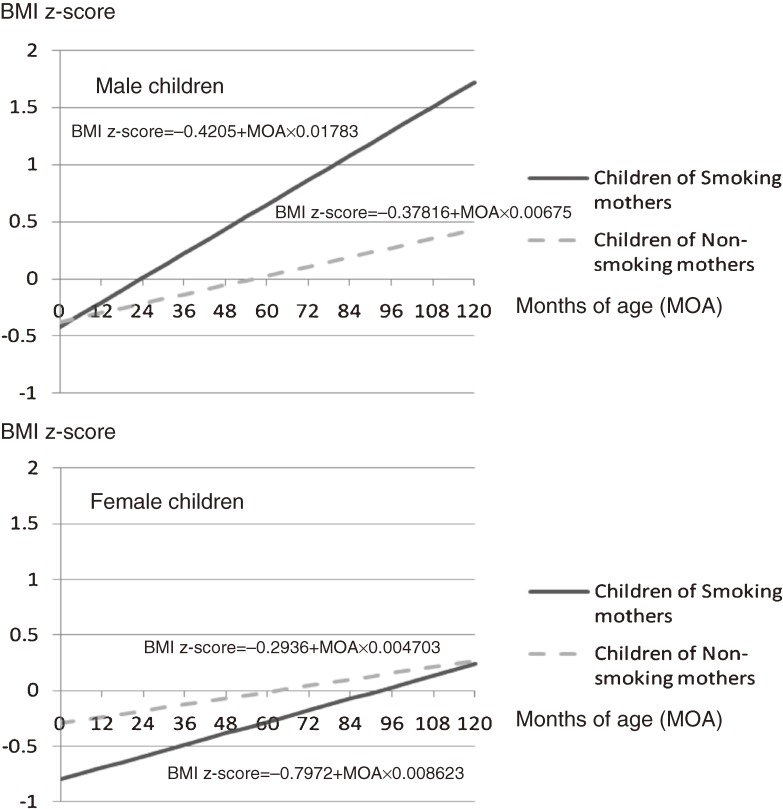
The study population comprised children born between 1 April 1991 and 31 March 1999 in Koshu City, Japan and their mothers. Maternal smoking during early pregnancy was the exposure studied. The body mass index (BMI) z-score trajectory of children born to smoking and non-smoking mothers, by gender, was used as the outcome. We modeled BMI trajectory using a 2-level random intercept and slope regression.
The participating mothers delivered 1619 babies during the study period. For male children, there was very strong evidence that the effect of age in months on the increase in BMI z-score was enhanced by maternal smoking during pregnancy (P < 0.0001). In contrast, for female children, there was only weak evidence for an interaction between age in months and maternal smoking during pregnancy (P = 0.054), which suggests that the effect of maternal smoking during pregnancy on the early-life BMI trajectory of offspring differed by gender.
These results may be valuable for exploring the mechanism of fetal programming and might therefore be clinically important.
尽管已有研究表明,母亲在怀孕期间吸烟会对儿童超重/肥胖产生影响,但母亲吸烟对其后代体重增长轨迹的影响尚不清楚。此前,我们使用固定效应模型对此进行了研究。然而,这种分析受到限制,因为它对儿童年龄进行了四舍五入和分类。因此,本研究采用随机效应分层线性回归模型。
研究人群包括 1991 年 4 月 1 日至 1999 年 3 月 31 日在日本甲州市出生的儿童及其母亲。本研究将母亲在妊娠早期吸烟作为暴露因素。以性别为分层变量,以吸烟和不吸烟母亲所生儿童的体重指数(BMI)z 评分轨迹为因变量。我们使用 2 水平随机截距和斜率回归模型来拟合 BMI 轨迹。
在研究期间,参与的母亲共分娩了 1619 名婴儿。对于男童,有很强的证据表明,月龄对 BMI z 评分增加的影响受到母亲妊娠期间吸烟的增强(P < 0.0001)。相比之下,对于女童,月龄与母亲妊娠期间吸烟之间的交互作用只有微弱的证据(P = 0.054),这表明母亲妊娠期间吸烟对后代早期 BMI 轨迹的影响存在性别差异。
这些结果可能对探索胎儿编程机制具有重要价值,因此可能具有临床意义。