Department of Dermatology, San Francisco Veterans Administration Medical Center, San Francisco, California 94121-1545, USA.
J Invest Dermatol. 2012 Apr;132(4):1188-95. doi: 10.1038/jid.2011.447. Epub 2012 Jan 26.
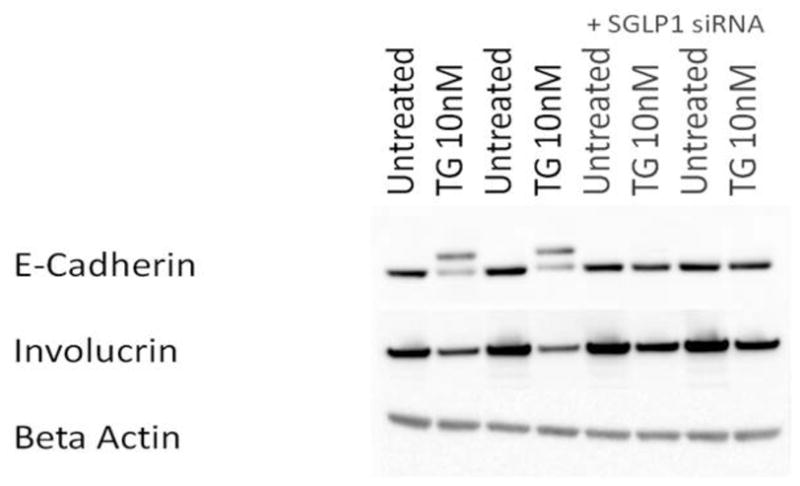
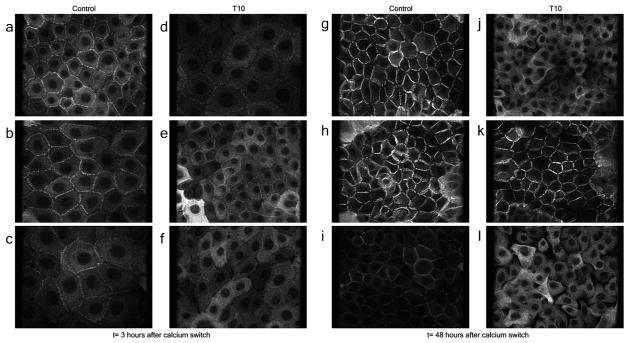
Darier's disease (DD), caused by mutations in the endoplasmic reticulum (ER) Ca(2+) ATPase ATP2A2 (SERCA2b), is a skin disease that exhibits impaired epidermal cell-to-cell adhesion and altered differentiation. Although previous studies have shown that keratinocyte Ca(2+) sequestration and fluxes are controlled by sphingolipid signaling, the role of this signaling pathway in DD previously has not been investigated. We show here that sphingosine levels increase and sphingosine kinase (SPHK1) expression decreases after inactivating SERCA2b with the specific SERCA2 inhibitors thapsigargin (TG) or small interfering RNA to SERCA2b. Conversely, inhibiting sphingosine lyase rescues the defects in keratinocyte differentiation, E-cadherin localization, desmoplakin (DP) translocation, and ER Ca(2+) sequestration seen in TG-treated keratinocytes. Here, we report early evidence that the keratinocyte sphingolipid and Ca(2+) signaling pathways intersect in ATP2A2-controlled ER Ca(2+) sequestration, E-cadherin and DP localization, and Ca(2+)-controlled differentiation, and thus may be important mediators in DD.
Darier 病(DD)是一种由内质网(ER)Ca(2+)ATP 酶 ATP2A2(SERCA2b)突变引起的皮肤疾病,表现为表皮细胞间粘附受损和分化改变。尽管先前的研究表明角质形成细胞 Ca(2+)摄取和通量受鞘脂信号控制,但该信号通路在 DD 中的作用以前尚未得到研究。我们在这里表明,用特异性 SERCA2 抑制剂 thapsigargin(TG)或 SERCA2b 的小干扰 RNA 使 SERCA2b 失活后,鞘氨醇水平增加,鞘氨醇激酶(SPHK1)表达减少。相反,抑制鞘氨醇酶可挽救 TG 处理的角质形成细胞中观察到的角质形成细胞分化、E-钙粘蛋白定位、桥粒斑蛋白(DP)易位和 ER Ca(2+)摄取缺陷。在这里,我们报告了早期证据,表明角质形成细胞鞘脂和 Ca(2+)信号通路在 ATP2A2 控制的 ER Ca(2+)摄取、E-钙粘蛋白和 DP 定位以及 Ca(2+)控制的分化中相互交叉,因此可能是 DD 的重要介质。