Division of Clinical Research, Fred Hutchinson Cancer Research Center, Seattle, Washington, United States of America.
PLoS One. 2012;7(1):e30062. doi: 10.1371/journal.pone.0030062. Epub 2012 Jan 18.
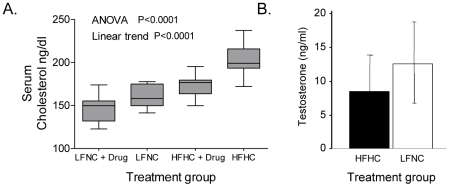
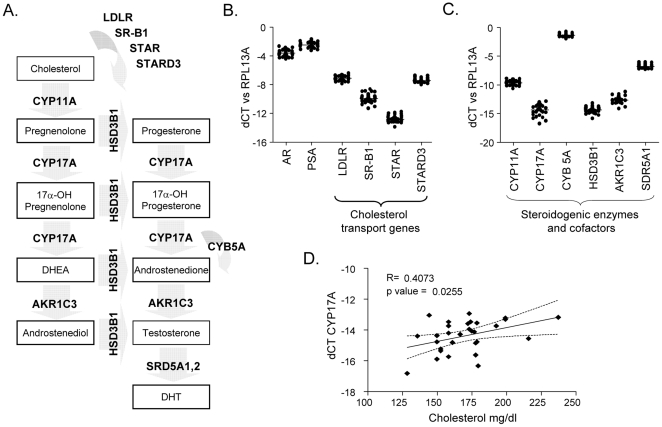
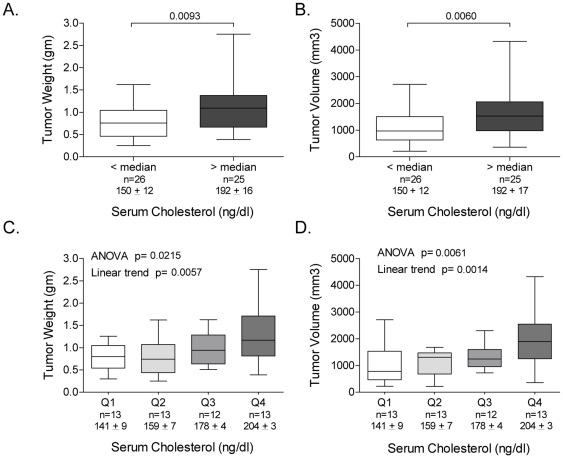
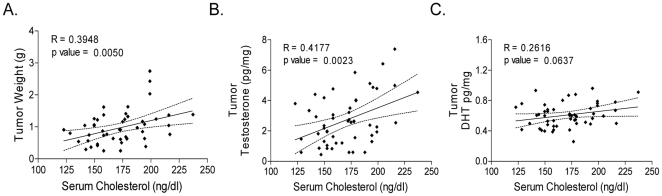
Prostate cancer (PCa) is the second most common cancer in men. Androgen deprivation therapy (ADT) leads to tumor involution and reduction of tumor burden. However, tumors eventually reemerge that have overcome the absence of gonadal androgens, termed castration resistant PCa (CRPC). Theories underlying the development of CRPC include androgen receptor (AR) mutation allowing for promiscuous activation by non-androgens, AR amplification and overexpression leading to hypersensitivity to low androgen levels, and/or tumoral uptake and conversion of adrenally derived androgens. More recently it has been proposed that prostate tumor cells synthesize their own androgens through de novo steroidogenesis, which involves the step-wise synthesis of androgens from cholesterol. Using the in vivo LNCaP PCa xenograft model, previous data from our group demonstrated that a hypercholesterolemia diet potentiates prostatic tumor growth via induction of angiogenesis. Using this same model we now demonstrate that circulating cholesterol levels are significantly associated with tumor size (R = 0.3957, p = 0.0049) and intratumoral levels of testosterone (R = 0.41, p = 0.0023) in LNCaP tumors grown in hormonally intact mice. We demonstrate tumoral expression of cholesterol uptake genes as well as the spectrum of steroidogenic enzymes necessary for androgen biosynthesis from cholesterol. Moreover, we show that circulating cholesterol levels are directly correlated with tumoral expression of CYP17A, the critical enzyme required for de novo synthesis of androgens from cholesterol (R = 0.4073, p = 0.025) Since hypercholesterolemia does not raise circulating androgen levels and the adrenal gland of the mouse synthesizes minimal androgens, this study provides evidence that hypercholesterolemia increases intratumoral de novo steroidogenesis. Our results are consistent with the hypothesis that cholesterol-fueled intratumoral androgen synthesis may accelerate the growth of prostate tumors, and suggest that treatment of CRPC may be optimized by inclusion of cholesterol reduction therapies in conjunction with therapies targeting androgen synthesis and the AR.
前列腺癌(PCa)是男性中第二常见的癌症。去势治疗(ADT)导致肿瘤萎缩和肿瘤负担减少。然而,肿瘤最终会重新出现,这些肿瘤已经克服了性腺雄激素的缺乏,称为去势抵抗性前列腺癌(CRPC)。CRPC 发展的理论包括雄激素受体(AR)突变,允许非雄激素的杂乱激活、AR 扩增和过表达导致对低雄激素水平的超敏反应,和/或肿瘤摄取和转化肾上腺来源的雄激素。最近有人提出,前列腺肿瘤细胞通过从头类固醇生成合成自身雄激素,这涉及雄激素从胆固醇的逐步合成。使用体内 LNCaP PCa 异种移植模型,我们小组以前的数据表明,高胆固醇血症饮食通过诱导血管生成增强前列腺肿瘤的生长。使用相同的模型,我们现在证明,在激素完整的小鼠中生长的 LNCaP 肿瘤中,循环胆固醇水平与肿瘤大小显著相关(R = 0.3957,p = 0.0049),与肿瘤内睾酮水平显著相关(R = 0.41,p = 0.0023)。我们证明了胆固醇摄取基因以及从胆固醇合成雄激素所需的类固醇生成酶谱在肿瘤中的表达。此外,我们表明,循环胆固醇水平与 CYP17A 的肿瘤表达直接相关,CYP17A 是胆固醇从头合成雄激素的关键酶(R = 0.4073,p = 0.025)。由于高胆固醇血症不会提高循环雄激素水平,而且小鼠的肾上腺仅合成少量雄激素,因此这项研究提供了证据表明,高胆固醇血症增加了肿瘤内的从头类固醇生成。我们的结果与胆固醇驱动的肿瘤内雄激素合成可能加速前列腺肿瘤生长的假说一致,并表明在针对雄激素合成和 AR 的治疗中加入胆固醇降低治疗,可能会优化 CRPC 的治疗。