Institute of Occupational Medicine and Industrial Hygiene, College of Public Health, National Taiwan University, Room 722, No, 17, Xuzhou Road, Taipei City 100, Taiwan.
BMC Public Health. 2012 Jan 27;12:85. doi: 10.1186/1471-2458-12-85.
This study aimed to examine the longitudinal contributions of four political and socioeconomic factors to the increase in life expectancy in less developed countries (LDCs) between 1970 and 2004.
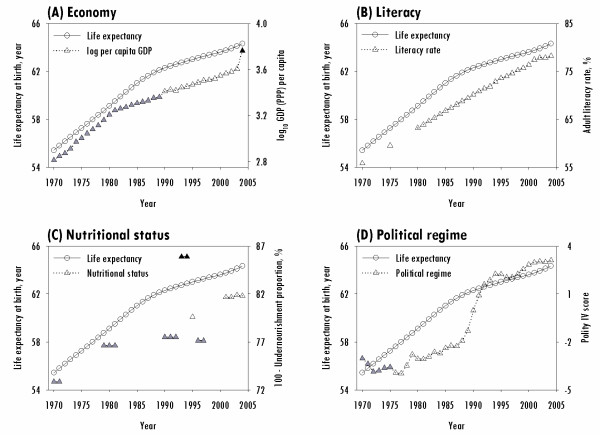
We collected 35 years of annual data for 119 LDCs on life expectancy at birth and on four key socioeconomic indicators: economy, measured by log10 gross domestic product per capita at purchasing power parity; educational environment, measured by the literacy rate of the adult population aged 15 years and over; nutritional status, measured by the proportion of undernourished people in the population; and political regime, measured by the regime score from the Polity IV database. Using linear mixed models, we analyzed the longitudinal effects of these multiple factors on life expectancy at birth with a lag of 0-10 years, adjusting for both time and regional correlations.
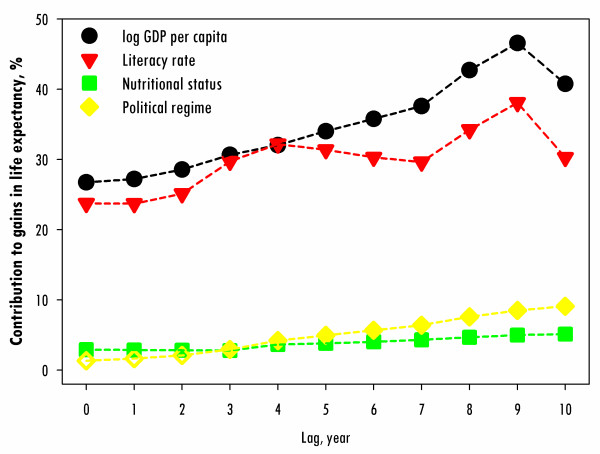
The LDCs' increases in life expectancy over time were associated with all four factors. Political regime had the least influence on increased life expectancy to begin with, but became significant starting in the 3rd year and continued to increase, while the impact of the other socioeconomic factors began strong but continually decreased over time. The combined effects of these four socioeconomic and political determinants contributed 54.74% - 98.16% of the life expectancy gains throughout the lag periods of 0-10 years.
Though the effect of democratic politics on increasing life expectancy was relatively small in the short term when compared to the effects of the other socioeconomic factors, the long-term impact of democracy should not be underestimated.
本研究旨在考察四个政治和社会经济因素对 1970 年至 2004 年间较不发达国家(LDCs)预期寿命增长的长期贡献。
我们收集了 119 个 LDCs 的 35 年的出生预期寿命数据和四个关键社会经济指标的数据:经济,以人均国内生产总值(按购买力平价计算的对数)衡量;教育环境,以 15 岁及以上成年人口的识字率衡量;营养状况,以人口中营养不良者的比例衡量;政治制度,以 Polity IV 数据库中的制度评分衡量。使用线性混合模型,我们分析了这些多种因素对出生时预期寿命的纵向影响,同时考虑了时间和区域相关性的影响。
随着时间的推移,LDCs 的预期寿命增加与所有四个因素有关。政治制度一开始对预期寿命的增加影响最小,但从第 3 年开始变得显著,并持续增加,而其他社会经济因素的影响开始较强,但随着时间的推移持续下降。这四个社会经济和政治决定因素的综合影响在 0-10 年的滞后期内对预期寿命的提高贡献了 54.74%-98.16%。
虽然与其他社会经济因素相比,民主政治对提高预期寿命的短期影响相对较小,但民主的长期影响不应被低估。