Division of Medical Screening and Special Testing, Department of Pathology and Laboratory Medicine, Women & Infants Hospital, Alpert Medical School of Brown University, Providence, Rhode Island, USA.
Genet Med. 2012 Mar;14(3):296-305. doi: 10.1038/gim.2011.73. Epub 2012 Feb 2.
To determine whether maternal plasma cell-free DNA sequencing can effectively identify trisomy 18 and 13.
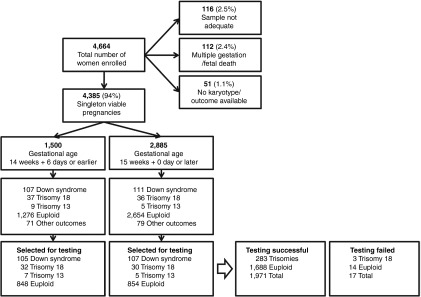
Sixty-two pregnancies with trisomy 18 and 12 with trisomy 13 were selected from a cohort of 4,664 pregnancies along with matched euploid controls (including 212 additional Down syndrome and matched controls already reported), and their samples tested using a laboratory-developed, next-generation sequencing test. Interpretation of the results for chromosome 18 and 13 included adjustment for CG content bias.
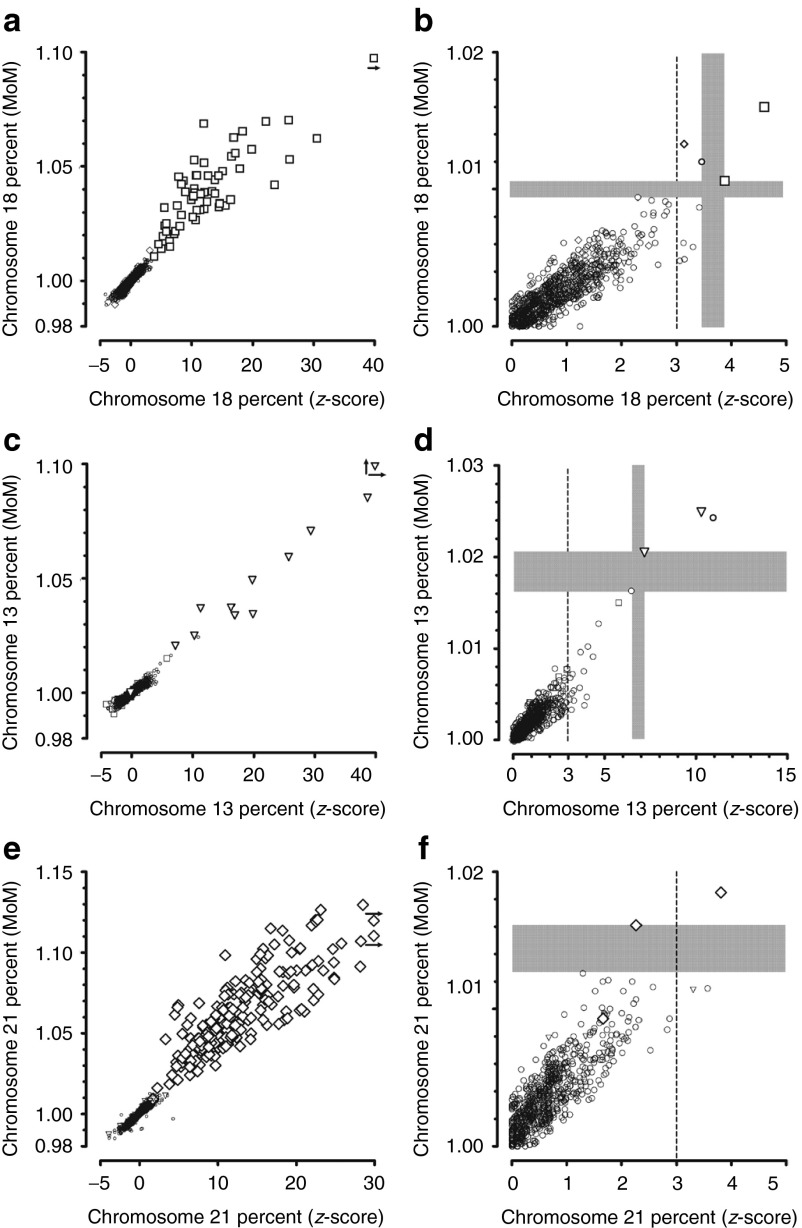
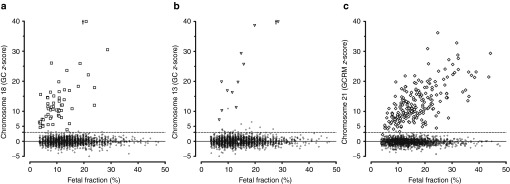
Among the 99.1% of samples interpreted (1,971/1,988), observed trisomy 18 and 13 detection rates were 100% (59/59) and 91.7% (11/12) at false-positive rates of 0.28% and 0.97%, respectively. Among the 17 samples without an interpretation, three were trisomy 18. If z-score cutoffs for trisomy 18 and 13 were raised slightly, the overall false-positive rates for the three aneuploidies could be as low as 0.1% (2/1,688) at an overall detection rate of 98.9% (280/283) for common aneuploidies. An independent academic laboratory confirmed performance in a subset.
Among high-risk pregnancies, sequencing circulating cell-free DNA detects nearly all cases of Down syndrome, trisomy 18, and trisomy 13, at a low false-positive rate. This can potentially reduce invasive diagnostic procedures and related fetal losses by 95%. Evidence supports clinical testing for these aneuploidies.
确定母体血浆游离 DNA 测序是否能有效识别 18 三体和 13 三体。
从 4664 例妊娠中选择 62 例 18 三体和 13 三体,并与匹配的整倍体对照组(包括已报道的 212 例额外的唐氏综合征和匹配对照组)进行比较,并用实验室开发的下一代测序试验检测他们的样本。对 18 号和 13 号染色体结果的解释包括调整 CG 含量偏倚。
在解释的 99.1%的样本中(1971/1988),观察到的 18 三体和 13 三体的检出率分别为 100%(59/59)和 91.7%(11/12),假阳性率分别为 0.28%和 0.97%。在 17 个未解释的样本中,有 3 个是 18 三体。如果将 18 三体和 13 三体的 Z 分数截断值略微提高,那么三种非整倍体的总体假阳性率可以低至 0.1%(2/1688),而常见非整倍体的总体检出率为 98.9%(280/283)。一个独立的学术实验室在一个亚组中确认了该方法的性能。
在高危妊娠中,循环游离 DNA 测序几乎可以检测到所有的唐氏综合征、18 三体和 13 三体病例,假阳性率很低。这可以将有创性诊断程序和相关的胎儿丢失率降低 95%。有证据支持对这些非整倍体进行临床检测。