Department of Anatomy and Neurobiology, Graduate School of Medicine, Nippon Medical School, Bunkyo-ku, Tokyo 113-8602, Japan.
Acta Histochem Cytochem. 2011 Dec 28;44(6):259-66. doi: 10.1267/ahc.11031. Epub 2011 Oct 22.
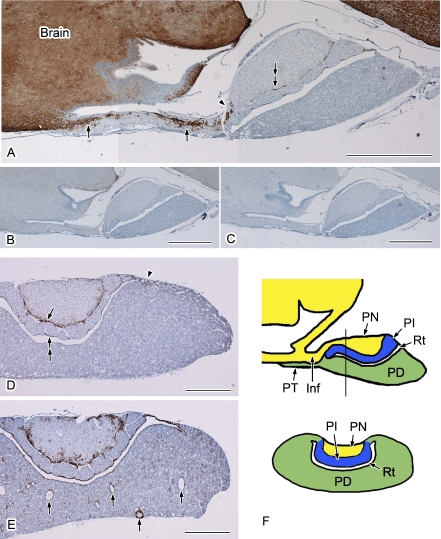
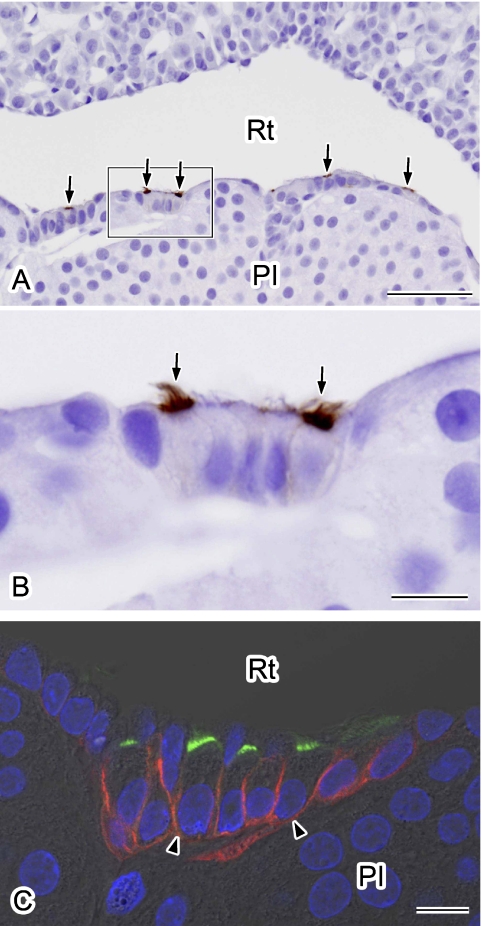
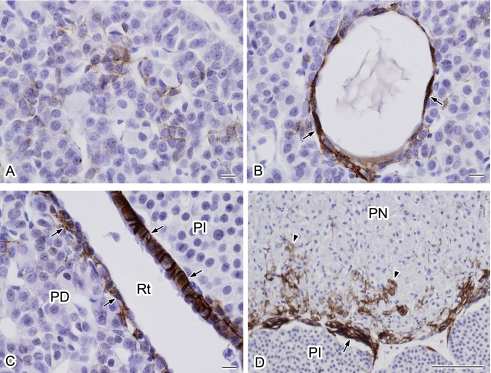
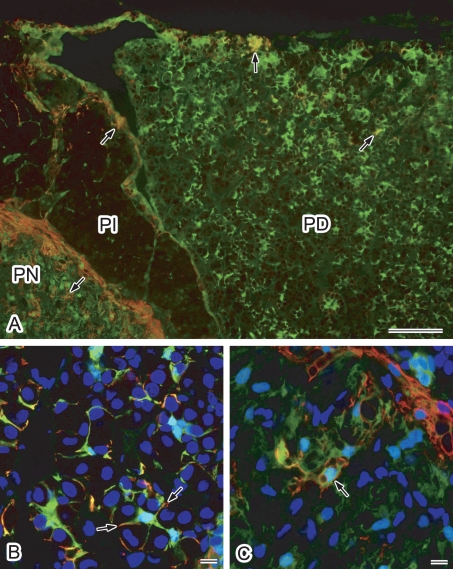
The pituitary gland is composed of the adenohypophysis and neurohypophysis. The adenohypophysis contains endocrine cells, folliculo-stellate (FS) cells, and marginal layer cells, whereas the neurohypophysis mainly comprises axons and pituicytes. To understand the molecular nature of water transfer in the pituitary gland, we examined the immunohistochemical localization of the membrane water channels aquaporin-4 (AQP4) and AQP5 in rat tissue. Double immunofluorescence analysis of AQP4 and S100 protein, a known marker for FS cells, marginal layer cells, and pituicytes, clearly revealed that FS cells and marginal layer cells in the adenohypophysis and the pituicytes in pars nervosa are positive for AQP4. AQP5 was found to be localized at the apical membrane in some marginal layer cells surrounding the Rathke's residual pouch, in which AQP4 was observed to be localized on the basolateral membranes. These results suggest the following possibilities: 1) FS cells especially require water for their functions and 2) transepithelial water transfer could occur between the lumen of Rathke's residual pouch and the interstitial fluid in the adenohypophysis through the AQP4 and AQP5 channels in the marginal layer cells.
垂体由腺垂体和神经垂体组成。腺垂体包含内分泌细胞、滤泡星形细胞(FS)和边缘层细胞,而神经垂体主要由轴突和垂体细胞组成。为了了解垂体中水分转运的分子特性,我们检查了水通道蛋白-4(AQP4)和 AQP5 在大鼠组织中的免疫组织化学定位。AQP4 与 S100 蛋白(FS 细胞、边缘层细胞和垂体细胞的已知标志物)的双重免疫荧光分析清楚地表明,腺垂体中的 FS 细胞和边缘层细胞以及神经部的垂体细胞呈 AQP4 阳性。AQP5 定位于围绕 Rathke 残余囊的一些边缘层细胞的顶膜上,在这些细胞中观察到 AQP4 定位于基底外侧膜上。这些结果表明以下可能性:1)FS 细胞尤其需要水分来发挥其功能,2)通过边缘层细胞中的 AQP4 和 AQP5 通道,Rathke 残余囊的管腔和腺垂体的间质液之间可能发生跨上皮水转运。