Department of Cardiovascular Diseases, Union Hospital, Huazhong University of Sciences and Technology, Wuhan, Peoples' Republic of China.
Am J Physiol Heart Circ Physiol. 2012 Apr 1;302(7):H1510-23. doi: 10.1152/ajpheart.00357.2011. Epub 2012 Jan 27.
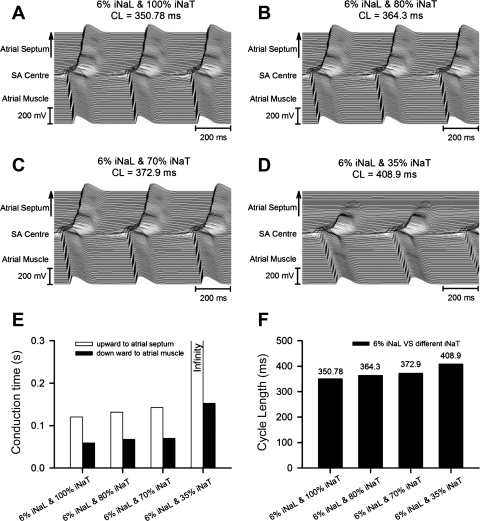
Mutations in SCN5A, the gene encoding the pore-forming subunit of cardiac Na(+) channels, cause a spectrum of arrhythmic syndromes. Of these, sinoatrial node (SAN) dysfunction occurs in patients with both loss- and gain-of-function SCN5A mutations. We explored for corresponding alterations in SAN function and intracardiac conduction and clarified possible mechanisms underlying these in an established mouse long QT syndrome type 3 model carrying a mutation equivalent to human SCN5A-ΔKPQ. Electrophysiological characterizations of SAN function in living animals and in vitro sinoatrial preparations were compared with cellular SAN and two-dimensional tissue models exploring the consequences of Scn5a+/ΔKPQ mutations. Scn5a+/ΔKPQ mice showed prolonged electrocardiographic QT and corrected QT intervals confirming long QT phenotypes. They showed frequent episodes of sinus bradycardia, sinus pause/arrest, and significantly longer sinus node recovery times, suggesting compromised pacemaker activity compared with wild-type mice. Electrocardiographic waveforms suggested depressed intra-atrial, atrioventricular node, and intraventricular conduction in Scn5a+/ΔKPQ mice. Isolated Scn5a+/ΔKPQ sinoatrial preparations similarly showed lower mean intrinsic heart rates and overall slower conduction through the SAN to the surrounding atrium than did wild-type preparations. Computer simulations of both single SAN cells as well as two-dimensional SAN-atrial models could reproduce the experimental observations of impaired pacemaker and sinoatrial conduction in terms of changes produced by both augmented tail and reduced total Na(+) currents, respectively. In conclusion, the gain-of-function long QT syndrome type 3 murine Scn5a+/ΔKPQ cardiac system, in overlap with corresponding features reported in loss-of-function Na(+) channel mutations, shows compromised SAN pacemaker and conduction function explicable in modeling studies through a combination of augmented tail and reduced peak Na(+) currents.
SCN5A 基因突变,该基因编码心脏 Na(+)通道的孔形成亚基,引起一系列心律失常综合征。在这些患者中,窦性结(SAN)功能障碍发生在丧失和获得功能 SCN5A 突变的患者中。我们在携带与人 SCN5A-ΔKPQ 等效突变的既定小鼠长 QT 综合征 3 型模型中探索了 SAN 功能和心内传导的相应改变,并阐明了这些改变的可能机制。在活体动物和体外窦房结准备中对 SAN 功能进行电生理特性分析,并与探索 Scn5a+/ΔKPQ 突变后果的 SAN 细胞和二维组织模型进行比较。Scn5a+/ΔKPQ 小鼠表现出心电图 QT 和校正 QT 间隔延长,证实了长 QT 表型。它们表现出频繁的窦性心动过缓、窦性停顿/阻滞,以及明显更长的窦房结恢复时间,表明与野生型小鼠相比,起搏器活动受损。心电图波形提示 Scn5a+/ΔKPQ 小鼠的心房内、房室结和室内传导减弱。分离的 Scn5a+/ΔKPQ 窦房结准备也显示出比野生型准备更低的平均固有心率和整体 SAN 向周围心房的传导速度较慢。单个 SAN 细胞和二维 SAN-心房模型的计算机模拟可以复制实验观察到的起搏器和窦房结传导受损,分别是通过增强尾部和减少总 Na(+)电流产生的变化。总之,功能获得性长 QT 综合征 3 型小鼠 Scn5a+/ΔKPQ 心脏系统与失活功能 Na(+)通道突变报告的相应特征重叠,显示 SAN 起搏器和传导功能受损,在建模研究中通过增强尾部和减少峰值 Na(+)电流的组合可以解释。