Department of Pharmacology,University of Minnesota Medical School, Minneapolis, Minnesota 55455, USA.
J Biol Chem. 2012 Mar 16;287(12):8904-11. doi: 10.1074/jbc.M111.325803. Epub 2012 Jan 30.
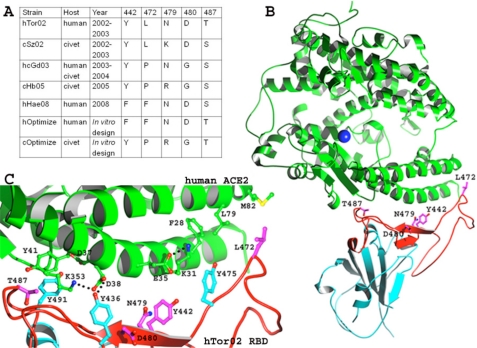
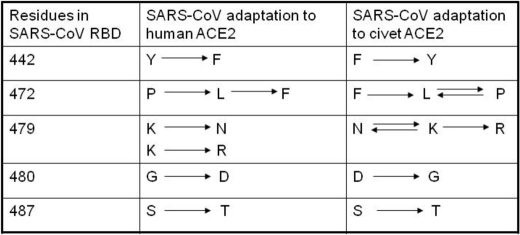
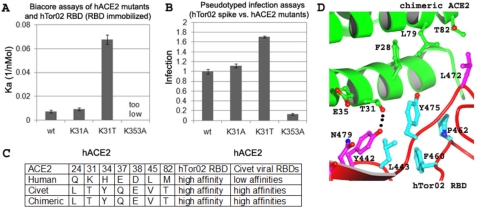
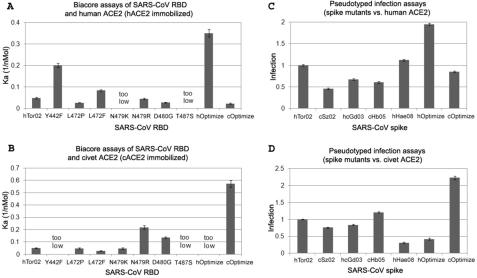
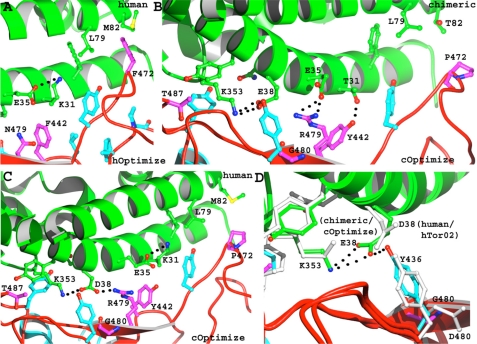
The severe acute respiratory syndrome coronavirus (SARS-CoV) from palm civets has twice evolved the capacity to infect humans by gaining binding affinity for human receptor angiotensin-converting enzyme 2 (ACE2). Numerous mutations have been identified in the receptor-binding domain (RBD) of different SARS-CoV strains isolated from humans or civets. Why these mutations were naturally selected or how SARS-CoV evolved to adapt to different host receptors has been poorly understood, presenting evolutionary and epidemic conundrums. In this study, we investigated the impact of these mutations on receptor recognition, an important determinant of SARS-CoV infection and pathogenesis. Using a combination of biochemical, functional, and crystallographic approaches, we elucidated the molecular and structural mechanisms of each of these naturally selected RBD mutations. These mutations either strengthen favorable interactions or reduce unfavorable interactions with two virus-binding hot spots on ACE2, and by doing so, they enhance viral interactions with either human (hACE2) or civet (cACE2) ACE2. Therefore, these mutations were viral adaptations to either hACE2 or cACE2. To corroborate the above analysis, we designed and characterized two optimized RBDs. The human-optimized RBD contains all of the hACE2-adapted residues (Phe-442, Phe-472, Asn-479, Asp-480, and Thr-487) and possesses exceptionally high affinity for hACE2 but relative low affinity for cACE2. The civet-optimized RBD contains all of the cACE2-adapted residues (Tyr-442, Pro-472, Arg-479, Gly-480, and Thr-487) and possesses exceptionally high affinity for cACE2 and also substantial affinity for hACE2. These results not only illustrate the detailed mechanisms of host receptor adaptation by SARS-CoV but also provide a molecular and structural basis for tracking future SARS-CoV evolution in animals.
严重急性呼吸综合征冠状病毒(SARS-CoV)来源于果子狸,通过获得对人类受体血管紧张素转化酶 2(ACE2)的结合亲和力,两次进化出感染人类的能力。从人类或果子狸中分离出的不同 SARS-CoV 株的受体结合域(RBD)中已经鉴定出许多突变。为什么这些突变是自然选择的,或者 SARS-CoV 如何进化以适应不同的宿主受体,这些问题还没有得到很好的理解,这给进化和流行带来了难题。在这项研究中,我们研究了这些突变对受体识别的影响,受体识别是 SARS-CoV 感染和发病机制的一个重要决定因素。我们使用生化、功能和晶体学方法的组合,阐明了这些自然选择的 RBD 突变中的每一个的分子和结构机制。这些突变要么加强了与 ACE2 上两个病毒结合热点的有利相互作用,要么减少了不利相互作用,从而增强了病毒与人类(hACE2)或果子狸(cACE2)ACE2 的相互作用。因此,这些突变是病毒对 hACE2 或 cACE2 的适应。为了证实上述分析,我们设计并鉴定了两个优化的 RBD。人类优化的 RBD 包含所有适应 hACE2 的残基(Phe-442、Phe-472、Asn-479、Asp-480 和 Thr-487),对 hACE2 具有极高的亲和力,但对 cACE2 的亲和力相对较低。果子狸优化的 RBD 包含所有适应 cACE2 的残基(Tyr-442、Pro-472、Arg-479、Gly-480 和 Thr-487),对 cACE2 具有极高的亲和力,对 hACE2 也有相当大的亲和力。这些结果不仅说明了 SARS-CoV 对宿主受体适应的详细机制,也为追踪未来 SARS-CoV 在动物中的进化提供了分子和结构基础。