Division of Infectious Diseases, Case Western Reserve University/University Hospitals Case Medical Center, Cleveland, Ohio, United States of America.
PLoS One. 2012;7(1):e30306. doi: 10.1371/journal.pone.0030306. Epub 2012 Jan 24.
Type I interferons play important roles in innate immune defense. In HIV infection, type I interferons may delay disease progression by inhibiting viral replication while at the same time accelerating disease progression by contributing to chronic immune activation.
To investigate the effects of type I interferons in HIV-infection, we obtained cryopreserved peripheral blood mononuclear cell samples from 10 subjects who participated in AIDS Clinical Trials Group Study 5192, a trial investigating the activity of systemic administration of IFNα for twelve weeks to patients with untreated HIV infection. Using flow cytometry, we examined changes in cell cycle status and expression of activation antigens by circulating T cells and their maturation subsets before, during and after IFNα treatment.
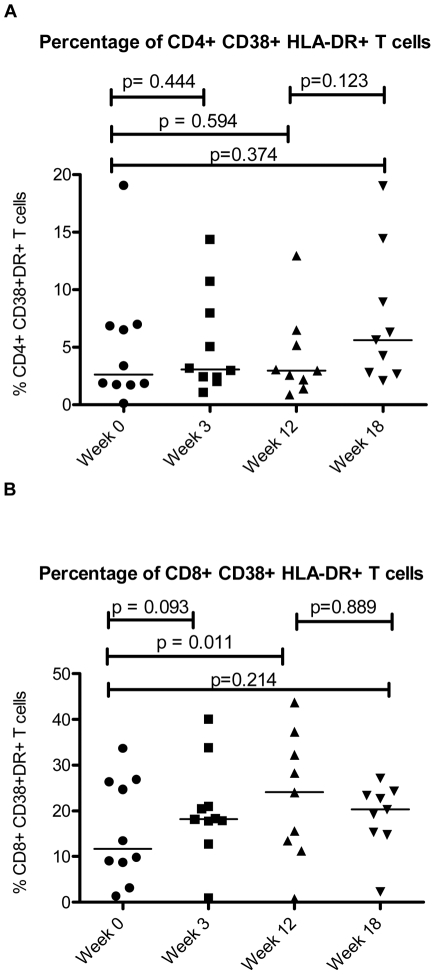
The proportion of CD38+HLA-DR+CD8+ T cells increased from a mean of 11.7% at baseline to 24.1% after twelve weeks of interferon treatment (p = 0.006). These frequencies dropped to an average of 20.1% six weeks after the end of treatment. In contrast to CD8+ T cells, the frequencies of activated CD4+ T cells did not change with administration of type I interferon (mean percentage of CD38+DR+ cells = 2.62% at baseline and 2.17% after 12 weeks of interferon therapy). As plasma HIV levels fell with interferon therapy, this was correlated with a "paradoxical" increase in CD8+ T cell activation (p<0.001).
Administration of type I interferon increased expression of the activation markers CD38 and HLA DR on CD8+ T cells but not on CD4+ T cells of HIV+ persons. These observations suggest that type I interferons may contribute to the high levels of CD8+ T cell activation that occur during HIV infection.
I 型干扰素在先天免疫防御中发挥重要作用。在 HIV 感染中,I 型干扰素可能通过抑制病毒复制来延缓疾病进展,同时通过促进慢性免疫激活来加速疾病进展。
为了研究 I 型干扰素在 HIV 感染中的作用,我们从参加 AIDS 临床试验组研究 5192 的 10 名受试者中获得了冷冻保存的外周血单核细胞样本,该研究调查了全身性 IFNα 给药对未经治疗的 HIV 感染患者的 12 周活性。使用流式细胞术,我们检查了在 IFNα 治疗之前、期间和之后,循环 T 细胞及其成熟亚群的细胞周期状态和激活抗原表达的变化。
CD38+HLA-DR+CD8+T 细胞的比例从基线时的平均 11.7%增加到 12 周干扰素治疗后的 24.1%(p=0.006)。这些频率在治疗结束后六周平均降至 20.1%。与 CD8+T 细胞相反,I 型干扰素给药后激活的 CD4+T 细胞频率没有变化(基线时 CD38+DR+细胞的平均百分比为 2.62%,12 周干扰素治疗后为 2.17%)。随着干扰素治疗时血浆 HIV 水平下降,这与 CD8+T 细胞激活的“矛盾”增加相关(p<0.001)。
I 型干扰素的给药增加了 HIV+个体 CD8+T 细胞上激活标志物 CD38 和 HLA DR 的表达,但对 CD4+T 细胞没有影响。这些观察结果表明,I 型干扰素可能导致 HIV 感染期间发生的高水平 CD8+T 细胞激活。