Northern Institute for Cancer Research, Newcastle University, Framlington Place, Newcastle upon Tyne NE2 4HH, U.K.
ACS Chem Biol. 2012 May 18;7(5):811-6. doi: 10.1021/cb2004516. Epub 2012 Feb 10.
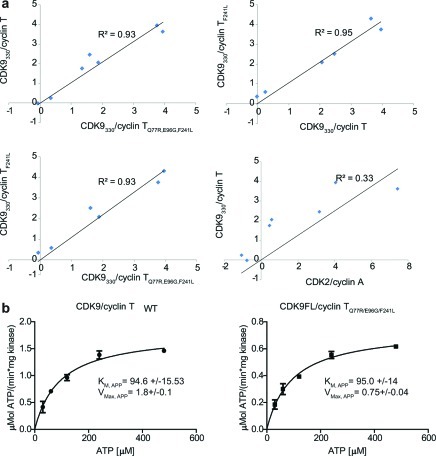
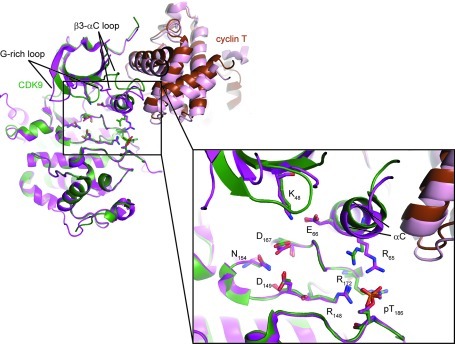
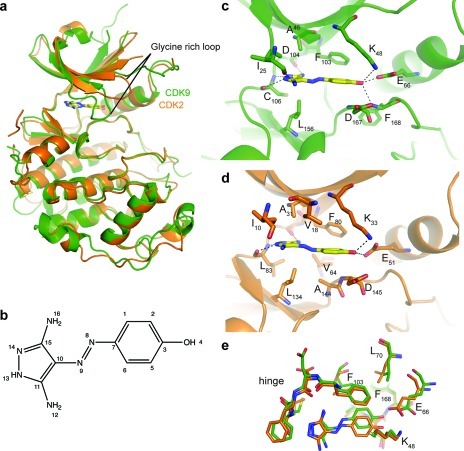
CDK9 is the kinase of positive transcription elongation factor b and facilitates the transition of paused RNA polymerase II to processive transcription elongation. CDK9 is a validated target for the treatment of cancer, cardiac hypertrophy, and human immunodeficiency virus. Here we analyze different CDK9/cyclin T variants to identify a form of the complex amenable to use in inhibitor design. To demonstrate the utility of this system, we have determined the crystal structures of CDK9/cyclin T and CDK2/cyclin A bound to the CDK9-specific inhibitor CAN508. Comparison of the structures reveals CDK9-specific conformational changes and identifies a CDK9-specific hydrophobic pocket, adjacent to the αC-helix. By comparison with a previously published structure of CDK9/cyclin T/human immunodeficiency virus TAT we find that the CDK9 αC-helix has a degree of conformational variability that has the potential to be exploited for inhibitor design.
CDK9 是正转录延伸因子 b 的激酶,有助于暂停的 RNA 聚合酶 II 向连续转录延伸的转变。CDK9 是治疗癌症、心肌肥厚和人类免疫缺陷病毒的有效靶点。在这里,我们分析了不同的 CDK9/周期蛋白 T 变体,以确定一种适合抑制剂设计的复合物形式。为了证明该系统的实用性,我们已经确定了 CDK9/周期蛋白 T 和 CDK2/周期蛋白 A 与 CDK9 特异性抑制剂 CAN508 结合的晶体结构。结构比较揭示了 CDK9 特异性构象变化,并确定了一个位于 αC-螺旋附近的 CDK9 特异性疏水性口袋。通过与先前发表的 CDK9/周期蛋白 T/人类免疫缺陷病毒 TAT 的结构进行比较,我们发现 CDK9 的 αC-螺旋具有一定的构象可变性,有可能被用于抑制剂设计。