State Key Laboratory of Oncology in South China and Department of Neurosurgery, Sun Yat-sen University Cancer Center, No, 651, Dong Feng Road East, Guangzhou 510060, People's Republic of China.
BMC Cancer. 2012 Feb 1;12:49. doi: 10.1186/1471-2407-12-49.
Brain metastases (BM) from hepatocellular carcinoma (HCC) are extremely rare and are associated with a poor prognosis. The aim of this study was to define clinical outcome and prognostic determinants in patients with BM from HCC.
Between January 1994 and December 2009, all patients with HCC and BM treated in Sun Yat-sen University Cancer Center were retrospectively reviewed. Univariate and multivariate survival analyses were performed to identify possible prognostic factors.
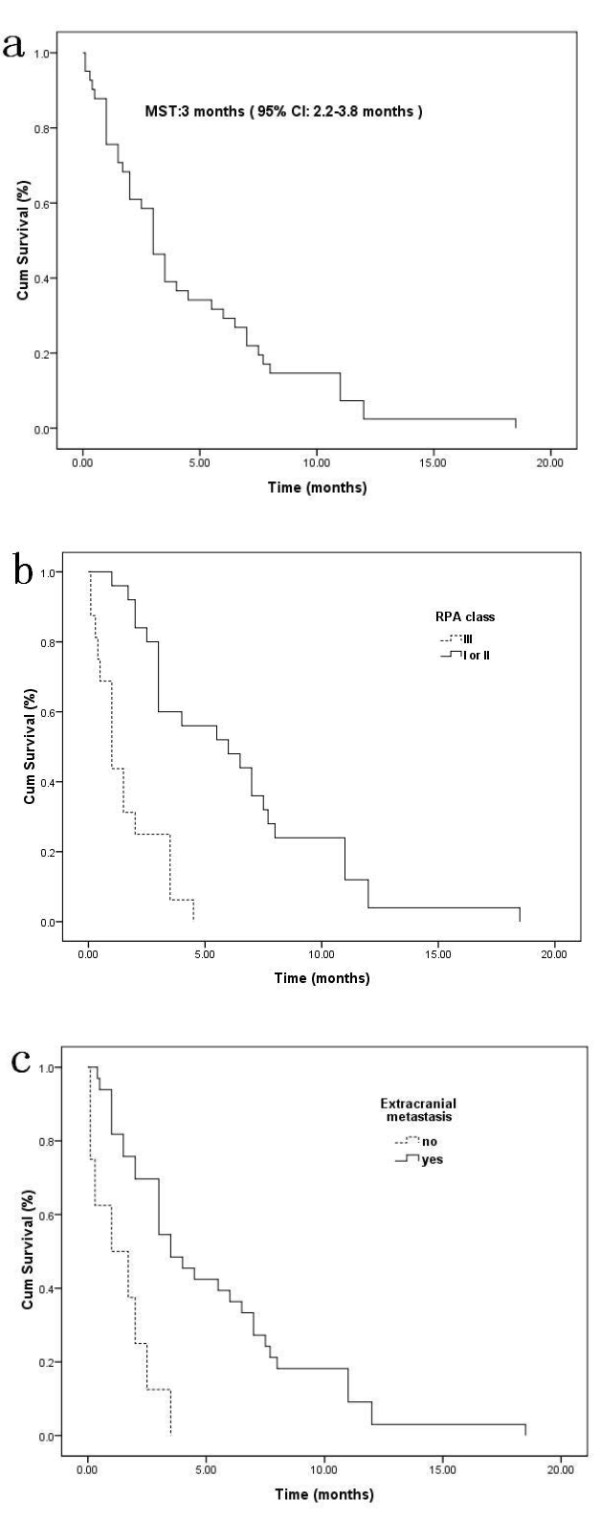
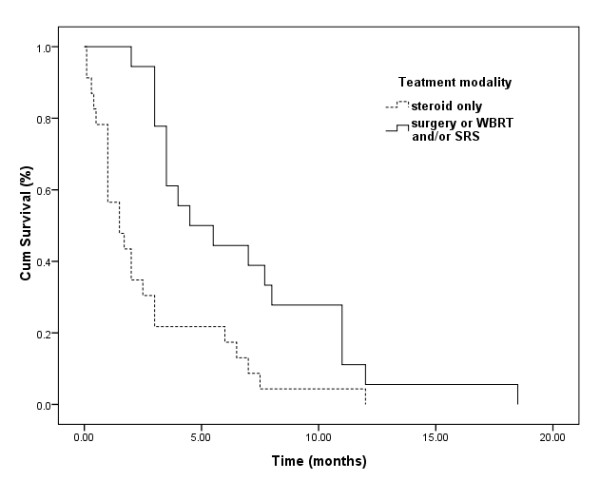
Forty-one patients were diagnosed with BM from HCC, an incidence of 0.47%. The median age at diagnosis of BM was 48.5 years. Thirty-three patients (80.5%) developed extracranial metastases at diagnosis of BM, and 30 patients (73.2%) had hepatitis B. Intracranial hemorrhage occurred in 19 patients (46.3%). BM were treated primarily either with whole brain radiation therapy (WBRT; 5 patients), stereotactic radiosurgery (SRS; 7 patients), or surgical resection (6 patients). The cause of death was systemic disease in 17 patients and neurological disease in 23. Patients in a high RPA (recursive partitioning analysis) class, treated with conservatively and without lung metastases, tended to die from neurological disease. Median survival after the diagnosis of BM was 3 months (95% confidence interval: 2.2-3.8 months). In multivariate analysis, the presence of extracranial metastases, a low RPA class and aggressive treatment, were positively associated with improved survival.
BM from HCC is rare and associated with an extremely poor prognosis. However, patients with a low RPA class may benefit from aggressive treatment. The clinical implication of extracranial metastases in HCC patients with BM needs further assessment.
肝细胞癌(HCC)脑转移(BM)极为罕见,预后不良。本研究旨在确定 HCC 脑转移患者的临床结局和预后因素。
回顾性分析中山大学肿瘤防治中心 1994 年 1 月至 2009 年 12 月收治的所有 HCC 合并 BM 患者。采用单因素和多因素生存分析确定可能的预后因素。
41 例患者被诊断为 HCC 脑转移,发病率为 0.47%。BM 的中位年龄为 48.5 岁。33 例(80.5%)患者在诊断 BM 时即已发生颅外转移,30 例(73.2%)患者有乙型肝炎。19 例(46.3%)患者发生颅内出血。BM 主要采用全脑放疗(WBRT;5 例)、立体定向放疗(SRS;7 例)或手术切除(6 例)治疗。17 例患者因全身疾病死亡,23 例患者因神经系统疾病死亡。RPA(递归分区分析)评分较高、治疗保守且无肺转移的患者,倾向于因神经系统疾病死亡。BM 诊断后中位生存时间为 3 个月(95%置信区间:2.2-3.8 个月)。多因素分析显示,存在颅外转移、RPA 评分低和积极治疗与生存时间延长相关。
HCC 脑转移罕见,预后极差。然而,RPA 评分低的患者可能从积极治疗中获益。HCC 脑转移患者存在颅外转移的临床意义尚需进一步评估。