Department of Pathology, Anhui Medical University, Hefei, Anhui, People's Republic of China.
BMC Cancer. 2012 Feb 1;12:51. doi: 10.1186/1471-2407-12-51.
miRNAs, endogenous oligonucleotide RNAs, play an important role in mammary gland carcinogenesis and tumor progression. Detection of their expression and investigation of their functions could lead to discovery of novel biomarkers for breast cancer.
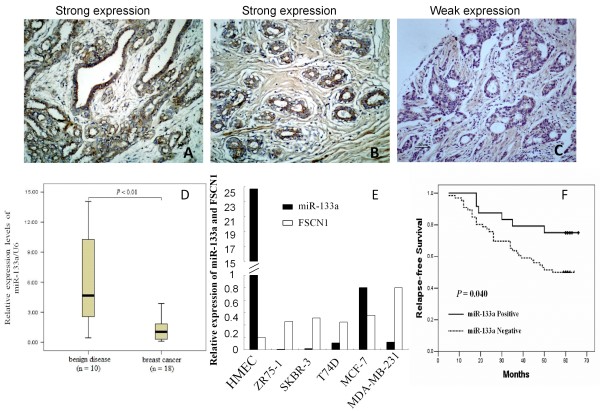
In situ hybridization was used to detect miR-133a expression in formalin-fixed paraffin-embedded breast surgical specimens from 26 benign, 34 pericancerously normal and 90 cancerous tissues. qRT-PCR was performed to assess miR-133a levels in 6 breast cell lines and 10 benign and 18 cancerous fresh breast tissue specimens. Cell viability, migration, and invasion assays were used to determine the role of miR-133a in regulation of breast cancer cell growth, migration, and invasion, respectively. Luciferase assay was performed to assess miR-133a binding to FSCN1 gene.
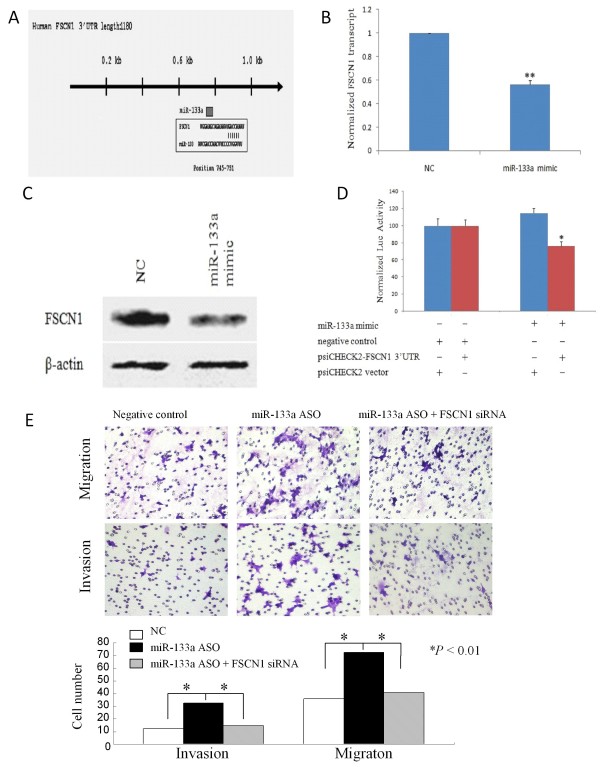
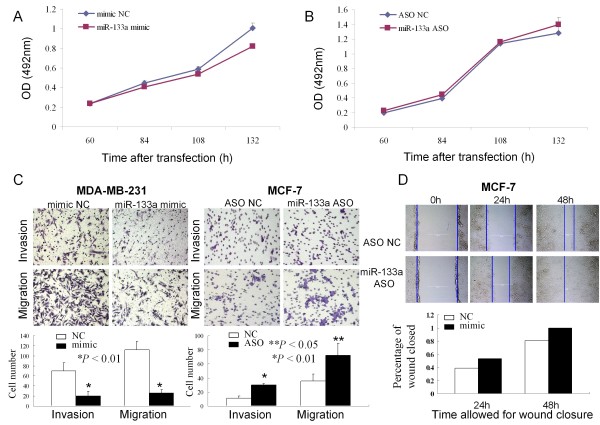
Expression of miR-133a was reduced from normal through benign to cancerous breast tissues. Expression of miR-133a was also low in breast cancer cell lines. The reduced miR-133a expression was associated with lymph nodes metastasis, high clinical stages, and shorter relapse-free survivals of patients with breast cancer. Furthermore, transfection of miR-133a oligonucleotides slightly inhibited growth but significantly decreased migration and invasion capacity of breast cancer cells, compared with negative controls, whereas knockdown of miR-133a expression induced breast cancer cell migration and invasion. In addition, we identified a putative miR-133a binding site in the 3'-untranslated region (UTR) of Fascin1 (FSCN1) gene using an online bioinformatical tool. We found that miR-133a transfection significantly reduced expression of FSCN1 mRNA and protein. The luciferase reporter assay confirmed that FSCN1 was the direct target gene of miR-133a.
miR-133a expression was lost in breast cancer tissues, loss of which was associated with lymph nodes metastasis, high clinical stages and shorter relapse-free survivals of patients with breast cancer. Functionally, miR-133a can suppress tumor cell invasion and migration and targeted the expression of FSCN1. Future study will verify whether detection of miR-133a expression can served as a novel biomarker for breast cancer progression and patient prognosis.
miRNAs 是内源性寡核苷酸 RNA,在乳腺肿瘤发生和肿瘤进展中发挥重要作用。检测其表达并研究其功能可能会发现乳腺癌的新型生物标志物。
采用原位杂交法检测 26 例良性、34 例癌旁正常和 90 例癌组织福尔马林固定石蜡包埋的乳腺外科标本中 miR-133a 的表达。采用 qRT-PCR 检测 6 种乳腺癌细胞系和 10 例良性和 18 例癌性新鲜乳腺组织标本中 miR-133a 的水平。采用细胞活力、迁移和侵袭试验分别确定 miR-133a 调节乳腺癌细胞生长、迁移和侵袭的作用。采用荧光素酶试验评估 miR-133a 与 FSCN1 基因的结合。
miR-133a 的表达从正常、良性到癌性乳腺组织逐渐降低。miR-133a 在乳腺癌细胞系中的表达也较低。miR-133a 表达降低与淋巴结转移、高临床分期和乳腺癌患者较短的无复发生存期相关。此外,与阴性对照相比,miR-133a 寡核苷酸的转染略微抑制了细胞生长,但显著降低了乳腺癌细胞的迁移和侵袭能力,而 miR-133a 表达的下调则诱导了乳腺癌细胞的迁移和侵袭。此外,我们使用在线生物信息学工具鉴定了 Fascin1(FSCN1)基因 3'-UTR 中的一个假定的 miR-133a 结合位点。我们发现 miR-133a 转染可显著降低 FSCN1 mRNA 和蛋白的表达。荧光素酶报告基因检测证实 FSCN1 是 miR-133a 的直接靶基因。
miR-133a 在乳腺癌组织中表达缺失,缺失与淋巴结转移、高临床分期和乳腺癌患者较短的无复发生存期相关。功能上,miR-133a 可抑制肿瘤细胞侵袭和迁移,并靶向 FSCN1 的表达。未来的研究将验证检测 miR-133a 的表达是否可作为乳腺癌进展和患者预后的新型生物标志物。