Department of Physiology, Kosin University College of Medicine, Busan, Korea.
Mucosal Immunol. 2012 Mar;5(2):207-15. doi: 10.1038/mi.2011.67. Epub 2012 Feb 1.
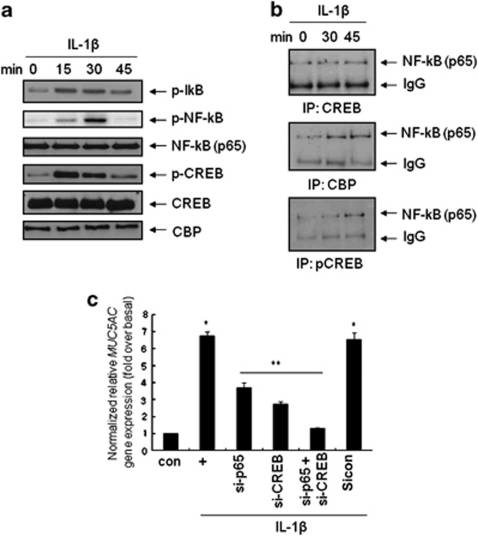
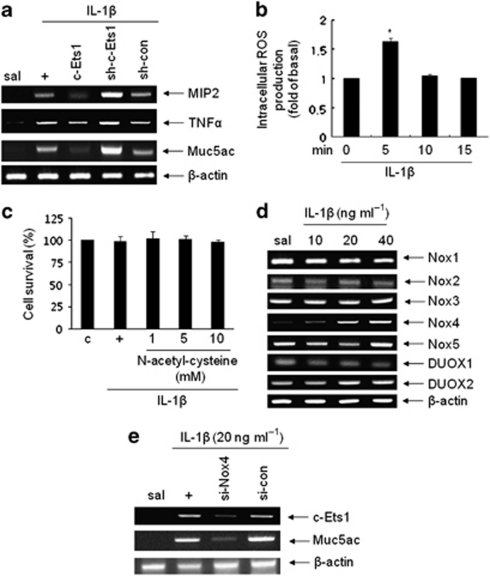
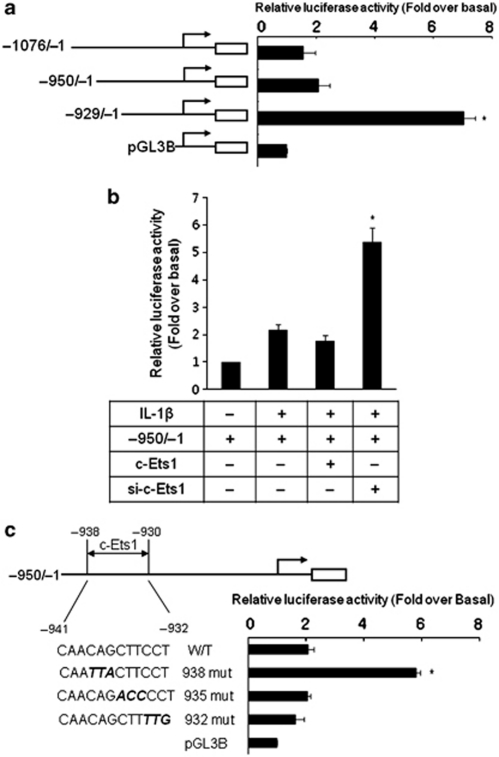
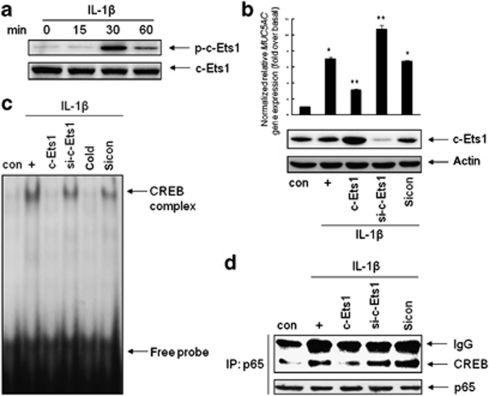
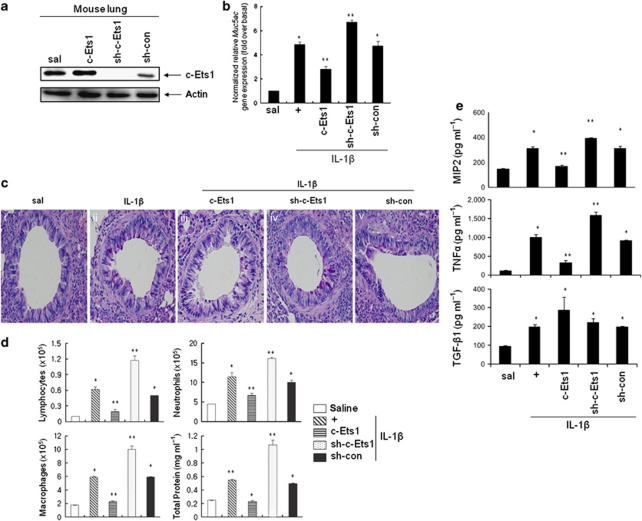
Mucin hypersecretion is frequently observed in many inflammatory diseases of the human respiratory tract. As mucin hypersecretion refers to uncontrolled mucin expression and secretion during inflammation, studies examining the negative control mechanisms of mucin hypersecretion are vital in developing novel therapeutic medications. We hypothesized that the c-Ets1 induced by interleukin (IL)-1β would decrease MUC5AC overproduction by inhibiting the interaction of NF-κB with cAMP response element-binding protein (CREB) in vivo. Stimulation with IL-1β caused the direct binding of NF-κB and CREB to the MUC5AC promoter, thus increasing MUC5AC gene expression. However, IL-1β-induced MUC5AC messenger RNA levels were surprizingly downregulated by c-Ets1 (located -938 to -930). Interestingly, c-Ets1 also suppressed IL-1β-induced MUC5AC gene expression in vitro and in vivo by disrupting the interaction of NF-κB with CREB on the MUC5AC promoter. In addition, c-Ets1 also inhibited significant morphologic changes and inflammatory cell infiltration after IL-1β exposure in mouse lungs infected with either wild-type or shRNA-c-Ets1. Moreover, reactive oxygen species produced by NOX4 increased c-Ets1 gene expression and MUC5AC gene expression in alveolar macrophages from bronchoalveolar lavage fluid. These results suggest a molecular paradigm for the establishment of a novel mechanism underlying the negative regulation of mucin overproduction, thus enhancing our understanding of airway inflammation.
粘蛋白过度分泌常发生于人类呼吸道的多种炎症性疾病。由于粘蛋白过度分泌是指在炎症过程中粘蛋白不受控制的表达和分泌,因此研究粘蛋白过度分泌的负调控机制对于开发新型治疗药物至关重要。我们假设白细胞介素(IL)-1β诱导的 c-Ets1 可通过抑制 NF-κB 与 cAMP 反应元件结合蛋白(CREB)之间的相互作用,减少 MUC5AC 的过度产生。用 IL-1β刺激可导致 NF-κB 和 CREB 直接与 MUC5AC 启动子结合,从而增加 MUC5AC 基因表达。然而,IL-1β 诱导的 MUC5AC 信使 RNA 水平出人意料地被 c-Ets1(位于 -938 至 -930)下调。有趣的是,c-Ets1 还通过破坏 NF-κB 与 CREB 在 MUC5AC 启动子上的相互作用,在体外和体内抑制 IL-1β诱导的 MUC5AC 基因表达。此外,c-Ets1 还抑制了感染野生型或 shRNA-c-Ets1 的小鼠肺部在暴露于 IL-1β 后的形态学变化和炎症细胞浸润。此外,NOX4 产生的活性氧增加了肺泡巨噬细胞中 c-Ets1 基因表达和 MUC5AC 基因表达。这些结果为粘蛋白过度产生的负调控提供了一个新的分子范例,从而增强了我们对气道炎症的理解。