Department of Urology, Medical University of Vienna, Währinger Gürtel 18-20, Vienna 1090, Austria.
Br J Cancer. 2012 Feb 28;106(5):904-8. doi: 10.1038/bjc.2012.20. Epub 2012 Jan 31.
To date, no reliable serum marker for clear cell renal cell carcinoma (CCRCC) is available. The aim of this study was to evaluate the putative significance of circulating 20S proteasome levels.
Preoperative 20S proteasome serum levels were determined in 113 CCRCC patients and 15 healthy controls by a sandwich enzyme-linked immunosorbent assay. Associations with CCRCC, pathological variables, disease-specific survival (DSS), and response to sunitinib were evaluated.
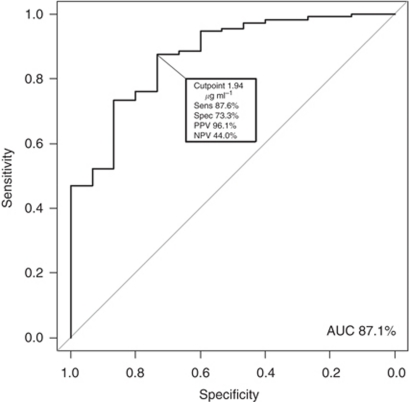
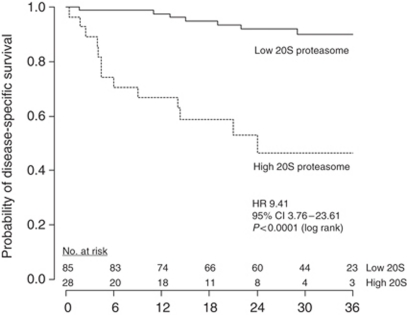
Median 20S proteasome levels were higher in CCRCC patients than in healthy controls (4.66 vs 1.52 μg ml(-1), P<0.0001). The area under the receiver operating characteristics curve curve was 87.1%. The 20S proteasome levels were associated with symptoms (P=0.0008), distant metastases (P=0.0011), grade (P=0.0247), and necrosis (P=0.0462). The 20S proteasome levels were identified as a prognostic factor for DSS in both univariable (hazards ratio 1.21, P<0.001) and multivariable (hazards ratio 1.17, P=0.0015) survival analysis. In patients responding to sunitinib, 20S proteasome levels were lower than in patients with stable disease and progressive disease.
This study demonstrates for the first time that increased 20S proteasome levels are associated with CCRCC, advanced disease, and poor prognosis. Routine use of this marker may allow better diagnosis, risk stratification, risk-adjusted follow-up, and identification of patients with a greater likelihood of response to targeted therapy.
迄今为止,尚无可靠的用于透明细胞肾细胞癌(ccRCC)的血清标志物。本研究旨在评估循环 20S 蛋白酶体水平的可能意义。
采用夹心酶联免疫吸附试验(ELISA)法检测 113 例 ccRCC 患者和 15 例健康对照者术前的 20S 蛋白酶体血清水平。评估其与 ccRCC、病理变量、疾病特异性生存(DSS)和对舒尼替尼的反应之间的关系。
ccRCC 患者的中位 20S 蛋白酶体水平高于健康对照组(4.66 与 1.52 μg/ml,P<0.0001)。受试者工作特征曲线下面积为 87.1%。20S 蛋白酶体水平与症状(P=0.0008)、远处转移(P=0.0011)、分级(P=0.0247)和坏死(P=0.0462)有关。20S 蛋白酶体水平在单变量(危险比 1.21,P<0.001)和多变量(危险比 1.17,P=0.0015)生存分析中均被确定为 DSS 的预后因素。在对舒尼替尼有反应的患者中,20S 蛋白酶体水平低于疾病稳定和疾病进展的患者。
本研究首次证明,20S 蛋白酶体水平升高与 ccRCC、晚期疾病和不良预后相关。该标志物的常规使用可能有助于更好地诊断、风险分层、风险调整随访以及识别更有可能对靶向治疗有反应的患者。