Division of Parasitology, Department of Pathology, Faculty of Medicine, University of Jaffna, Jaffna, Sri Lanka.
PLoS One. 2012;7(1):e30516. doi: 10.1371/journal.pone.0030516. Epub 2012 Jan 25.
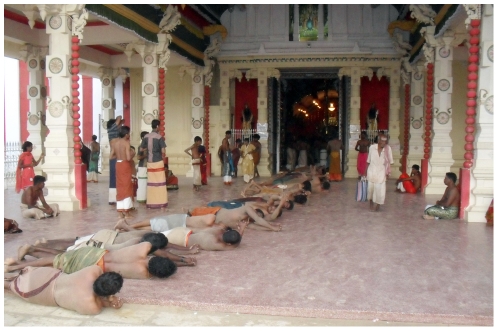
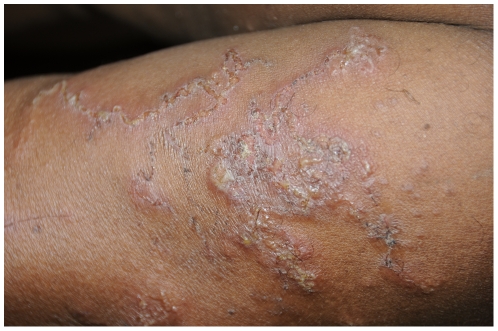
Many cases of Cutaneous Larva Migrans (CLM) have been observed among devotees, during and immediately after the annual festival at the Nallur Hindu temple in Jaffna.
To ascertain the risk factors associated with infestation and devotees' knowledge and practices regarding the condition.
METHODOLOGY/PRINCIPAL FINDINGS: A cross-sectional study using an interviewer-administered questionnaire and observation was conducted in August 2010. Out of 200 selected devotees 194(97%) responded. Soil and dog faecal samples were collected from the temple premises and examined for the presence of nematode larva and egg respectively. Among 194 male respondents, 58.2%(95% CI: 51.2%-65.0%) had lesions of CLM. One hundred and thirty (67%) respondents performed the ritual everyday; whereas 33% did so on special days. One hundred and twelve (57.7%) participants performed the ritual before 5.00am and remaining 42.3% performed after 5.00am. Among the participants, 77(36.7%) had the similar condition in previous years. One hundred and fifty seven (80.9%) were aware about this disease and 52(27%) devotees adopted some kind of precautionary measures. Bivariate analysis showed significant association between occurrence of CLM lesions and frequency of performing the ritual (p<0.001, OR-15.1; 95% CI:7.2-32.0), the timing of ritual performance (p = 0.022, OR-1.96; 95% CI:1.10-3.52), similar condition in previous year (p<0.001, OR-6.83; 95% CI: 3.39-13.76) and previous awareness of the condition (p = 0.005; OR-0.59;95% CI:0.43-0.82). Multivariate analysis showed that the frequency of ritual performance (OR-11.75; 95% CI 5.37-25.74) and similar conditions in previous years (OR-4.71; 95% CI: 2.14-10.39) were the independent risk factors. Two of the 20 soil samples were positive for the nematode larvae and three out of five dog faeces were positive for hookworm eggs.
CONCLUSIONS/SIGNIFICANCE: Deworming the stray dogs around the temple premises combined with the awareness programs among the public may be the effective and feasible precautionary measures to control similar epidemics in future.
在贾夫纳的纳尔勒印度教寺庙的年度节日期间和之后,许多人发现患有游走性幼虫疹(CLM)。
确定与感染有关的危险因素,以及信徒对这种情况的了解和做法。
方法/主要发现:2010 年 8 月,采用问卷调查和观察的方法进行了一项横断面研究。从 200 名选定的信徒中,有 194 名(97%)做出了回应。从寺庙场地采集土壤和狗粪便样本,分别检查是否存在线虫幼虫和卵。在 194 名男性受访者中,58.2%(95%CI:51.2%-65.0%)有游走性幼虫疹的病变。130 名(67%)受访者每天都进行这种仪式;而 33%的人只在特殊日子进行。112 名(57.7%)参与者在凌晨 5 点之前进行仪式,其余 42.3%在凌晨 5 点之后进行。在参与者中,77 人(36.7%)在过去几年中出现过类似情况。157 人(80.9%)了解这种疾病,52 人(27%)信徒采取了某种预防措施。双变量分析显示,CLM 病变的发生与仪式的频率(p<0.001,OR-15.1;95%CI:7.2-32.0)、仪式进行的时间(p=0.022,OR-1.96;95%CI:1.10-3.52)、前一年的类似情况(p<0.001,OR-6.83;95%CI:3.39-13.76)和以前对该疾病的了解(p=0.005;OR-0.59;95%CI:0.43-0.82)之间存在显著关联。多变量分析显示,仪式的频率(OR-11.75;95%CI 5.37-25.74)和前一年的类似情况(OR-4.71;95%CI:2.14-10.39)是独立的危险因素。20 个土壤样本中有 2 个样本中检出线虫幼虫,5 个狗粪便样本中有 3 个样本中检出钩虫卵。
结论/意义:对寺庙周围的流浪狗进行驱虫,并在公众中开展宣传活动,可能是控制未来类似疫情的有效可行的预防措施。