Department of Radiation Oncology, University of Washington, Seattle, Washington, USA.
Bioconjug Chem. 2012 Mar 21;23(3):409-20. doi: 10.1021/bc200401b. Epub 2012 Feb 10.
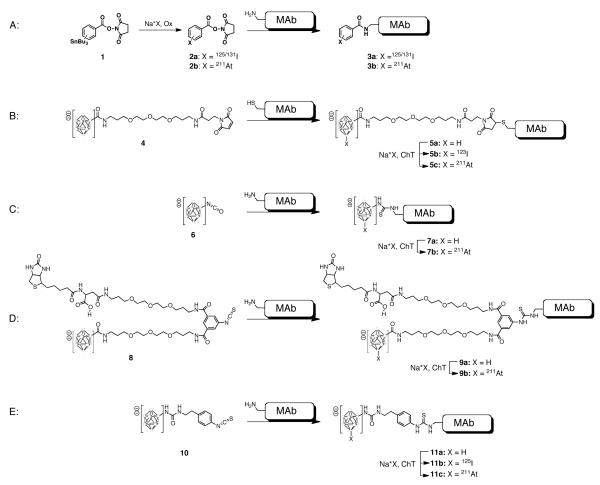
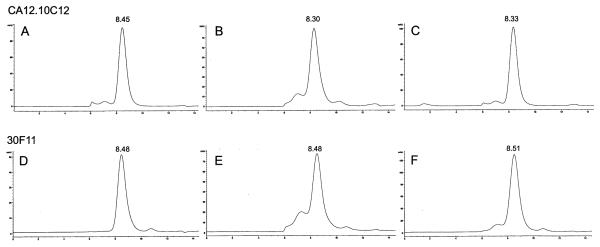
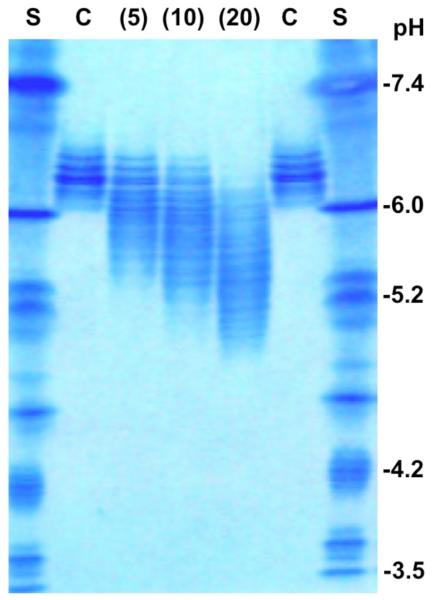
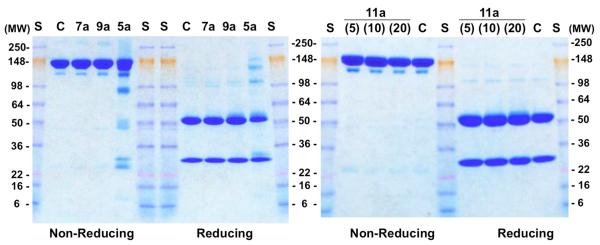
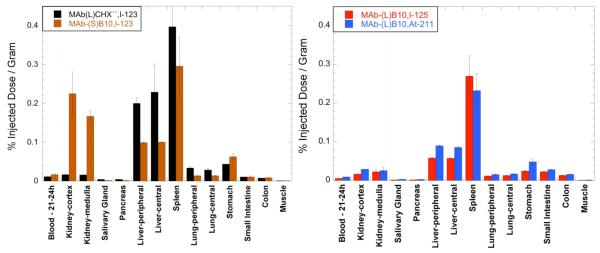
We are investigating the use of an (211)At-labeled anti-CD45 monoclonal antibody (mAb) as a replacement of total body irradiation in conditioning regimens designed to decrease the toxicity of hematopoietic cell transplantation (HCT). As part of that investigation, dose-escalation studies were conducted in dogs using (211)At-labeled anticanine CD45 mAb, CA12.10C12, conjugated with a maleimido-closo-decaborate(2-) derivative, 4. Unacceptable renal toxicity was noted in the dogs receiving doses in the 0.27-0.62 mCi/kg range. This result was not anticipated, as no toxicity had been noted in prior biodistribution and toxicity studies conducted in mice. Studies were conducted to understand the cause of the renal toxicity and to find a way to circumvent it. A dog biodistribution study was conducted with (123)I-labeled CA12.10C12 that had been conjugated with 4. The biodistribution data showed that 10-fold higher kidney concentrations were obtained with the maleimido-conjugate than had been obtained in a previous biodistribution study with (123)I-labeled CA12.10C12 conjugated with an amine-reactive phenylisothiocyanato-CHX-A″ derivative. The difference in kidney concentrations observed in dogs for the two conjugation approaches led to an investigation of the reagents. SE-HPLC analyses showed that the purity of the CA12.10C12 conjugated via reduced disulfides was lower than that obtained with amine-reactive conjugation reagents, and nonreducing SDS-PAGE analyses indicated protein fragments were present in the disulfide reduced conjugate. Although we had previously prepared closo-decaborate(2-) derivatives with amine-reactive functional groups (e.g., 6 and 8), a new, easily synthesized, amine-reactive (phenylisothiocyanate) derivative, 10, was prepared for use in the current studies. A biodistribution was conducted with coadministered (125)I- and (211)At-labeled CA12.10C10 conjugated with 10. In that study, lower kidney concentrations were obtained for both radionuclides than had been obtained in the earlier study of the same antibody conjugated with 4 after reduction of disulfide bonds.
我们正在研究使用(211)At 标记的抗 CD45 单克隆抗体(mAb)作为全身照射在设计以降低造血细胞移植(HCT)毒性的调理方案的替代物。作为该研究的一部分,使用(211)At 标记的抗犬 CD45 mAb CA12.10C12 进行了剂量递增研究,该 mAb 与马来酰亚胺-closo-癸硼烷(2-)衍生物 4 缀合。在接受 0.27-0.62 mCi/kg 范围内剂量的狗中观察到不可接受的肾毒性。这一结果出乎意料,因为在先前在小鼠中进行的生物分布和毒性研究中没有注意到毒性。进行了研究以了解肾毒性的原因并找到规避它的方法。用(123)I 标记的 CA12.10C12 进行了犬生物分布研究,该 mAb 与 4 缀合。生物分布数据表明,与先前用与胺反应的苯异硫氰酸酯-CHX-A″衍生物缀合的(123)I 标记的 CA12.10C12 进行的生物分布研究相比,马来酰亚胺缀合物获得了 10 倍更高的肾脏浓度。两种缀合方法在狗中观察到的肾脏浓度差异导致了对试剂的研究。SE-HPLC 分析表明,通过还原二硫键缀合的 CA12.10C12 的纯度低于与胺反应性缀合试剂获得的纯度,非还原 SDS-PAGE 分析表明存在蛋白质片段在还原的二硫键缀合物中。尽管我们以前已经制备了具有胺反应性官能团的 closo-癸硼烷(2-)衍生物(例如 6 和 8),但为了当前的研究,我们还制备了一种新的、易于合成的、胺反应性(苯异硫氰酸酯)衍生物 10。用共给予的(125)I-和(211)At 标记的 CA12.10C10 进行了生物分布研究,该 mAb 与 10 缀合。在该研究中,与用 4 还原二硫键后用相同抗体缀合的早期研究相比,两种放射性核素的肾脏浓度均降低。