RTI Health Solutions, The Pavilion, Towers Business Park, Wilmslow Road, Didsbury, Manchester, M20 2LS, UK.
Eli Lilly and Company, Global Health Outcomes, Lilly Corporate Center, Indianapolis, IN 46285 USA.
Cost Eff Resour Alloc. 2012 Feb 1;10(1):1. doi: 10.1186/1478-7547-10-1.
Decision makers in many jurisdictions use cost-effectiveness estimates as an aid for selecting interventions with an appropriate balance between health benefits and costs. This systematic literature review aims to provide an overview of published cost-effectiveness models in major depressive disorder (MDD) with a focus on the methods employed. Key components of the identified models are discussed and any challenges in developing models are highlighted.
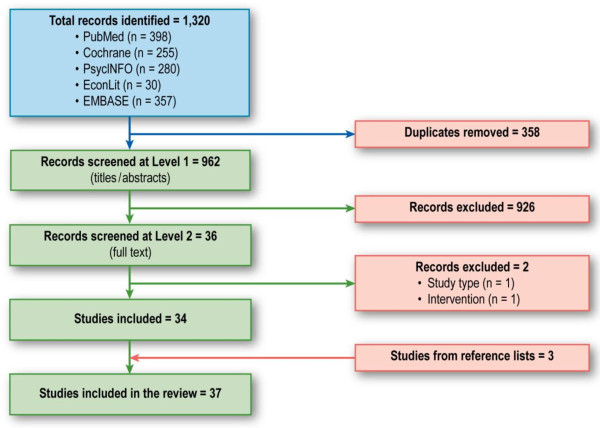
A systematic literature search was performed to identify all primary model-based economic evaluations of MDD interventions indexed in MEDLINE, the Cochrane Library, EMBASE, EconLit, and PsycINFO between January 2000 and May 2010.
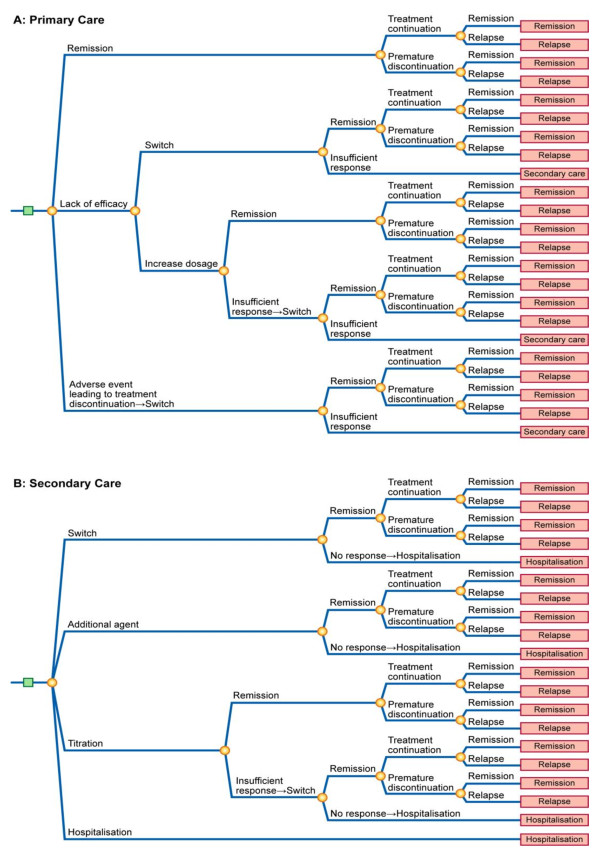
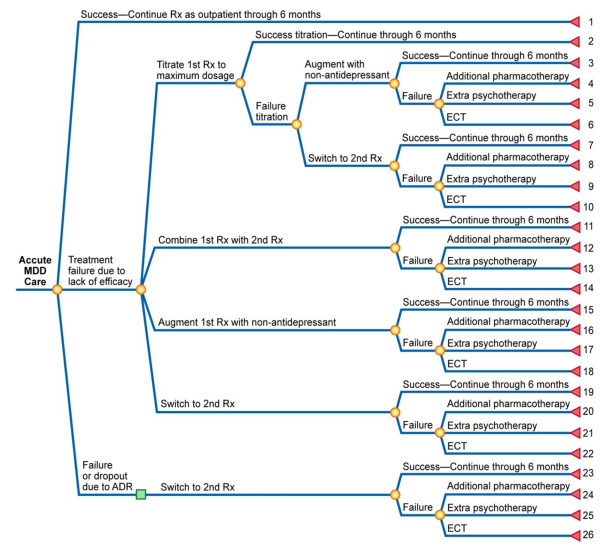
A total of 37 studies were included in the review. These studies predominantly evaluated antidepressant medications. The analyses were performed across a broad set of countries. The majority of models were decision-trees; eight were Markov models. Most models had a time horizon of less than 1 year. The majority of analyses took a payer perspective. Clinical input data were obtained from pooled placebo-controlled comparative trials, single head-to-head trials, or meta-analyses. The majority of studies (24 of 37) used treatment success or symptom-free days as main outcomes, 14 studies incorporated health state utilities, and 2 used disability-adjusted life-years. A few models (14 of 37) incorporated probabilities and costs associated with suicide and/or suicide attempts. Two models examined the cost-effectiveness of second-line treatment in patients who had failed to respond to initial therapy. Resource use data used in the models were obtained mostly from expert opinion. All studies, with the exception of one, explored parameter uncertainty.
The review identified several model input data gaps, including utility values in partial responders, efficacy of second-line treatments, and resource utilisation estimates obtained from relevant, high-quality studies. It highlighted the differences in outcome measures among the trials of MDD interventions, which can lead to difficulty in performing indirect comparisons, and the inconsistencies in definitions of health states used in the clinical trials and those used in utility studies. Clinical outcomes contributed to the uncertainty in cost-effectiveness estimates to a greater degree than costs or utility weights.
许多司法管辖区的决策者使用成本效益估计作为选择干预措施的辅助手段,这些干预措施在健康效益和成本之间取得适当平衡。本系统文献回顾旨在概述主要抑郁症(MDD)成本效益模型的研究,重点介绍所采用的方法。讨论了所确定模型的关键组成部分,并强调了模型开发中的任何挑战。
系统地检索了 MEDLINE、Cochrane 图书馆、EMBASE、EconLit 和 PsycINFO 中 2000 年 1 月至 2010 年 5 月期间索引的所有针对 MDD 干预措施的基于模型的经济学评价的原始文献。
共纳入 37 项研究。这些研究主要评估了抗抑郁药物。分析在广泛的国家进行。大多数模型是决策树,8 个是马尔可夫模型。大多数模型的时间范围不到 1 年。大多数分析从支付者的角度出发。临床投入数据来自汇总的安慰剂对照对照试验、单项头对头试验或荟萃分析。大多数研究(37 项中的 24 项)将治疗成功或无症状天数作为主要结果,14 项研究纳入健康状态效用,2 项研究采用残疾调整生命年。少数模型(37 项中的 14 项)纳入了与自杀和/或自杀未遂相关的概率和成本。有两个模型研究了二线治疗在初始治疗失败的患者中的成本效益。模型中使用的资源利用数据主要来自专家意见。除一项外,所有研究均探讨了参数不确定性。
本综述确定了一些模型输入数据的差距,包括部分缓解患者的效用值、二线治疗的疗效以及从相关高质量研究中获得的资源利用估计值。它强调了 MDD 干预试验之间结果测量的差异,这可能导致难以进行间接比较,以及临床试验中使用的健康状态定义与效用研究中使用的健康状态定义之间的不一致。临床结果对成本效益估计的不确定性的贡献程度大于成本或效用权重。