Hôpital Neurologique, Université Claude Bernard Lyon 1, France.
Mult Scler. 2012 Sep;18(9):1278-89. doi: 10.1177/1352458512436594. Epub 2012 Feb 3.
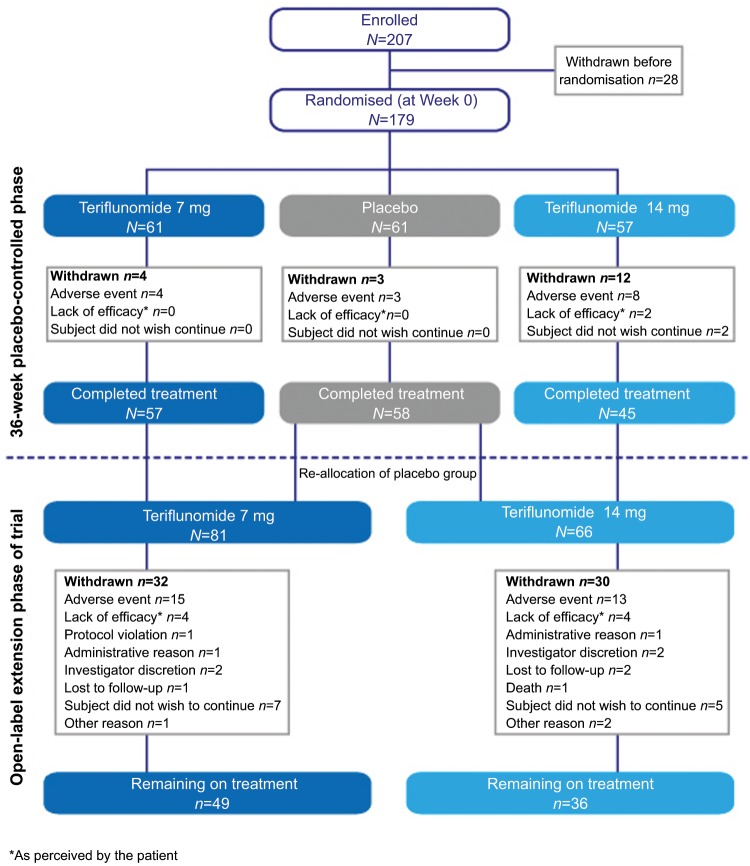
Teriflunomide, an oral disease-modifying therapy in development for patients with relapsing forms of multiple sclerosis (RMS), was well tolerated and effective in reducing magnetic resonance imaging (MRI) lesions in 179 RMS patients in a phase 2 36-week, placebo-controlled study.
A total of 147 patients who completed the core study entered an open-label extension. Teriflunomide patients continued their assigned dose, and placebo patients were re-allocated to teriflunomide, 7 mg/day or 14 mg/day. An interim analysis was performed at a cut-off on January 8 2010.
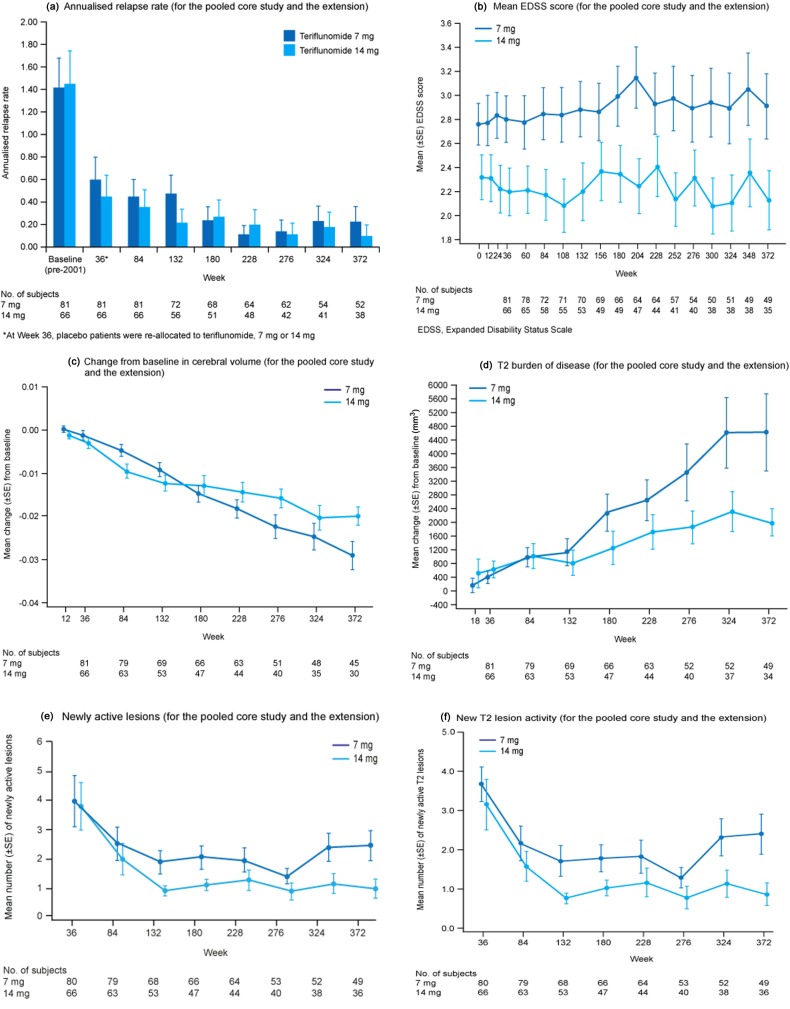
The mean and median duration of study treatment, including both the core and extension phase, from baseline to the interim cut-off, was 5.6 years (standard deviation: 2.7 years) and 7.1 years (range: 0.05-8.5 years), respectively. Of 147 patients, 62 (42.2%) discontinued (19% due to treatment-emergent adverse events (TEAEs)). The most common TEAEs were mild infections, fatigue, sensory disturbances and diarrhoea. No serious opportunistic infections occurred, with no discontinuations due to infection. Asymptomatic alanine aminotransferase increases (≤3× upper limit of normal (ULN)) were common (7 mg, 64.2%; 14 mg, 62.1%); increases >3×ULN were similar across groups (7 mg, 12.3%; 14 mg, 12.1%). Mild decreases in neutrophil counts occurred; none led to discontinuation. The incidence of malignancies was comparable to that of the general population, and cases were not reminiscent of those observed in immunocompromised patients. Annualised relapse rates remained low, minimal disability progression was observed, with a dose-dependent benefit with teriflunomide 14 mg for several MRI parameters.
Teriflunomide had a favourable safety profile for up to 8.5 years.
特立氟胺是一种正在开发中的口服疾病修正疗法,用于治疗复发型多发性硬化症(RMS)患者。在一项为期 36 周、安慰剂对照的 2 期临床试验中,179 例 RMS 患者中,特立氟胺耐受性良好,能有效减少磁共振成像(MRI)病变。
完成核心研究的 147 例患者进入开放标签扩展研究。特立氟胺组继续接受其分配的剂量,安慰剂组重新分配至特立氟胺 7mg/天或 14mg/天。在 2010 年 1 月 8 日截止日期进行了中期分析。
从基线到截止日期的研究治疗(包括核心期和扩展期)的平均和中位数持续时间分别为 5.6 年(标准差:2.7 年)和 7.1 年(范围:0.05-8.5 年)。147 例患者中,62 例(42.2%)停药(19%因治疗出现的不良事件(TEAE))。最常见的 TEAEs 为轻度感染、疲劳、感觉障碍和腹泻。未发生严重机会性感染,无因感染而停药。无症状性丙氨酸氨基转移酶升高(≤3×正常值上限(ULN))常见(7mg,64.2%;14mg,62.1%);各组间升高>3×ULN 相似(7mg,12.3%;14mg,12.1%)。中性粒细胞计数轻度下降;无因该不良反应停药。恶性肿瘤的发病率与普通人群相当,且病例与免疫抑制患者观察到的病例不同。每年复发率仍然较低,观察到最小的残疾进展,特立氟胺 14mg 具有剂量依赖性获益,对几个 MRI 参数有效果。
特立氟胺的安全性良好,最长可达 8.5 年。