Interdepartmental Research Centre for Sexual Medicine (CIRMS), University of Naples, Federico II, Naples, Italy.
PLoS One. 2012;7(2):e31019. doi: 10.1371/journal.pone.0031019. Epub 2012 Feb 2.
Urotensin II (U-II) is a cyclic peptide originally isolated from the neurosecretory system of the teleost fish and subsequently found in other species, including man. U-II was identified as the natural ligand of a G-protein coupled receptor, namely UT receptor. U-II and UT receptor are expressed in a variety of peripheral organs and especially in cardiovascular tissue. Recent evidence indicates the involvement of U-II/UT pathway in penile function in human, but the molecular mechanism is still unclear. On these bases the aim of this study is to investigate the mechanism(s) of U-II-induced relaxation in human corpus cavernosum and its relationship with L-arginine/Nitric oxide (NO) pathway.
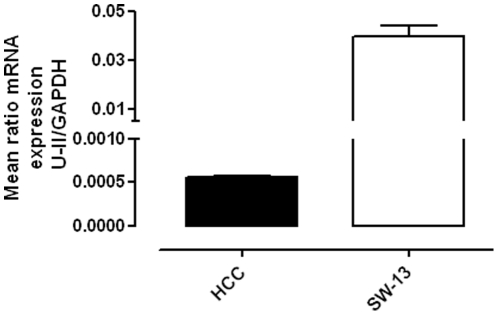
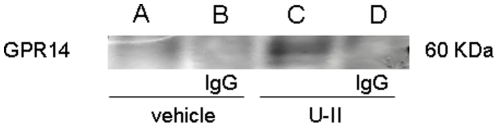
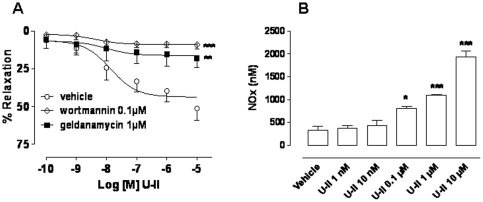
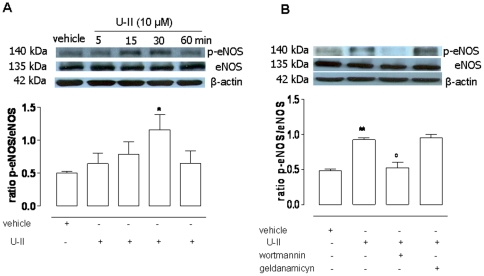
METHODOLOGY/PRINCIPAL FINDINGS: Human corpus cavernosum tissue was obtained following in male-to-female transsexuals undergoing surgical procedure for sex reassignment. Quantitative RT-PCR clearly demonstrated the U-II expression in human corpus cavernosum. U-II (0.1 nM-10 µM) challenge in human corpus cavernosum induced a significant increase in NO production as revealed by fluorometric analysis. NO generation was coupled to a marked increase in the ratio eNOS phosphorilated/eNOS as determined by western blot analysis. A functional study in human corpus cavernosum strips was performed to asses eNOS involvement in U-II-induced relaxation by using a pharmacological modulation. Pre-treatment with both wortmannin or geldanamycinin (inhibitors of eNOS phosphorylation and heath shock protein 90 recruitment, respectively) significantly reduced U-II-induced relaxation (0.1 nM-10 µM) in human corpus cavernosum strips. Finally, a co-immunoprecipitation study demonstrated that UT receptor and eNOS co-immunoprecipitate following U-II challenge of human corpus cavernosum tissue.
CONCLUSION/SIGNIFICANCE: U-II is endogenously synthesized and locally released in human corpus cavernosum. U-II elicited penile erection through eNOS activation. Thus, U-II/UT pathway may represent a novel therapeutical target in erectile dysfunction.
尿鸟素 II(U-II)是一种环状肽,最初从硬骨鱼的神经分泌系统中分离出来,随后在其他物种中发现,包括人类。U-II 被鉴定为 G 蛋白偶联受体,即 UT 受体的天然配体。U-II 和 UT 受体在各种外周器官中表达,特别是在心血管组织中。最近的证据表明 U-II/UT 途径参与了人类阴茎的功能,但分子机制尚不清楚。基于这些基础,本研究旨在探讨 U-II 诱导人海绵体松弛的机制及其与 L-精氨酸/一氧化氮(NO)途径的关系。
方法/主要发现:本研究从接受性别重置手术的男变女跨性别者中获得人海绵体组织。定量 RT-PCR 清楚地证明了 U-II 在人海绵体中的表达。U-II(0.1 nM-10 µM)刺激人海绵体可显著增加荧光分析显示的 NO 生成。通过 Western blot 分析确定,NO 生成与 eNOS 磷酸化/eNOS 的比值明显增加相关。在人海绵体条中进行了一项功能研究,通过药理学调节评估 eNOS 在 U-II 诱导松弛中的作用。预先用wortmannin 或geldanamycin(分别为 eNOS 磷酸化和热休克蛋白 90 募集的抑制剂)处理,可显著降低 U-II 诱导的人海绵体条松弛(0.1 nM-10 µM)。最后,共免疫沉淀研究表明,U-II 刺激人海绵体组织后,UT 受体和 eNOS 共免疫沉淀。
结论/意义:U-II 在人海绵体中内源性合成并局部释放。U-II 通过激活 eNOS 引起阴茎勃起。因此,U-II/UT 途径可能成为勃起功能障碍的新治疗靶点。