Cardiovascular Center, Department of Cardiology, Charles University and University Hospital Motol, Prague, Czech Republic.
Arch Med Sci. 2011 Dec 31;7(6):977-83. doi: 10.5114/aoms.2011.26609. Epub 2011 Dec 30.
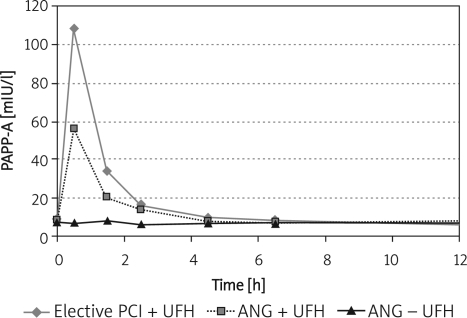
The time course of pregnancy-associated plasma protein-A (PAPP-A) levels was studied at admission, immediately after percutaneous coronary intervention (PCI) and 1, 2, 4, 6, 12, 24 and 48 h after PCI in acute coronary syndrome with ST segment elevation (ACS-STE) to determine the impact of PCI, concomitant clinical complications and heparin administration.
Pregnancy-associated plasma protein-A serum levels, examined by the Kryptor(TM) system, were studied in 30 heparinized PCI ACS-STE patients, in 10 elective PCIs and 12 coronary angiographies with heparin, and in 5 patients with normal coronary angiogram without heparin.
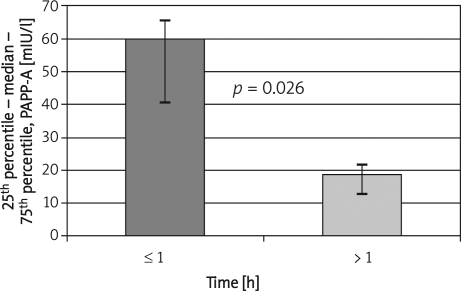
Heparin caused a high PAPP-A increase in ACS-STE patients, in all patients with heparin without ACS and angiographic signs of significant atherosclerosis. This increase was directly associated with heparin dosage and activated clotting time (ACT) (r = 0.71, p = 0.0001) and inversely with the interval between heparin applications and time of serum sampling. It was followed by a rapid decrease within 1 to 2 h and return to normal levels in 10 to 12 h. In ACS-STE patients the decrease was significantly slower than in heparinized elective PCI and angiography patients. The PAPP-A increase was not significantly dependent on the length of PCI. Persistent increase after 24 h was associated in 4/7 patients with concomitant clinical complications.
The diagnostic validity of PAPP-A can be verified only within the 1(st) h after clinical onset of ACS before heparin administration, the prognostic value in heparinized patients not earlier than 12 h after the last heparin application, if ACT is normal and serious clinical concomitant complications are eliminated.
本研究旨在探讨急性冠状动脉综合征伴 ST 段抬高(ACS-STE)患者在入院时、经皮冠状动脉介入治疗(PCI)后即刻,以及 PCI 后 1、2、4、6、12、24 和 48 小时,妊娠相关血浆蛋白 A(PAPP-A)水平的时间变化,并分析 PCI、合并临床并发症和肝素治疗对其的影响。
使用 Kryptor(TM)系统检测 30 例肝素化 PCI 治疗的 ACS-STE 患者、10 例择期 PCI 患者和 12 例肝素化冠状动脉造影患者,以及 5 例无肝素冠状动脉造影正常的患者的血清 PAPP-A 水平。
肝素可引起 ACS-STE 患者、所有无 ACS 且无明显动脉粥样硬化征象的肝素应用患者的 PAPP-A 水平显著升高。这种升高与肝素剂量和活化凝血时间(ACT)直接相关(r = 0.71,p = 0.0001),与肝素应用间隔和采血时间呈反比。肝素治疗后 1 至 2 小时内迅速下降,10 至 12 小时内恢复正常水平。ACS-STE 患者的下降速度明显慢于肝素化择期 PCI 和冠状动脉造影患者。PAPP-A 升高与 PCI 时间长短无显著相关性。4/7 例患者在 24 小时后持续升高,与合并临床并发症相关。
只有在 ACS 临床发病后 1 小时内、且在给予肝素前,PAPP-A 的诊断有效性才能得到验证。在 ACT 正常且排除严重临床合并症的情况下,肝素化患者的预后价值最早可在最后一次肝素应用后 12 小时进行评估。