Institut National de la Santé et de la Recherche Médicale (INSERM) U-892, Nantes, 44035, France.
EJNMMI Res. 2012 Feb 13;2:7. doi: 10.1186/2191-219X-2-7.
Noninvasive multimodality imaging is essential for preclinical evaluation of the biodistribution and pharmacokinetics of radionuclide therapy and for monitoring tumor response. Imaging with nonstandard positron-emission tomography [PET] isotopes such as 124I is promising in that context but requires accurate activity quantification. The decay scheme of 124I implies an optimization of both acquisition settings and correction processing. The PET scanner investigated in this study was the Inveon PET/CT system dedicated to small animal imaging.
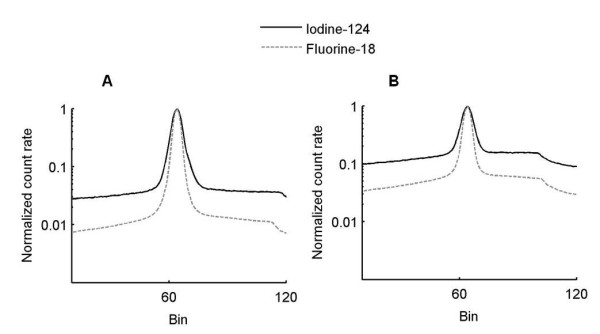
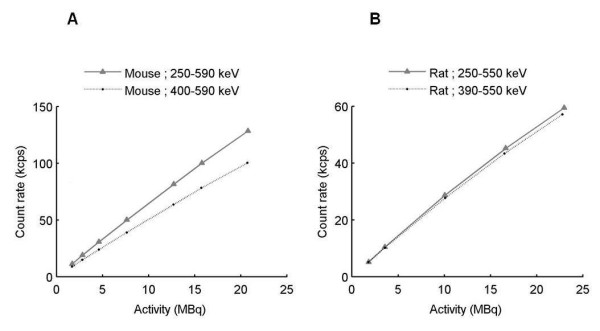
The noise equivalent count rate [NECR], the scatter fraction [SF], and the gamma-prompt fraction [GF] were used to determine the best acquisition parameters for mouse- and rat-sized phantoms filled with 124I. An image-quality phantom as specified by the National Electrical Manufacturers Association NU 4-2008 protocol was acquired and reconstructed with two-dimensional filtered back projection, 2D ordered-subset expectation maximization [2DOSEM], and 3DOSEM with maximum a posteriori [3DOSEM/MAP] algorithms, with and without attenuation correction, scatter correction, and gamma-prompt correction (weighted uniform distribution subtraction).
Optimal energy windows were established for the rat phantom (390 to 550 keV) and the mouse phantom (400 to 590 keV) by combining the NECR, SF, and GF results. The coincidence time window had no significant impact regarding the NECR curve variation. Activity concentration of 124I measured in the uniform region of an image-quality phantom was underestimated by 9.9% for the 3DOSEM/MAP algorithm with attenuation and scatter corrections, and by 23% with the gamma-prompt correction. Attenuation, scatter, and gamma-prompt corrections decreased the residual signal in the cold insert.
The optimal energy windows were chosen with the NECR, SF, and GF evaluation. Nevertheless, an image quality and an activity quantification assessment were required to establish the most suitable reconstruction algorithm and corrections for 124I small animal imaging.
非侵入性多模态成像对于放射性核素治疗的生物分布和药代动力学的临床前评估以及监测肿瘤反应至关重要。在这种情况下,使用非标准正电子发射断层扫描[PET]同位素(如 124I)进行成像很有前途,但需要准确的活性定量。124I 的衰变方案意味着需要优化采集设置和校正处理。本研究中使用的 PET 扫描仪是专门用于小动物成像的 Inveon PET/CT 系统。
使用噪声等效计数率[NECR]、散射分数[SF]和伽马提示分数[GF]来确定充满 124I 的小鼠和大鼠大小的体模的最佳采集参数。根据美国国家电器制造商协会 NU 4-2008 协议获取图像质量体模,并使用二维滤波后投影、二维有序子集期望最大化[2DOSEM]和具有最大后验[3DOSEM/MAP]算法进行重建,包括衰减校正、散射校正和伽马提示校正(加权均匀分布扣除)。
通过结合 NECR、SF 和 GF 结果,为大鼠体模(390 至 550 keV)和小鼠体模(400 至 590 keV)建立了最佳的能量窗口。符合时间窗口对 NECR 曲线变化没有显著影响。使用衰减和散射校正的 3DOSEM/MAP 算法,图像质量体模均匀区域的 124I 活性浓度测量值低估了 9.9%,而使用伽马提示校正则低估了 23%。衰减、散射和伽马提示校正减少了冷插入中的残留信号。
选择了最佳的能量窗口,通过 NECR、SF 和 GF 评估。然而,为了确定最适合的重建算法和 124I 小动物成像的校正,还需要进行图像质量和活性定量评估。