Department of Cellular and Molecular Physiology, Physiological Laboratory, Institute of Translational Medicine, University of Liverpool, Crown St, Liverpool L69 3BX, UK.
BMC Genomics. 2012 Feb 14;13:71. doi: 10.1186/1471-2164-13-71.
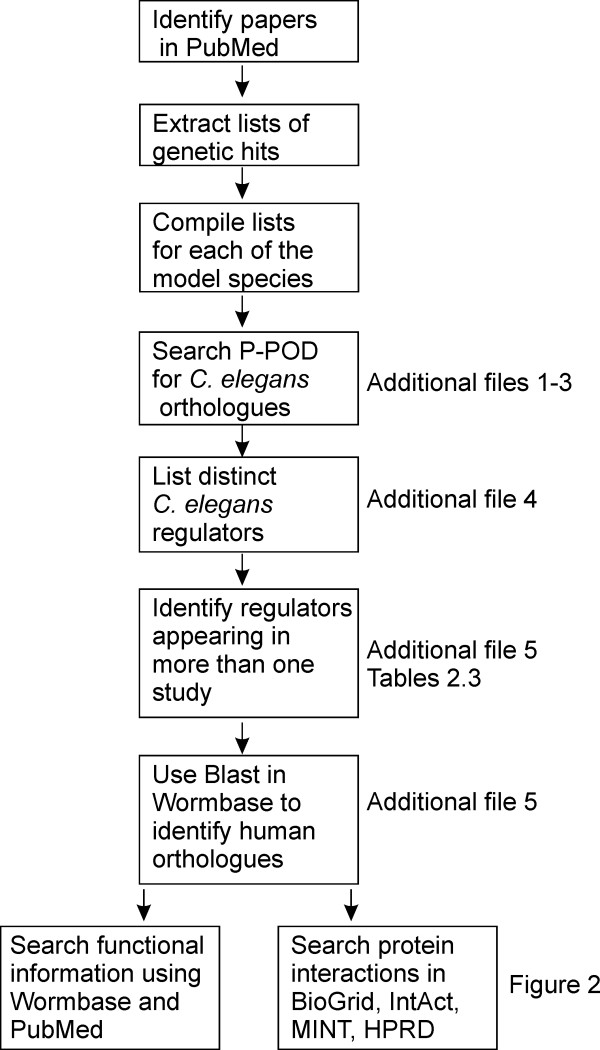
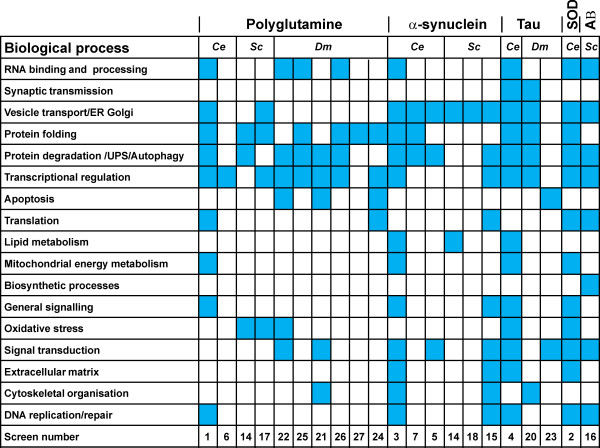
An array of experimental models have been developed in the small model organisms C. elegans, S. cerevisiae and D. melanogaster for the study of various neurodegenerative diseases including Alzheimer's disease, Parkinson's disease, and expanded polyglutamine diseases as exemplified by Huntington's disease (HD) and related ataxias. Genetic approaches to determine the nature of regulators of the disease phenotypes have ranged from small scale to essentially whole genome screens. The published data covers distinct models in all three organisms and one important question is the extent to which shared genetic factors can be uncovered that affect several or all disease models. Surprisingly it has appeared that there may be relatively little overlap and that many of the regulators may be organism or disease-specific. There is, however, a need for a fully integrated analysis of the available genetic data based on careful comparison of orthologues across the species to determine the real extent of overlap.
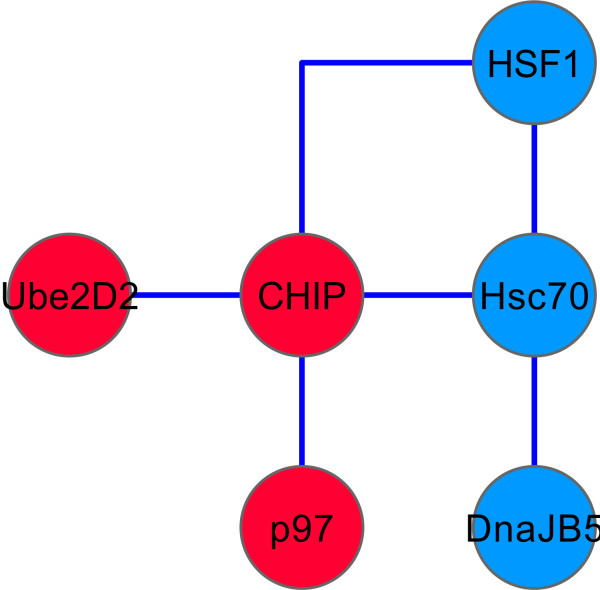
We carried out an integrated analysis using C. elegans as the baseline model organism since this is the most widely studied in this context. Combination of data from 28 published studies using small to large scale screens in all three small model organisms gave a total of 950 identifications of genetic regulators. Of these 624 were separate genes with orthologues in C. elegans. In addition, 34 of these genes, which all had human orthologues, were found to overlap across studies. Of the common genetic regulators some such as chaperones, ubiquitin-related enzymes (including the E3 ligase CHIP which directly links the two pathways) and histone deacetylases were involved in expected pathways whereas others such as the peroxisomal acyl CoA-oxidase suggest novel targets for neurodegenerative disease therapy
We identified a significant number of overlapping regulators of neurodegenerative disease models. Since the diseases have, as an underlying feature, protein aggregation phenotypes it was not surprising that some of the overlapping genes encode proteins involved in protein folding and protein degradation. Interestingly, however, some of the overlapping genes encode proteins that have not previously featured in targeted studies of neurodegeneration and this information will form a useful resource to be exploited in further studies of potential drug-targets.
在秀丽隐杆线虫、酿酒酵母和黑腹果蝇等小模式生物中,已经开发出了一系列实验模型,用于研究各种神经退行性疾病,包括阿尔茨海默病、帕金森病和扩展多聚谷氨酰胺疾病,如亨廷顿病(HD)和相关共济失调。确定疾病表型调节剂性质的遗传方法从小规模到基本上全基因组筛选不等。已发表的数据涵盖了这三种生物中的不同模型,一个重要问题是,能够发现多少影响几种或所有疾病模型的共同遗传因素。令人惊讶的是,似乎重叠程度相对较低,许多调节剂可能是特定于生物体或疾病的。然而,需要基于仔细比较物种间的同源物,对现有遗传数据进行全面综合分析,以确定真正的重叠程度。
我们使用秀丽隐杆线虫作为基线模式生物进行了综合分析,因为这是在这种情况下研究最广泛的模式生物。将来自 28 项已发表研究的数据结合起来,这些研究使用了三种小模式生物中的小规模到大规模筛选,总共鉴定出了 950 种遗传调节剂。其中 624 个是与秀丽隐杆线虫有同源物的独立基因。此外,在这些基因中有 34 个,它们都有人类同源物,在研究中存在重叠。在共同的遗传调节剂中,一些调节剂,如伴侣蛋白、泛素相关酶(包括直接将两条通路连接起来的 E3 连接酶 CHIP)和组蛋白去乙酰化酶,参与了预期的通路,而其他调节剂,如过氧化物酶体酰基辅酶 A 氧化酶,则为神经退行性疾病治疗提供了新的靶点。
我们鉴定出了大量神经退行性疾病模型的重叠调节剂。由于这些疾病具有蛋白质聚集表型的特征,因此一些重叠基因编码参与蛋白质折叠和蛋白质降解的蛋白质并不奇怪。然而,有趣的是,一些重叠基因编码的蛋白质以前没有在神经退行性变的靶向研究中出现,这些信息将成为进一步研究潜在药物靶点的有用资源。