Zeng Xiaomei, Li Zhixi, Hou Mei
Cancer Center, West China Hospital, Sichuan University, Chengdu 610041, China.
Zhongguo Fei Ai Za Zhi. 2012 Feb;15(2):84-9. doi: 10.3779/j.issn.1009-3419.2012.02.04.
The third generation single-agent drug has been recommended as a first-line chemotherapy for elderly patients with advanced non-small cell lung cancer (NSCLC). The aim of the current radomized trial is to compare the clinical efficacy and toxicities of single-agent paclitaxel liposome versus paclitaxel liposome plus oxaliplatin as a first-line chemotherapy for elderly patients.
Sixty-nine advanced NSCLC patients from July 2008 to August 2010, confirmed with pathology or cytology and had never received treatment, were randomly divided into two groups. The first group was given 135 mg/m² of single-agent paclitaxel liposome on day 1 of each cycle. The second group was given 135 mg/m² paclitaxel liposome plus 125 mg/m² oxaliplatin on day 1 of each cycle. One cycle is composed of 21 days. Efficacy and toxicities could be evaluated after two or more cycles.
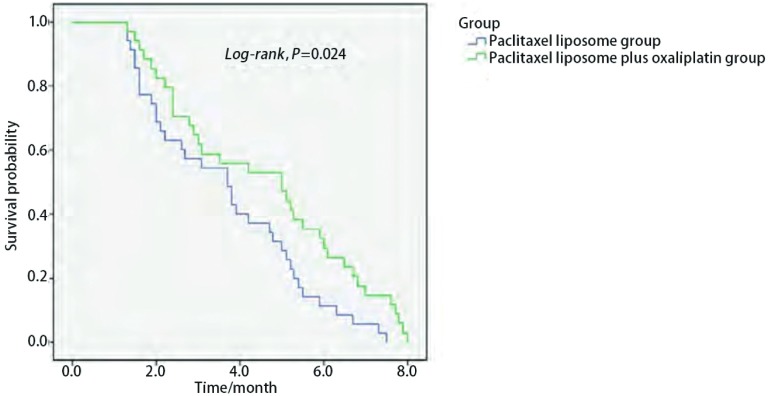
No statistical differences were observed between the two groups in terms of efficacy (22.9% vs 35.3%, P=0.297), disease control rate (60.0% vs 70.6%, P=0.450), and 1-year survival rate (28.6% vs 41.2%, P=0.724). However, the group treated with paclitaxel liposome plus oxaliplatin had longer progression free survival (PFS) (5.0 months vs 3.5 months, P=0.024). In addition, the toxicities that occurred in the two groups were similar including leukocytopenia (P=0.808), thrombocytopenia (P>0.999), anemia (P=0.477), and nausea/vomiting (P=0.777). The number of neurotoxicity that occurred in the two groups were 33 and 3 (97.1% vs 8.6%, P<0.001), respectively. However, all were grade I-II.
The clinical efficacy of paclitaxel liposome plus oxaliplatin as a first-line chemotherapy for elderly patients with advanced NSCLC is more better than that of the single-agent paclitaxel liposome. It prolongs PFS and is safe for clinical use.
第三代单药已被推荐作为老年晚期非小细胞肺癌(NSCLC)患者的一线化疗药物。本随机试验的目的是比较单药紫杉醇脂质体与紫杉醇脂质体联合奥沙利铂作为老年患者一线化疗的临床疗效和毒性。
选取2008年7月至2010年8月确诊为病理或细胞学检查且未接受过治疗的69例晚期NSCLC患者,随机分为两组。第一组在每个周期的第1天给予135mg/m²单药紫杉醇脂质体。第二组在每个周期的第1天给予135mg/m²紫杉醇脂质体加125mg/m²奥沙利铂。一个周期为21天。两个或更多周期后可评估疗效和毒性。
两组在疗效(22.9%对35.3%,P = 0.297)、疾病控制率(60.0%对70.6%,P = 0.450)和1年生存率(28.6%对41.2%,P = 0.724)方面未观察到统计学差异。然而,紫杉醇脂质体联合奥沙利铂治疗组的无进展生存期(PFS)更长(5.0个月对3.5个月,P = 0.024)。此外,两组发生的毒性相似,包括白细胞减少(P = 0.808)、血小板减少(P>0.999)、贫血(P = 0.477)和恶心/呕吐(P = 0.777)。两组发生神经毒性的例数分别为33例和3例(97.1%对8.6%,P<0.001)。然而,均为Ⅰ-Ⅱ级。
紫杉醇脂质体联合奥沙利铂作为老年晚期NSCLC患者的一线化疗,其临床疗效优于单药紫杉醇脂质体。它延长了PFS,临床使用安全。