Health Impact Assessment Division, Department of Health, Ministry of Public Health, Nonthaburi, Thailand.
J Epidemiol. 2012;22(3):251-60. doi: 10.2188/jea.je20110082. Epub 2012 Feb 18.
We examined the relationship between self-reported occupational heat stress and incidence of self-reported doctor-diagnosed kidney disease in Thai workers.
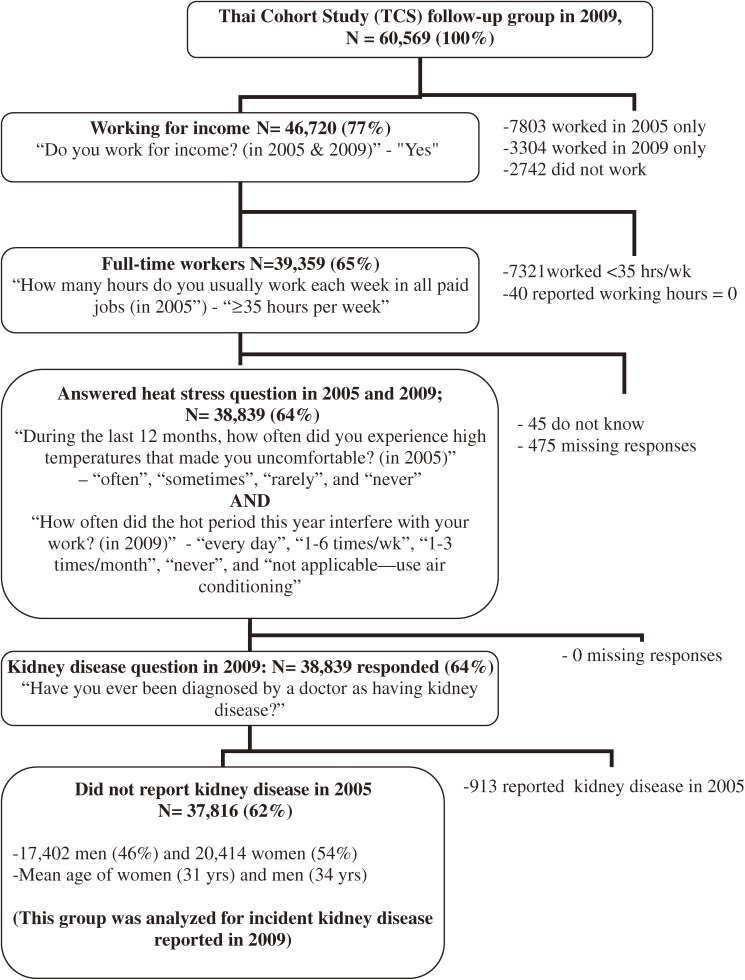
Data were derived from baseline (2005) and follow-up (2009) self-report questionnaires from a large national Thai Cohort Study (TCS). Analysis was restricted to full-time workers (n = 17 402 men and 20 414 women) without known kidney disease at baseline. We used logistic regression models to examine the association of incident kidney disease with heat stress at work, after adjustment for smoking, alcohol drinking, body mass index, and a large number of socioeconomic and demographic characteristics.
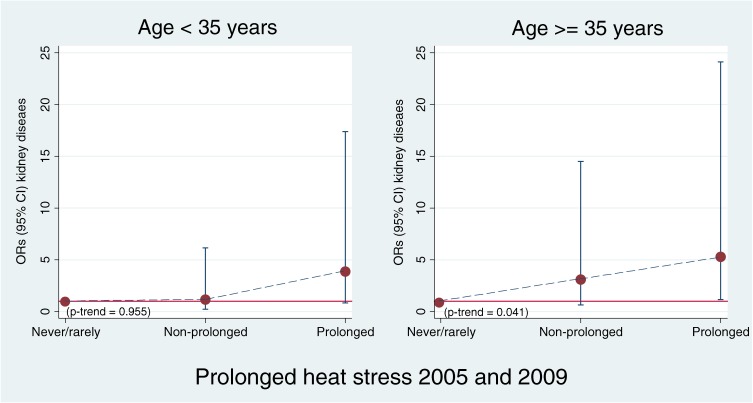
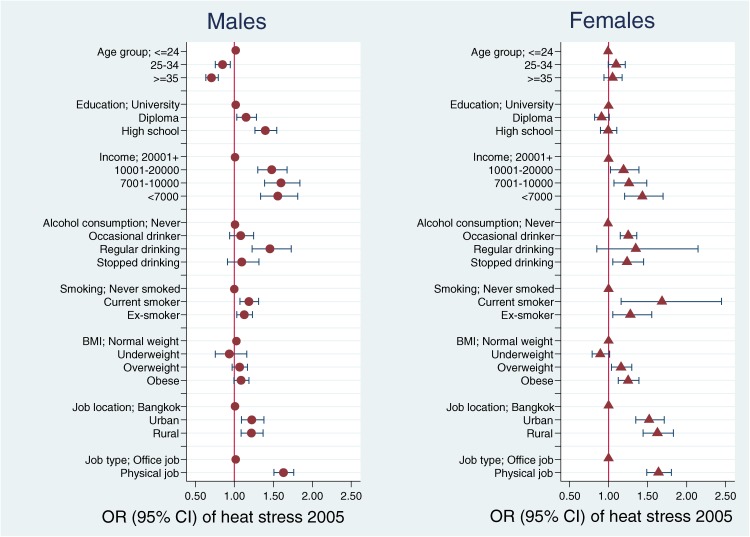
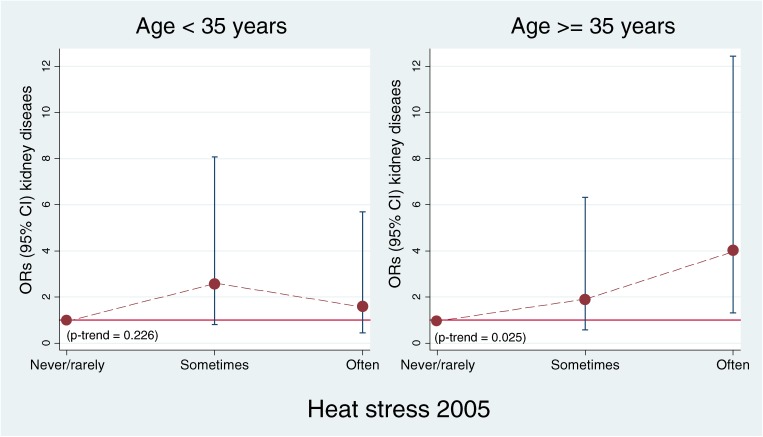
Exposure to heat stress was more common in men than in women (22% vs 15%). A significant association between heat stress and incident kidney disease was observed in men (adjusted odds ratio [OR] = 1.48, 95% CI: 1.01-2.16). The risk of kidney disease was higher among workers reporting workplace heat stress in both 2005 and 2009. Among men exposed to prolonged heat stress, the odds of developing kidney disease was 2.22 times that of men without such exposure (95% CI 1.48-3.35, P-trend <0.001). The incidence of kidney disease was even higher among men aged 35 years or older in a physical job: 2.2% exposed to prolonged heat stress developed kidney disease compared with 0.4% with no heat exposure (adjusted OR = 5.30, 95% CI 1.17-24.13).
There is an association between self-reported occupational heat stress and self-reported doctor-diagnosed kidney disease in Thailand. The results indicate a need for occupational health interventions for heat stress among workers in tropical climates.
我们研究了泰国工人自我报告的职业热应激与自我报告的医生诊断的肾脏疾病发病率之间的关系。
数据来自泰国大型全国队列研究(TCS)的基线(2005 年)和随访(2009 年)的自我报告问卷。分析仅限于无基线已知肾脏疾病的全职工人(男性 17402 人,女性 20414 人)。我们使用逻辑回归模型,在校正吸烟、饮酒、体重指数和大量社会经济和人口统计学特征后,研究了工作中热应激与新发肾脏疾病的关联。
男性比女性更常暴露于热应激(22%比 15%)。男性中观察到热应激与新发肾脏疾病之间存在显著关联(调整后的优势比 [OR] = 1.48,95%置信区间:1.01-2.16)。报告工作场所热应激的工人在 2005 年和 2009 年均存在更高的肾脏疾病风险。在暴露于长期热应激的男性中,发生肾脏疾病的几率是未暴露于此类应激的男性的 2.22 倍(95%置信区间 1.48-3.35,P 趋势 <0.001)。在从事体力劳动的 35 岁及以上男性中,肾脏疾病的发病率甚至更高:暴露于长期热应激的 2.2%男性发生肾脏疾病,而无热暴露的 0.4%男性则未发生(调整后的 OR = 5.30,95%置信区间 1.17-24.13)。
在泰国,自我报告的职业热应激与自我报告的医生诊断的肾脏疾病之间存在关联。结果表明,在热带气候下,需要对工人的热应激进行职业健康干预。