Janssen Pharmaceutical Companies of Johnson & Johnson, San Diego, California, United States of America.
PLoS One. 2012;7(2):e30792. doi: 10.1371/journal.pone.0030792. Epub 2012 Feb 7.
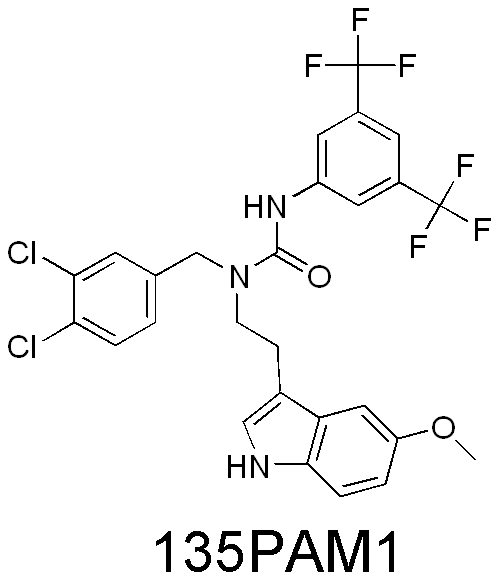
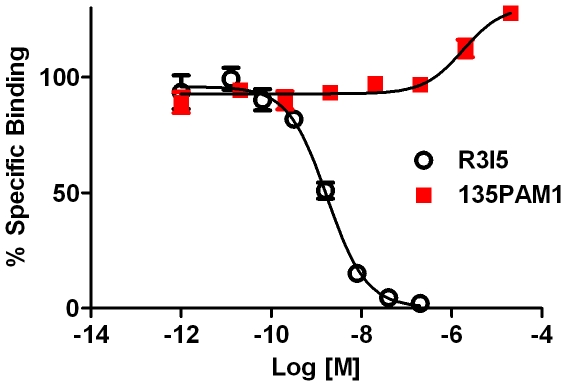
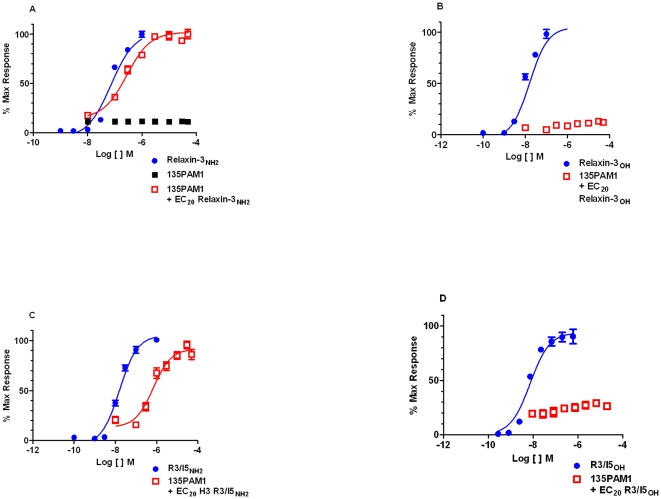
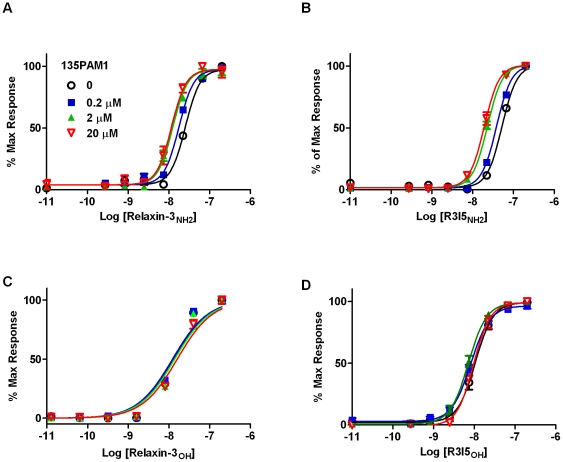
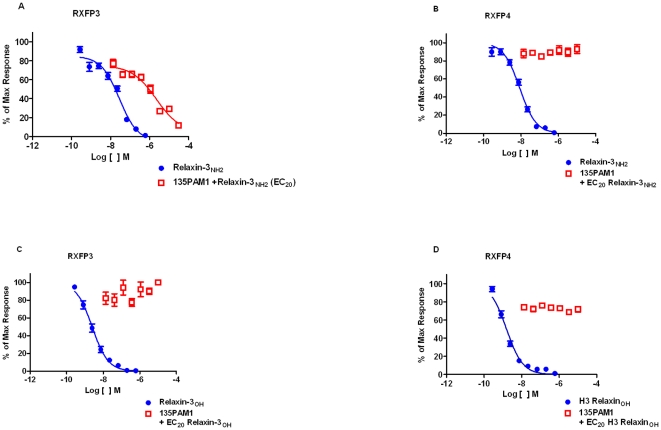
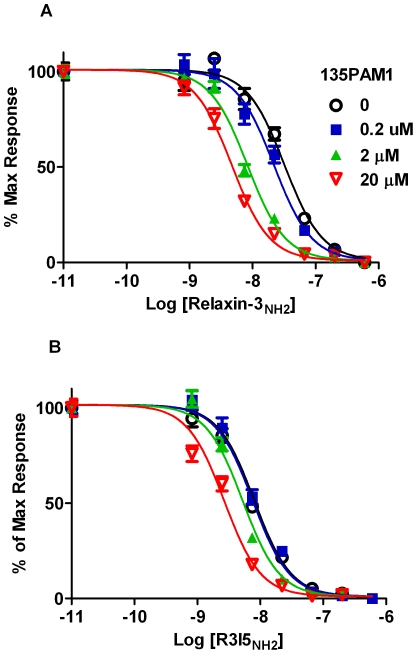
Recent findings suggest that the relaxin-3 neural network may represent a new ascending arousal pathway able to modulate a range of neural circuits including those affecting circadian rhythm and sleep/wake states, spatial and emotional memory, motivation and reward, the response to stress, and feeding and metabolism. Therefore, the relaxin-3 receptor (RXFP3) is a potential therapeutic target for the treatment of various CNS diseases. Here we describe a novel selective RXFP3 receptor positive allosteric modulator (PAM), 3-[3,5-Bis(trifluoromethyl)phenyl]-1-(3,4-dichlorobenzyl)-1-[2-(5-methoxy-1H-indol-3-yl)ethyl]urea (135PAM1). Calcium mobilization and cAMP accumulation assays in cell lines expressing the cloned human RXFP3 receptor show the compound does not directly activate RXFP3 receptor but increases functional responses to amidated relaxin-3 or R3/I5, a chimera of the INSL5 A chain and the Relaxin-3 B chain. 135PAM1 increases calcium mobilization in the presence of relaxin-3(NH2) and R3/I5(NH2) with pEC50 values of 6.54 (6.46 to 6.64) and 6.07 (5.94 to 6.20), respectively. In the cAMP accumulation assay, 135PAM1 inhibits the CRE response to forskolin with a pIC50 of 6.12 (5.98 to 6.27) in the presence of a probe (10 nM) concentration of relaxin-3(NH2). 135PAM1 does not compete for binding with the orthosteric radioligand, [(125)I] R3I5 (amide), in membranes prepared from cells expressing the cloned human RXFP3 receptor. 135PAM1 is selective for RXFP3 over RXFP4, which also responds to relaxin-3. However, when using the free acid (native) form of relaxin-3 or R3/I5, 135PAM1 doesn't activate RXFP3 indicating that the compound's effect is probe dependent. Thus one can exchange the entire A-chain of the probe peptide while retaining PAM activity, but the state of the probe's c-terminus is crucial to allosteric activity of the PAM. These data demonstrate the existence of an allosteric site for modulation of this GPCR as well as the subtlety of changes in probe molecules that can affect allosteric modulation of RXFP3.
最近的研究结果表明,松弛素-3 神经网络可能代表一种新的上行唤醒途径,能够调节包括影响昼夜节律和睡眠/觉醒状态、空间和情绪记忆、动机和奖励、应激反应以及进食和代谢的一系列神经回路。因此,松弛素-3 受体(RXFP3)是治疗各种中枢神经系统疾病的潜在治疗靶点。在这里,我们描述了一种新型选择性 RXFP3 受体正变构调节剂(PAM),3-[3,5-双(三氟甲基)苯基]-1-(3,4-二氯苄基)-1-[2-(5-甲氧基-1H-吲哚-3-基)乙基]脲(135PAM1)。在表达克隆人 RXFP3 受体的细胞系中进行钙动员和 cAMP 积累测定表明,该化合物不会直接激活 RXFP3 受体,但可增加酰胺化松弛素-3 或 R3/I5(INSL5 A 链和松弛素-3 B 链的嵌合体)对功能的反应。135PAM1 在存在松弛素-3(NH2)和 R3/I5(NH2)时增加钙动员,pEC50 值分别为 6.54(6.46 至 6.64)和 6.07(5.94 至 6.20)。在 cAMP 积累测定中,135PAM1 在存在探针(10 nM)浓度的松弛素-3(NH2)时,用 forskolin 抑制 CRE 反应,pIC50 为 6.12(5.98 至 6.27)。135PAM1 与在表达克隆人 RXFP3 受体的细胞中制备的膜中的正位放射性配体 [(125)I] R3I5(酰胺)不竞争结合。135PAM1 对 RXFP3 具有选择性,RXFP4 也对松弛素-3 有反应。然而,当使用松弛素-3 或 R3/I5 的游离酸(天然)形式时,135PAM1 不会激活 RXFP3,这表明化合物的作用取决于探针。因此,人们可以在保留 PAM 活性的同时交换探针肽的整个 A 链,但探针 C 末端的状态对 PAM 的变构活性至关重要。这些数据表明,存在一种变构位点来调节这种 GPCR,以及探针分子的细微变化会影响 RXFP3 的变构调节。