Dilmaghani M, Ahmadi M, Zahraei Salehi T, Talebi A, Darvishzadeh R
Department of Microbiology, Faculty of Veterinary Medicine, University of Urmia,Urmia, Iran.
Iran J Microbiol. 2010 Dec;2(4):178-84.
Economic constraint of diseases arising from Salmonella Typhimurium causes the study of this zoonotic organism more important. Most studies on identification and characterization of S. Typhimurium are conducted at DNA level. Flagellin genes (fliC and fljB genes encoding phase-1 and phase-2 flagella, respectively) are useful as a model system for studying genetic differentiation. The objectives of the present study were to identify the polymorphism of fljB among avians in different regions by the PCR-RFLP method.
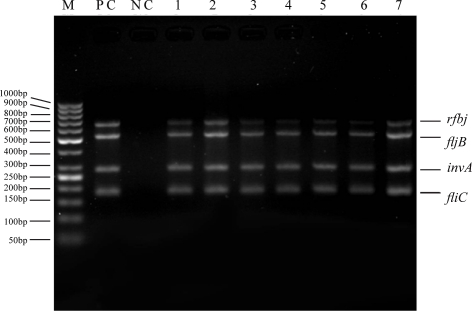
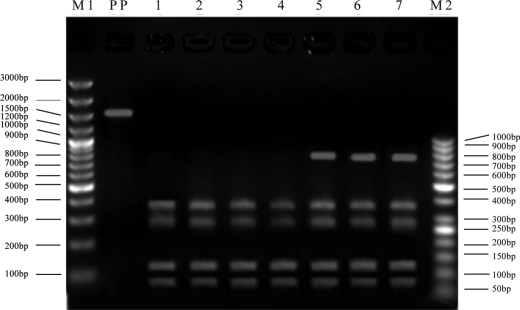
Fifty-two S. Typhimurium isolates out of 1,870 intestine samples were identified using culture and serotyping as well as multiplex-PCR (broiler (n=13), layer (n=12), duck (n=5), goose (n=5), sparrow (n=8), canary (n=3), pigeon (n=5) and casco parrot (n=1)). Amplification of fljB gene was performed and amplified products subjected to restriction digestion with Hha I enzyme.
Two RFLP patterns generated DNA fragments between approximately 50 to 800 bps. Pattern A was observed in 33 (63.46%) and pattern B in 19 (36.54%) of isolates. Salmonella Typhimurium recovered from 13 broilers (ten with pattern A and 3 with pattern B) and 8 sparrow (three with pattern A and 5 with pattern B) showed both A and B patterns. Twelve layers, 5 pigeons and 3 canaries showed pattern A and 5 ducks, 5 geese and one casco parrot showed pattern B. None of these patterns was allotted for a special region.
The results of the present study showed that fljB gene is highly conserved among avians in different geographical regions, suggesting not only the importance of fljB gene in survival of organism in different environmental conditions but also the relation between proteins encoded by fljB gene and serotyping scheme.
鼠伤寒沙门氏菌引发疾病所带来的经济制约使得对这种人畜共患病原体的研究愈发重要。大多数关于鼠伤寒沙门氏菌鉴定与特征分析的研究是在DNA水平上进行的。鞭毛蛋白基因(分别编码1期和2期鞭毛的fliC和fljB基因)作为研究遗传分化的模型系统很有用。本研究的目的是通过PCR-RFLP方法鉴定不同地区禽类中fljB基因的多态性。
从1870份肠道样本中,通过培养、血清分型以及多重PCR鉴定出52株鼠伤寒沙门氏菌分离株(肉鸡13株、蛋鸡12株、鸭5株、鹅5株、麻雀8株、金丝雀3株、鸽子5株和凤头鹦鹉1株)。对fljB基因进行扩增,并将扩增产物用Hha I酶进行限制性消化。
两种RFLP模式产生了约50至800 bp的DNA片段。在33株(63.46%)分离株中观察到模式A,在19株(36.54%)分离株中观察到模式B。从13只肉鸡(10只具有模式A,3只具有模式B)和8只麻雀(3只具有模式A,5只具有模式B)中分离出的鼠伤寒沙门氏菌同时呈现A和B两种模式。12只蛋鸡、5只鸽子和3只金丝雀呈现模式A,5只鸭、5只鹅和1只凤头鹦鹉呈现模式B。这些模式均未特定分配给某一地区。
本研究结果表明,fljB基因在不同地理区域的禽类中高度保守,这不仅表明fljB基因在生物体于不同环境条件下生存中的重要性,还表明fljB基因编码的蛋白质与血清分型方案之间的关系。