Druz Regina S, Phillips Lawrence M, Sharifova Gulru
Department of Cardiology, North Shore University Hospital, Manhasset, New York, NY 11030-3816, USA.
ISRN Cardiol. 2011;2011:798318. doi: 10.5402/2011/798318. Epub 2011 Jun 2.
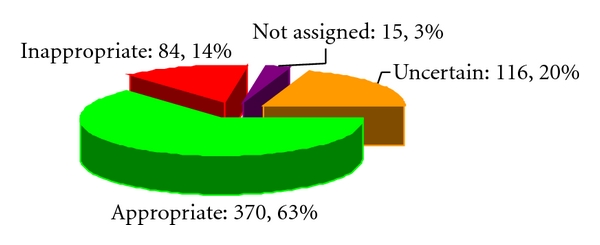
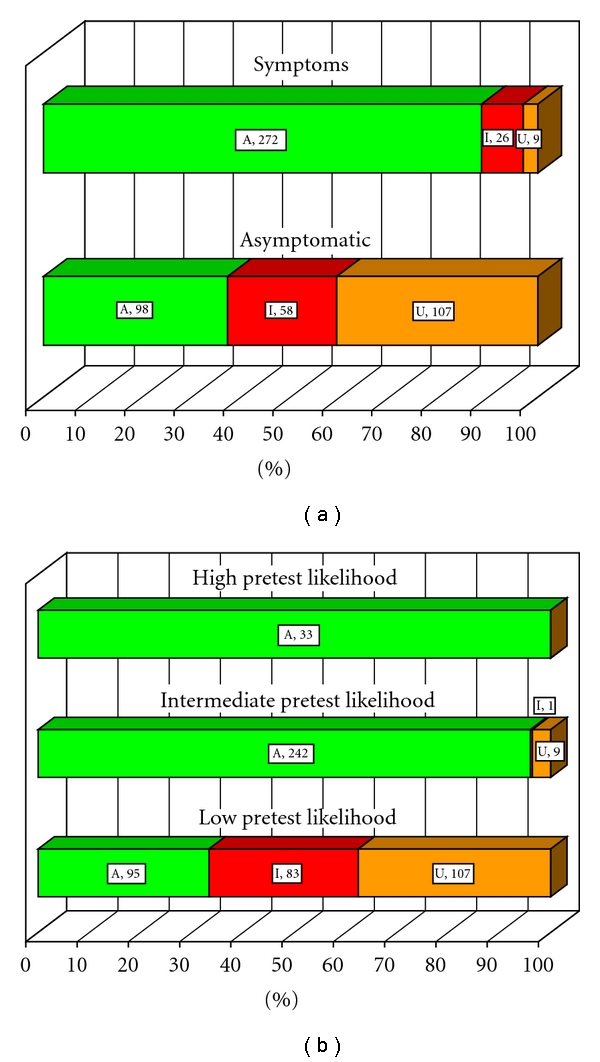
Objectives. Determine outcome of the 2005 appropriateness use criteria (AUC) for SPECT in a diverse population of patients and physicians. Background. AUC for SPECT were the first cardiology document to identify 52 clinical indications for imaging, 49 of them for stress SPECT. AUC have been proposed as cornerstone of responsible use of perfusion imaging. Methods. 585 consecutive patients undergoing SPECT were evaluated prospectively. Appropriateness was examined for demographic variables, clinical variables, and for physician and patient subgroups. Combined end-point of total mortality, cardiac revascularization, and cardiac admissions at 1 year post SPECT was evaluated. Results. SPECT indications were: appropriate, 63%; uncertain, 20%; inappropriate, 14%; not assigned, 3%. Most appropriate SPECT were observed in patients with known coronary disease (72%), chest pain syndrome (89%), high pre-test likelihood of disease (100%), men (70%), inpatients (72%), and cardiovascular physicians' referrals (69%). End-point was reached in 53 patients (97.4% follow up). Unadjusted event rates were: appropriate (12%), uncertain (7.1%), inappropriate (2.4%) SPECT (P = .01). Conclusion. Appropriateness of SPECT differs in subgroups of patients and physicians. Clinically significant outcomes occur more frequently in the appropriate stress SPECT group. Focused efforts are need for outpatients, asymptomatic patients, women, and non-cardiovascular physicians.
目的。确定2005年单光子发射计算机断层显像(SPECT)适宜性使用标准(AUC)在不同患者和医生群体中的结果。背景。SPECT的AUC是第一份确定52种影像学临床适应证的心脏病学文件,其中49种用于负荷SPECT。AUC已被提议作为合理使用灌注成像的基石。方法。对585例连续接受SPECT检查的患者进行前瞻性评估。对人口统计学变量、临床变量以及医生和患者亚组的适宜性进行了检查。评估了SPECT后检查后1年的总死亡率、心脏血运重建和心脏住院的综合终点。结果。SPECT适应证为:适宜,63%;不确定,20%;不适宜,14%;未分配,3%。已知冠心病患者(72%)、胸痛综合征患者(89%)、疾病预测试验可能性高的患者(100%)、男性患者(70%)、住院患者(72%)以及心血管科医生转诊的患者(69%)中观察到的SPECT最适宜。53例患者(随访率97.4%)达到终点。未经调整的事件发生率为:适宜的SPECT(12%)、不确定的SPECT(7.1%)、不适宜的SPECT(2.4%)(P = 0.01)。结论。SPECT的适宜性在患者和医生亚组中存在差异。在适宜的负荷SPECT组中,具有临床意义的结果更频繁地出现。需要针对门诊患者、无症状患者、女性患者和非心血管科医生进行有针对性的努力。