State Key Laboratory of Forest and Soil Ecology, Institute of Applied Ecology, Chinese Academy of Sciences, Shenyang, Liaoning Province, People's Republic of China.
PLoS One. 2012;7(2):e29469. doi: 10.1371/journal.pone.0029469. Epub 2012 Feb 13.
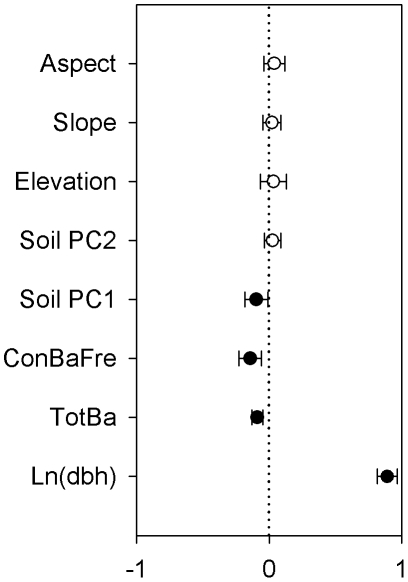
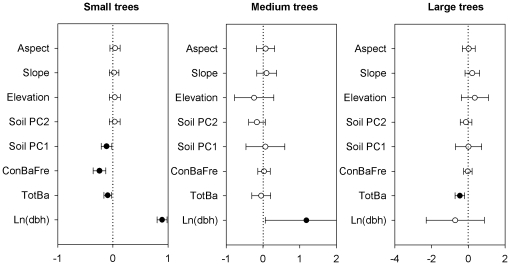
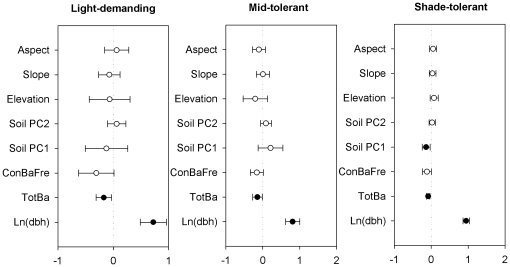
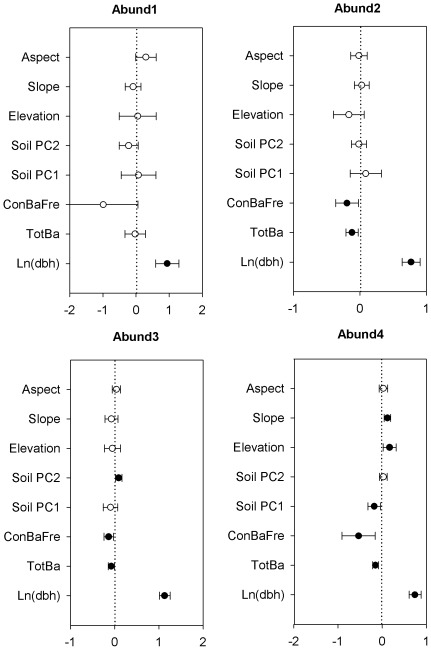
Tree survival plays a central role in forest ecosystems. Although many factors such as tree size, abiotic and biotic neighborhoods have been proposed as being important in explaining patterns of tree survival, their contributions are still subject to debate. We used generalized linear mixed models to examine the relative importance of tree size, local abiotic conditions and the density and identity of neighbors on tree survival in an old-growth temperate forest in northeastern China at three levels (community, guild and species). Tree size and both abiotic and biotic neighborhood variables influenced tree survival under current forest conditions, but their relative importance varied dramatically within and among the community, guild and species levels. Of the variables tested, tree size was typically the most important predictor of tree survival, followed by biotic and then abiotic variables. The effect of tree size on survival varied from strongly positive for small trees (1-20 cm dbh) and medium trees (20-40 cm dbh), to slightly negative for large trees (>40 cm dbh). Among the biotic factors, we found strong evidence for negative density and frequency dependence in this temperate forest, as indicated by negative effects of both total basal area of neighbors and the frequency of conspecific neighbors. Among the abiotic factors tested, soil nutrients tended to be more important in affecting tree survival than topographic variables. Abiotic factors generally influenced survival for species with relatively high abundance, for individuals in smaller size classes and for shade-tolerant species. Our study demonstrates that the relative importance of variables driving patterns of tree survival differs greatly among size classes, species guilds and abundance classes in temperate forest, which can further understanding of forest dynamics and offer important insights into forest management.
树木存活在森林生态系统中起着核心作用。尽管已经提出了许多因素,如树木大小、非生物和生物邻域,这些因素对于解释树木存活模式很重要,但它们的贡献仍存在争议。我们使用广义线性混合模型,在三个层次(群落、群系和物种)上检查了树木大小、局部非生物条件以及邻居的密度和身份对中国东北一个古老温带森林中树木存活的相对重要性。在当前的森林条件下,树木大小以及生物和非生物邻域变量都影响树木的存活,但它们在群落、群系和物种层次内和之间的相对重要性差异很大。在所测试的变量中,树木大小通常是树木存活的最重要预测因子,其次是生物变量,然后是非生物变量。树木大小对存活的影响从小树(1-20 cm dbh)和中树(20-40 cm dbh)的强烈正相关到大树(>40 cm dbh)的略微负相关。在生物因素中,我们在这个温带森林中发现了强烈的密度和频率依赖的证据,这表明邻居的总基面积和同种邻居的频率都有负面影响。在所测试的非生物因素中,土壤养分往往比地形变量更能影响树木的存活。非生物因素通常会影响相对丰富度的物种、较小尺寸类别的个体和耐荫物种的存活。我们的研究表明,在温带森林中,驱动树木存活模式的变量的相对重要性在大小类、物种群系和丰度类之间差异很大,这可以进一步了解森林动态,并为森林管理提供重要的见解。