Camilo José Cela University, Exercise Physiology Laboratory, Madrid, Spain.
PLoS One. 2012;7(2):e31380. doi: 10.1371/journal.pone.0031380. Epub 2012 Feb 14.
To investigate the effects of a caffeine-containing energy drink on soccer performance during a simulated game. A second purpose was to assess the post-exercise urine caffeine concentration derived from the energy drink intake.
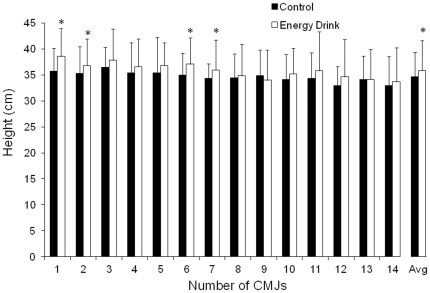
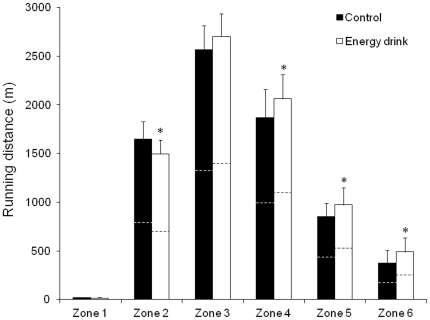
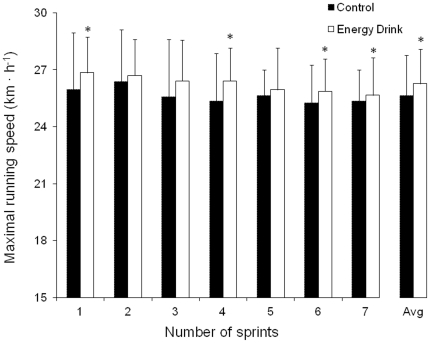
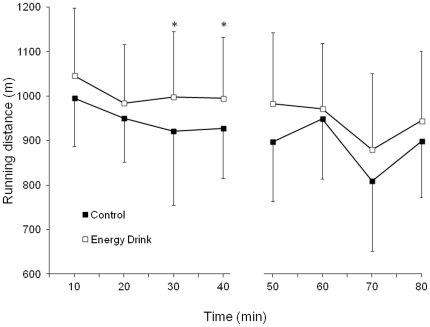
METHODOLOGY/PRINCIPAL FINDINGS: Nineteen semiprofessional soccer players ingested 630 ± 52 mL of a commercially available energy drink (sugar-free Red Bull®) to provide 3 mg of caffeine per kg of body mass, or a decaffeinated control drink (0 mg/kg). After sixty minutes they performed a 15-s maximal jump test, a repeated sprint test (7 × 30 m; 30 s of active recovery) and played a simulated soccer game. Individual running distance and speed during the game were measured using global positioning satellite (GPS) devices. In comparison to the control drink, the ingestion of the energy drink increased mean jump height in the jump test (34.7 ± 4.7 v 35.8 ± 5.5 cm; P<0.05), mean running speed during the sprint test (25.6 ± 2.1 v 26.3 ± 1.8 km · h(-1); P<0.05) and total distance covered at a speed higher than 13 km · h(-1) during the game (1205 ± 289 v 1436 ± 326 m; P<0.05). In addition, the energy drink increased the number of sprints during the whole game (30 ± 10 v 24 ± 8; P<0.05). Post-exercise urine caffeine concentration was higher after the energy drink than after the control drink (4.1 ± 1.0 v 0.1 ± 0.1 µg · mL(-1); P<0.05).
CONCLUSIONS/SIGNIFICANCE: A caffeine-containing energy drink in a dose equivalent to 3 mg/kg increased the ability to repeatedly sprint and the distance covered at high intensity during a simulated soccer game. In addition, the caffeinated energy drink increased jump height which may represent a meaningful improvement for headers or when players are competing for a ball.
研究含咖啡因的能量饮料对模拟比赛中足球表现的影响。第二个目的是评估运动后尿液中咖啡因浓度,这源于能量饮料的摄入。
方法/主要发现:19 名半职业足球运动员摄入了 630 ± 52 毫升市售能量饮料(不含糖红牛®),以提供每公斤体重 3 毫克的咖啡因,或摄入无咖啡因的对照饮料(0 毫克/公斤)。60 分钟后,他们进行了 15 秒最大跳跃测试、重复冲刺测试(7×30m;30 秒主动恢复)和模拟足球比赛。比赛中使用全球定位卫星(GPS)设备测量个人跑动距离和速度。与对照饮料相比,能量饮料的摄入增加了跳跃测试中的平均跳跃高度(34.7 ± 4.7 v 35.8 ± 5.5cm;P<0.05)、冲刺测试中的平均跑步速度(25.6 ± 2.1 v 26.3 ± 1.8km·h(-1);P<0.05)以及在比赛中以高于 13km·h(-1)的速度覆盖的总距离(1205 ± 289 v 1436 ± 326 m;P<0.05)。此外,能量饮料增加了整个比赛中的冲刺次数(30 ± 10 v 24 ± 8;P<0.05)。运动后尿液中咖啡因浓度在能量饮料后高于对照饮料(4.1 ± 1.0 v 0.1 ± 0.1μg·mL(-1);P<0.05)。
结论/意义:剂量相当于 3mg/kg 的含咖啡因能量饮料可提高重复冲刺的能力,并在模拟足球比赛中增加高强度跑动的距离。此外,含咖啡因的能量饮料增加了跳跃高度,这对于头球或球员争球时可能是一个有意义的提升。