Department of Psychology, University of Haifa, Haifa, Israel.
PLoS One. 2012;7(2):e31731. doi: 10.1371/journal.pone.0031731. Epub 2012 Feb 13.
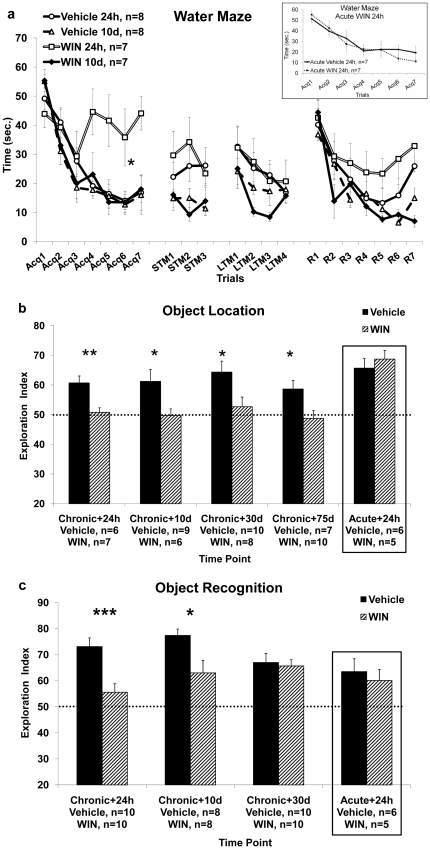
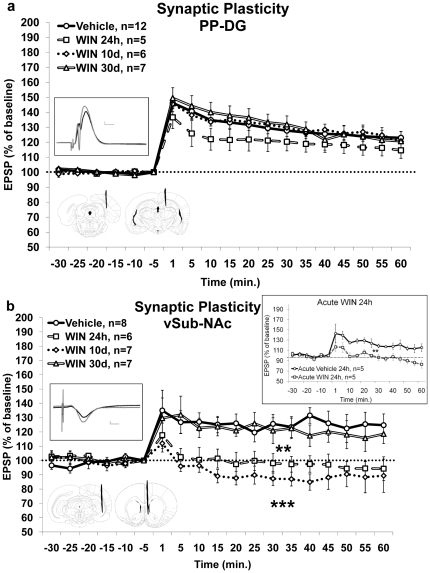
The use of cannabis can impair cognitive function, especially short-term memory. A controversial question is whether long-term cannabis use during the late-adolescence period can cause irreversible deficits in higher brain function that persist after drug use stops. In order to examine the short- and long-term effects of chronic exposure to cannabinoids, rats were administered chronic i.p. treatment with the CB1/CB2 receptor agonist WIN55,212-2 (WIN; 1.2 mg/kg) for two weeks during the late adolescence period (post-natal days 45-60) and tested for behavioral and electrophysiological measures of cognitive performance 24 hrs, 10 and 30 days after the last drug injection. The impairing effects of chronic WIN on short-term memory in the water maze and the object recognition tasks as well as long-term potentiation (LTP) in the ventral subiculum (vSub)-nucleus accumbens (NAc) pathway were temporary as they lasted only 24 h or 10 d after withdrawal. However, chronic WIN significantly impaired hippocampal dependent short-term memory measured in the object location task 24 hrs, 10, 30, and 75 days after the last drug injection. Our findings suggest that some forms of hippocampal-dependent short-term memory are sensitive to chronic cannabinoid administration but other cognitive impairments are temporary and probably result from a residue of cannabinoids in the brain or acute withdrawal effects from cannabinoids. Understanding the effects of cannabinoids on cognitive function may provide us with tools to overcome these impairments and for cannabinoids to be more favorably considered for clinical use.
大麻的使用会损害认知功能,尤其是短期记忆。一个有争议的问题是,青少年后期长期使用大麻是否会导致大脑高级功能的不可逆转损伤,而这种损伤在停止使用毒品后仍然存在。为了研究慢性暴露于大麻素的短期和长期影响,研究人员在青少年后期(出生后第 45-60 天)通过腹腔内注射 CB1/CB2 受体激动剂 WIN55,212-2(WIN;1.2mg/kg)对大鼠进行了为期两周的慢性治疗,并在最后一次药物注射后 24 小时、10 天和 30 天测试了认知表现的行为和电生理测量。慢性 WIN 对水迷宫和物体识别任务中的短期记忆以及腹侧下托(vSub)-伏隔核(NAc)通路中的长时程增强(LTP)的损害作用是暂时的,因为它们仅在停药后 24 小时或 10 天持续存在。然而,慢性 WIN 显著损害了物体位置任务中的海马体依赖的短期记忆,这种损害在最后一次药物注射后 24 小时、10 天、30 天和 75 天都存在。我们的发现表明,一些形式的海马体依赖的短期记忆对慢性大麻素给药敏感,但其他认知损伤是暂时的,可能是由于大脑中残留的大麻素或大麻素的急性戒断效应所致。了解大麻素对认知功能的影响可能为我们提供克服这些损伤的工具,并使大麻素更有利于临床应用。