Department of Mathematics/Program in Applied Mathematical and Computational Sciences, University of Iowa, Iowa City, IA, USA.
Biol Direct. 2012 Feb 21;7:9. doi: 10.1186/1745-6150-7-9.
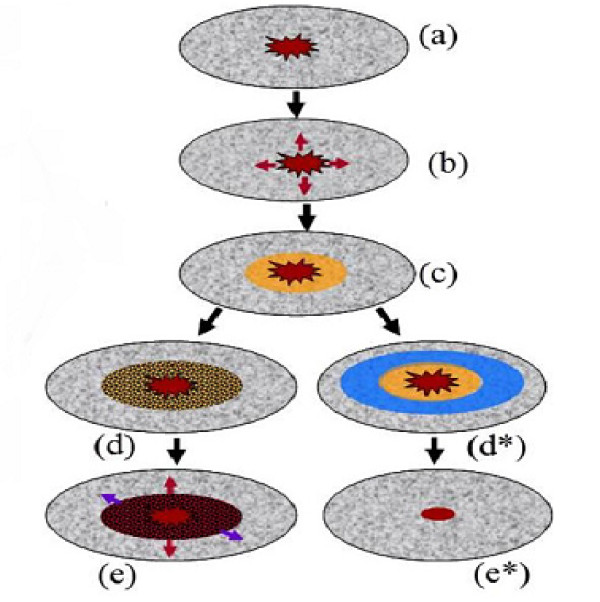
Injuries to articular cartilage result in the development of lesions that form on the surface of the cartilage. Such lesions are associated with articular cartilage degeneration and osteoarthritis. The typical injury response often causes collateral damage, primarily an effect of inflammation, which results in the spread of lesions beyond the region where the initial injury occurs.
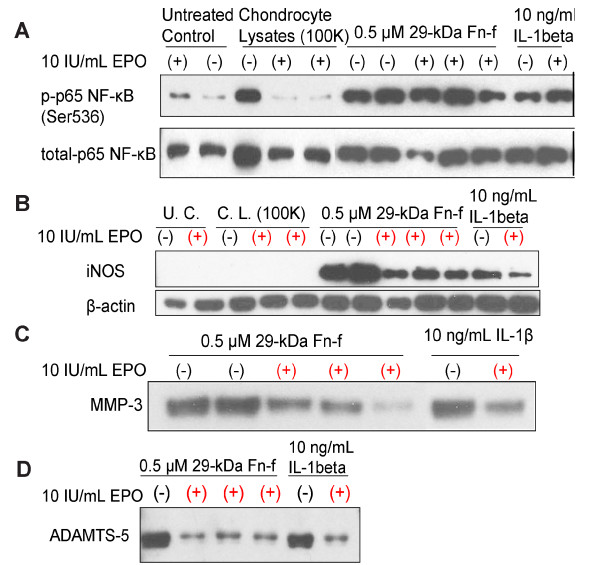
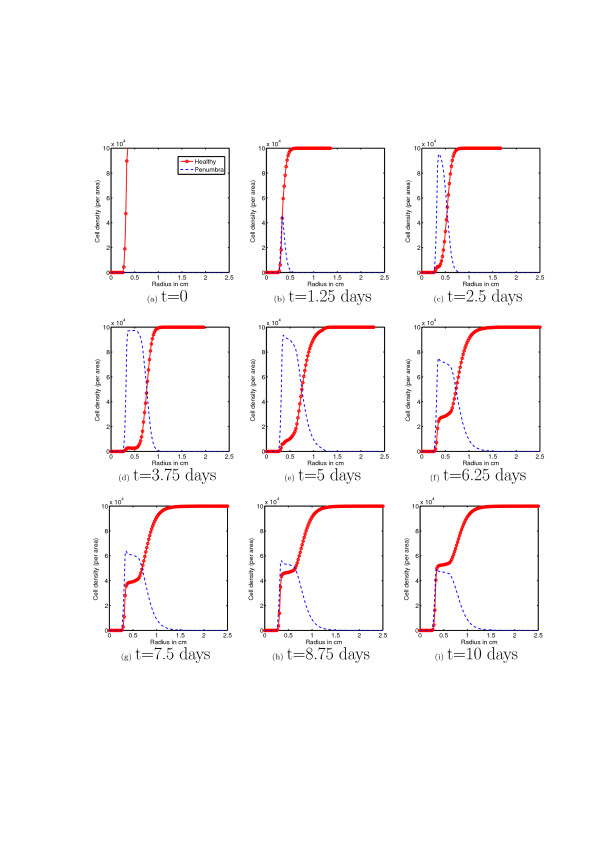
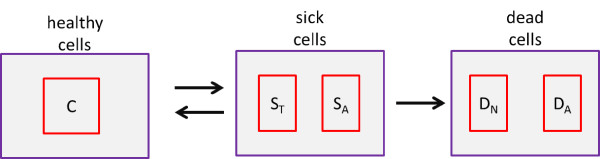
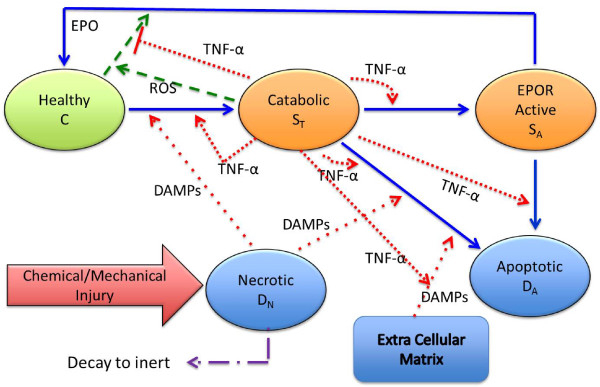
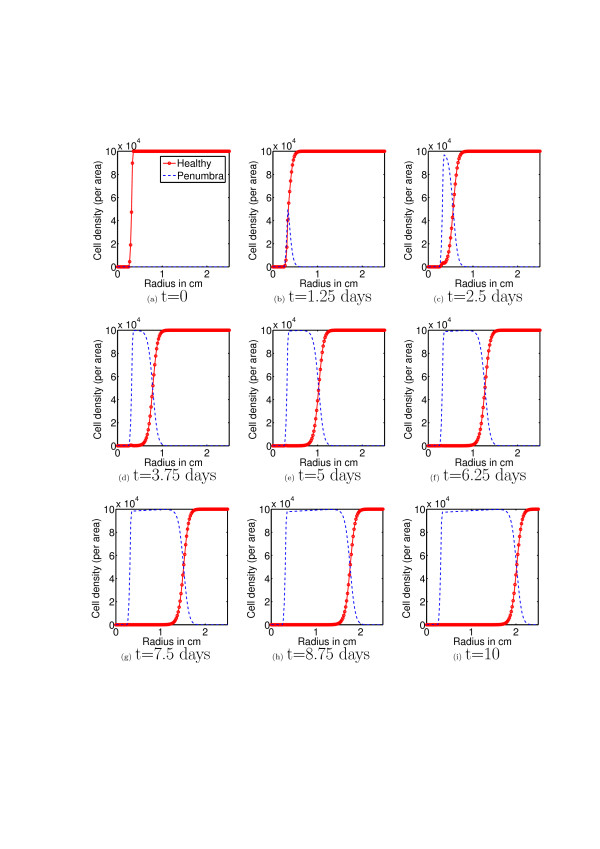
We present a minimal mathematical model based on known mechanisms to investigate the spread and abatement of such lesions. The first case corresponds to the parameter values listed in Table 1, while the second case has parameter values as in Table 2. In particular we represent the "balancing act" between pro-inflammatory and anti-inflammatory cytokines that is hypothesized to be a principal mechanism in the expansion properties of cartilage damage during the typical injury response. We present preliminary results of in vitro studies that confirm the anti-inflammatory activities of the cytokine erythropoietin (EPO). We assume that the diffusion of cytokines determine the spatial behavior of injury response and lesion expansion so that a reaction diffusion system involving chemical species and chondrocyte cell state population densities is a natural way to represent cartilage injury response. We present computational results using the mathematical model showing that our representation is successful in capturing much of the interesting spatial behavior of injury associated lesion development and abatement in articular cartilage. Further, we discuss the use of this model to study the possibility of using EPO as a therapy for reducing the amount of inflammation induced collateral damage to cartilage during the typical injury response.
The mathematical model presented herein suggests that not only are anti-inflammatory cytokines, such as EPO necessary to prevent chondrocytes signaled by pro-inflammatory cytokines from entering apoptosis, they may also influence how chondrocytes respond to signaling by pro-inflammatory cytokines.
关节软骨损伤会导致在软骨表面形成病变。这些病变与关节软骨退化和骨关节炎有关。典型的损伤反应通常会造成附带损伤,主要是炎症的影响,导致病变扩散超出初始损伤发生的区域。
我们提出了一个基于已知机制的最小数学模型,以研究这种病变的传播和减轻。第一种情况对应于表 1 中列出的参数值,而第二种情况的参数值如表 2 所示。特别是,我们代表了“炎症前和抗炎细胞因子之间的平衡作用”,这被假设是典型损伤反应中软骨损伤扩展特性的主要机制。我们展示了体外研究的初步结果,证实了细胞因子促红细胞生成素(EPO)的抗炎活性。我们假设细胞因子的扩散决定了损伤反应和病变扩展的空间行为,因此涉及化学物质和软骨细胞状态种群密度的反应扩散系统是表示软骨损伤反应的自然方式。我们使用数学模型展示了计算结果,表明我们的表示方法成功地捕捉到了与关节软骨损伤相关的病变发展和减轻的许多有趣的空间行为。此外,我们讨论了使用该模型研究使用 EPO 作为治疗方法来减少典型损伤反应中炎症诱导的软骨附带损伤的可能性。
本文提出的数学模型表明,抗炎细胞因子(如 EPO)不仅对于防止被促炎细胞因子信号转导的软骨细胞进入凋亡是必要的,它们还可能影响软骨细胞对促炎细胞因子信号的反应方式。