Key Laboratory of Swine Genetics and Breeding of Agricultural Ministry, College of Animal Science and Technology, Huazhong Agricultural University, Wuhan, People's Republic of China.
PLoS One. 2012;7(2):e31426. doi: 10.1371/journal.pone.0031426. Epub 2012 Feb 15.
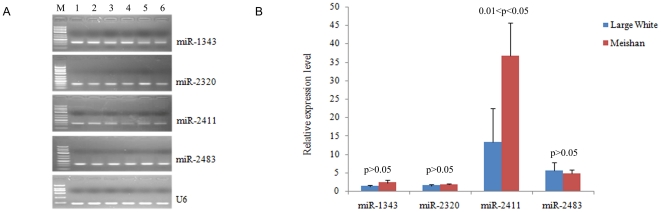
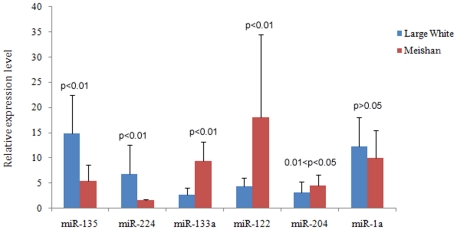
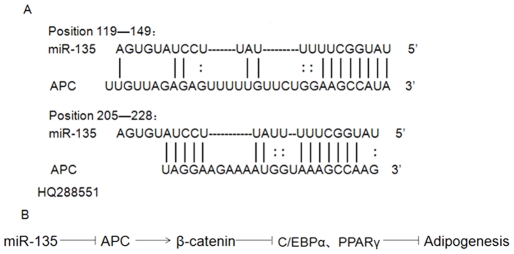
The domestic pig (Sus scrofa), an important species in animal production industry, is a right model for studying adipogenesis and fat deposition. In order to expand the repertoire of porcine miRNAs and further explore potential regulatory miRNAs which have influence on adipogenesis, high-throughput Solexa sequencing approach was adopted to identify miRNAs in backfat of Large White (lean type pig) and Meishan pigs (Chinese indigenous fatty pig). We identified 215 unique miRNAs comprising 75 known pre-miRNAs, of which 49 miRNA*s were first identified in our study, 73 miRNAs were overlapped in both libraries, and 140 were novelly predicted miRNAs, and 215 unique miRNAs were collectively corresponding to 235 independent genomic loci. Furthermore, we analyzed the sequence variations, seed edits and phylogenetic development of the miRNAs. 17 miRNAs were widely conserved from vertebrates to invertebrates, suggesting that these miRNAs may serve as potential evolutional biomarkers. 9 conserved miRNAs with significantly differential expressions were determined. The expression of miR-215, miR-135, miR-224 and miR-146b was higher in Large White pigs, opposite to the patterns shown by miR-1a, miR-133a, miR-122, miR-204 and miR-183. Almost all novel miRNAs could be considered pig-specific except ssc-miR-1343, miR-2320, miR-2326, miR-2411 and miR-2483 which had homologs in Bos taurus, among which ssc-miR-1343, miR-2320, miR-2411 and miR-2483 were validated in backfat tissue by stem-loop qPCR. Our results displayed a high level of concordance between the qPCR and Solexa sequencing method in 9 of 10 miRNAs comparisons except for miR-1a. Moreover, we found 2 miRNAs, miR-135 and miR-183, may exert impacts on porcine backfat development through WNT signaling pathway. In conclusion, our research develops porcine miRNAs and should be beneficial to study the adipogenesis and fat deposition of different pig breeds based on miRNAs.
家猪(Sus scrofa)是动物生产行业中的一个重要物种,是研究脂肪生成和脂肪沉积的理想模型。为了扩展猪 mirna 谱,并进一步探索对脂肪生成有影响的潜在调节 mirna,我们采用高通量 Solexa 测序方法来鉴定大白猪(瘦肉型猪)和梅山猪(中国本土脂肪型猪)背脂中的 mirna。我们鉴定了 215 个独特的 mirna,其中包括 75 个已知的前体 mirna,其中 49 个 mirna*是我们首次在研究中发现的,73 个 mirna 在两个文库中重叠,140 个是新预测的 mirna,215 个独特的 mirna 共对应 235 个独立的基因组位点。此外,我们分析了 mirna 的序列变异、种子编辑和系统发育发育。从脊椎动物到无脊椎动物,有 17 个 mirna 广泛保守,表明这些 mirna 可能作为潜在的进化生物标志物。确定了 9 个保守的差异表达 mirna。miR-215、miR-135、miR-224 和 miR-146b 在大白猪中的表达水平较高,而 miR-1a、miR-133a、miR-122、miR-204 和 miR-183 的表达模式则相反。除了在 Bos taurus 中具有同源物的 ssc-miR-1343、miR-2320、miR-2326、miR-2411 和 miR-2483 外,几乎所有的新 mirna 都可以被认为是猪特有的,其中 ssc-miR-1343、miR-2320、miR-2411 和 miR-2483 通过茎环 qPCR 在背脂组织中得到验证。在 10 个 mirna 比较中,qPCR 和 Solexa 测序方法的结果高度一致,除了 miR-1a。此外,我们发现 miR-135 和 miR-183 可能通过 WNT 信号通路对猪背脂发育产生影响。总之,我们的研究发展了猪 mirna,并应有助于基于 mirna 研究不同猪品种的脂肪生成和脂肪沉积。