Department of Cell Biology, The Johns Hopkins School of Medicine, Baltimore, Maryland, United States of America.
PLoS One. 2012;7(2):e32120. doi: 10.1371/journal.pone.0032120. Epub 2012 Feb 15.
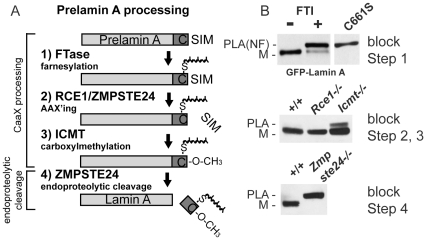
The proteolytic maturation of the nuclear protein lamin A by the zinc metalloprotease ZMPSTE24 is critical for human health. The lamin A precursor, prelamin A, undergoes a multi-step maturation process that includes CAAX processing (farnesylation, proteolysis and carboxylmethylation of the C-terminal CAAX motif), followed by ZMPSTE24-mediated cleavage of the last 15 amino acids, including the modified C-terminus. Failure to cleave the prelamin A "tail", due to mutations in either prelamin A or ZMPSTE24, results in a permanently prenylated form of prelamin A that underlies the premature aging disease Hutchinson-Gilford Progeria Syndrome (HGPS) and related progeroid disorders.
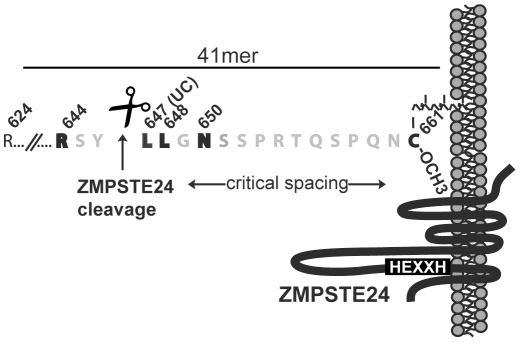
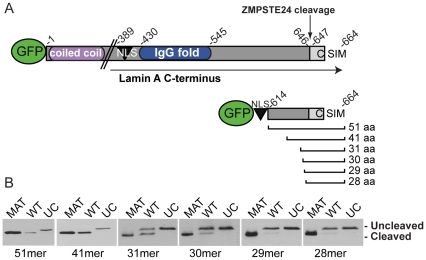
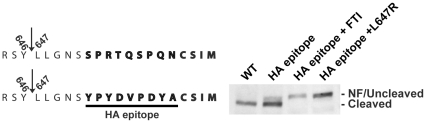
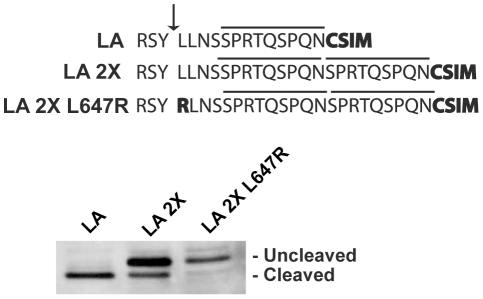
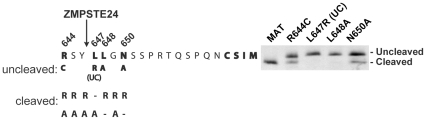
METHODOLOGY/PRINCIPAL FINDINGS: Here we have investigated the features of the prelamin A substrate that are required for efficient cleavage by ZMPSTE24. We find that the C-terminal 41 amino acids of prelamin A contain sufficient context to allow cleavage of the tail by ZMPSTE24. We have identified several mutations in amino acids immediately surrounding the cleavage site (between Y646 and L647) that interfere with efficient cleavage of the prelamin A tail; these mutations include R644C, L648A and N650A, in addition to the previously reported L647R. Our data suggests that 9 of the 15 residues within the cleaved tail that lie immediately upstream of the CAAX motif are not critical for ZMPSTE24-mediated cleavage, as they can be replaced by the 9 amino acid HA epitope. However, duplication of the same 9 amino acids (to increase the distance between the prenyl group and the cleavage site) impairs the ability of ZMPSTE24 to cleave prelamin A.
CONCLUSIONS/SIGNIFICANCE: Our data reveals amino acid preferences flanking the ZMPSTE24 cleavage site of prelamin A and suggests that spacing from the farnesyl-cysteine to the cleavage site is important for optimal ZMPSTE24 cleavage. These studies begin to elucidate the substrate requirements of an enzyme activity critical to human health and longevity.
核蛋白 lamin A 的蛋白水解成熟是由锌金属蛋白酶 ZMPSTE24 完成的,这对人类健康至关重要。lamin A 的前体蛋白 prelamin A 经历了一个多步成熟过程,包括 CAAX 加工(法呢基化、C 端 CAAX 基序的蛋白酶解和羧甲基化),然后是 ZMPSTE24 介导的对最后 15 个氨基酸的切割,包括修饰的 C 端。由于 prelamin A 或 ZMPSTE24 中的突变,导致前 lamin A“尾巴”不能被切割,会导致前 lamin A 形成永久的法尼基化形式,这是亨廷顿病性早老症(HGPS)和相关的早老症疾病的基础。
方法/主要发现:在这里,我们研究了 prelamin A 底物的特征,这些特征是 ZMPSTE24 有效切割所必需的。我们发现 prelamin A 的 C 端 41 个氨基酸含有足够的上下文,允许 ZMPSTE24 切割尾部。我们在切割位点(Y646 和 L647 之间)周围的几个氨基酸中发现了几个突变,这些突变干扰了 prelamin A 尾部的有效切割;这些突变包括 R644C、L648A 和 N650A,以及之前报道的 L647R。我们的数据表明,在 CAAX 基序上游紧邻的切割尾部的 15 个残基中,有 9 个残基对 ZMPSTE24 介导的切割并不重要,因为它们可以被 9 个氨基酸的 HA 表位取代。然而,相同的 9 个氨基酸的重复(增加法尼基和切割位点之间的距离)会损害 ZMPSTE24 切割 prelamin A 的能力。
结论/意义:我们的数据揭示了 prelamin A 的 ZMPSTE24 切割位点侧翼的氨基酸偏好性,并表明从法尼基-半胱氨酸到切割位点的间距对于最佳 ZMPSTE24 切割很重要。这些研究开始阐明对人类健康和长寿至关重要的酶活性的底物要求。