Western Fisheries Research Center, United States Geological Survey, 6505 NE 65th St., Seattle, WA 98115, USA.
Viruses. 2012 Jan;4(1):140-66. doi: 10.3390/v4010140. Epub 2012 Jan 18.
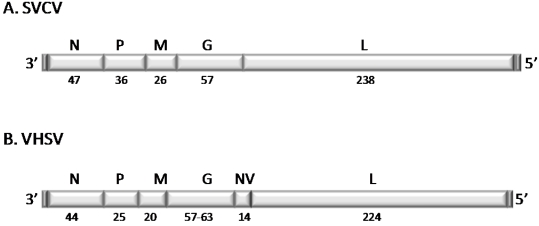
Members of the family Rhabdoviridae are single-stranded RNA viruses and globally important pathogens of wild and cultured fish and thus relatively well studied in their respective hosts or other model systems. Here, we review the protective immune mechanisms that fish mount in response to rhabdovirus infections. Teleost fish possess the principal components of innate and adaptive immunity found in other vertebrates. Neutralizing antibodies are critical for long-term protection from fish rhabdoviruses, but several studies also indicate a role for cell-mediated immunity. Survival of acute rhabdoviral infection is also dependent on innate immunity, particularly the interferon (IFN) system that is rapidly induced in response to infection. Paradoxically, rhabdoviruses are sensitive to the effects of IFN but virulent rhabdoviruses can continue to replicate owing to the abilities of the matrix (M) protein to mediate host-cell shutoff and the non‑virion (NV) protein to subvert programmed cell death and suppress functional IFN. While many basic features of the fish immune response to rhabdovirus infections are becoming better understood, much less is known about how factors in the environment affect the ecology of rhabdovirus infections in natural populations of aquatic animals.
弹状病毒科的成员是单链 RNA 病毒,是全球范围内野生和养殖鱼类的重要病原体,因此在其各自的宿主或其他模型系统中得到了相对较好的研究。在这里,我们回顾了鱼类针对弹状病毒感染所产生的保护性免疫机制。硬骨鱼类拥有其他脊椎动物中存在的固有免疫和适应性免疫的主要成分。中和抗体对于长期预防鱼类弹状病毒至关重要,但几项研究也表明细胞介导免疫的作用。急性弹状病毒感染的存活也依赖于固有免疫,特别是干扰素(IFN)系统,该系统在感染后迅速被诱导。矛盾的是,弹状病毒对 IFN 的作用敏感,但毒力弹状病毒能够继续复制,这要归功于基质(M)蛋白介导的宿主细胞关闭能力和非病毒(NV)蛋白对程序性细胞死亡的颠覆和抑制功能性 IFN。尽管鱼类对弹状病毒感染的免疫反应的许多基本特征正在得到更好的理解,但对于环境因素如何影响水生动物自然种群中弹状病毒感染的生态学知之甚少。