Division of Neonatology, University Hospital Zurich, Zurich, Switzerland.
BMC Pediatr. 2012 Feb 22;12:17. doi: 10.1186/1471-2431-12-17.
Over the last two decades, improvements in medical care have been associated with a significant increase and better outcome of very preterm (VP, < 32 completed gestational weeks) and very low birth weight (VLBW, < 1500 g) infants. Only a few publications analyse changes of their short-term outcome in a geographically defined area over more than 10 years. We therefore aimed to investigate the net change of VP- and VLBW infants leaving the hospital without major complications.
Our population-based observational cohort study used the Minimal Neonatal Data Set, a database maintained by the Swiss Society of Neonatology including information of all VP- and VLBW infants. Perinatal characteristics, mortality and morbidity rates and the survival free of major complications were analysed and their temporal trends evaluated.
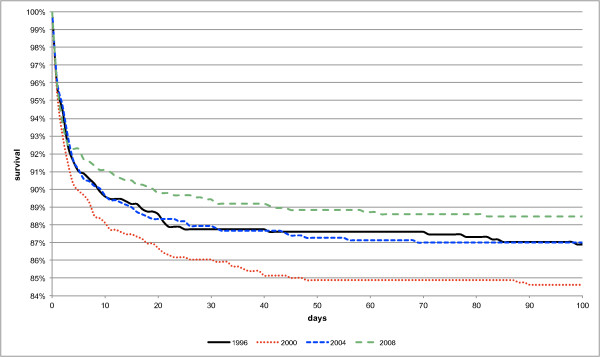
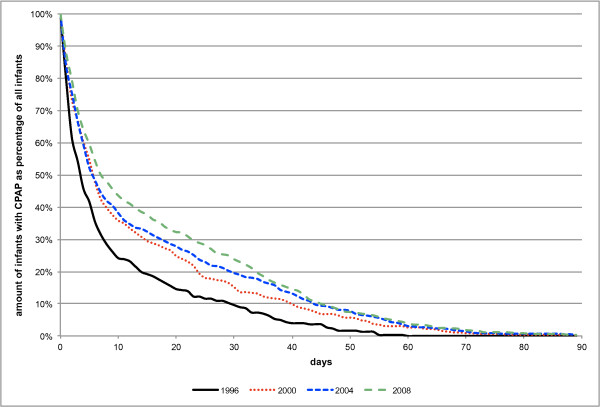
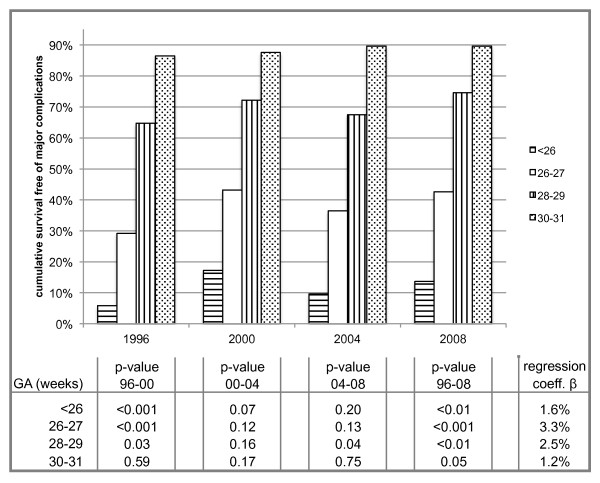
In 1996, 2000, 2004, and 2008, a total number of 3090 infants were enrolled in the Network Database. At the same time the rate of VP- and VLBW neonates increased significantly from 0.87% in 1996 to 1.10% in 2008 (p < 0.001). The overall mortality remained stable by 13%, but the survival free of major complications increased from 66.9% to 71.7% (p < 0.01). The percentage of infants getting a full course of antenatal corticosteroids increased from 67.7% in 1996 to 91.4% in 2008 (p < 0.001). Surfactant was given more frequently (24.8% in 1996 compared to 40.1% in 2008, p < 0.001) and the frequency of mechanical ventilation remained stable by about 43%. However, the use of CPAP therapy increased considerably from 43% to 73.2% (p < 0.001). Some of the typical neonatal pathologies like bronchopulmonary dysplasia, necrotising enterocolitis and intraventricular haemorrhage decreased significantly (p ≤ 0.02) whereas others like patent ductus arteriosus and respiratory distress syndrome increased (p < 0.001).
Over the 12-year observation period, the number of VP- and VLBW infants increased significantly. An unchanged overall mortality rate and an increase of survivors free of major complication resulted in a considerable net gain in infants with potentially good outcome.
在过去的二十年中,医疗水平的提高与极早产儿(VP,<32 周完成的妊娠周数)和极低出生体重儿(VLBW,<1500g)的数量显著增加和更好的结局相关。只有少数出版物分析了在一个地理上定义的地区超过 10 年的他们短期结局的变化。因此,我们旨在研究没有重大并发症的 VP 和 VLBW 婴儿出院的净变化。
我们的基于人群的观察性队列研究使用了最小新生儿数据组,这是一个由瑞士新生儿学会维护的数据库,包含所有 VP 和 VLBW 婴儿的信息。分析围产期特征、死亡率和发病率以及无重大并发症的存活率,并评估其时间趋势。
1996 年、2000 年、2004 年和 2008 年,共有 3090 名婴儿被纳入网络数据库。同时,VP 和 VLBW 新生儿的比例从 1996 年的 0.87%显著增加到 2008 年的 1.10%(p<0.001)。总死亡率保持稳定在 13%,但无重大并发症的存活率从 66.9%增加到 71.7%(p<0.01)。接受全程产前皮质类固醇治疗的婴儿比例从 1996 年的 67.7%增加到 2008 年的 91.4%(p<0.001)。表面活性剂的使用频率也有所增加(1996 年为 24.8%,2008 年为 40.1%,p<0.001),机械通气的频率保持在 43%左右稳定。然而,CPAP 治疗的使用率显著增加,从 43%增加到 73.2%(p<0.001)。一些典型的新生儿疾病,如支气管肺发育不良、坏死性小肠结肠炎和脑室内出血显著减少(p≤0.02),而其他疾病,如动脉导管未闭和呼吸窘迫综合征则增加(p<0.001)。
在 12 年的观察期内,VP 和 VLBW 婴儿的数量显著增加。总体死亡率不变,无重大并发症的存活率增加,导致具有良好潜在结局的婴儿数量显著增加。