Departamento de Ecoloxía e Bioloxía Animal, Facultade de Bioloxía, Universidade de Vigo, Vigo, Spain.
PLoS One. 2012;7(2):e31895. doi: 10.1371/journal.pone.0031895. Epub 2012 Feb 21.
Epigeic earthworms are key organisms in organic matter decomposition because of the interactions they establish with microorganisms. The earthworm species and the quality and/or substrate availability are expected to be major factors influencing the outcome of these interactions. Here we tested whether and to what extent the epigeic earthworms Eisenia andrei, Eisenia fetida and Perionyx excavatus, widely used in vermicomposting, are capable of altering the microbiological properties of fresh organic matter in the short-term. We also questioned if the earthworm-induced modifications to the microbial communities are dependent on the type of substrate ingested.
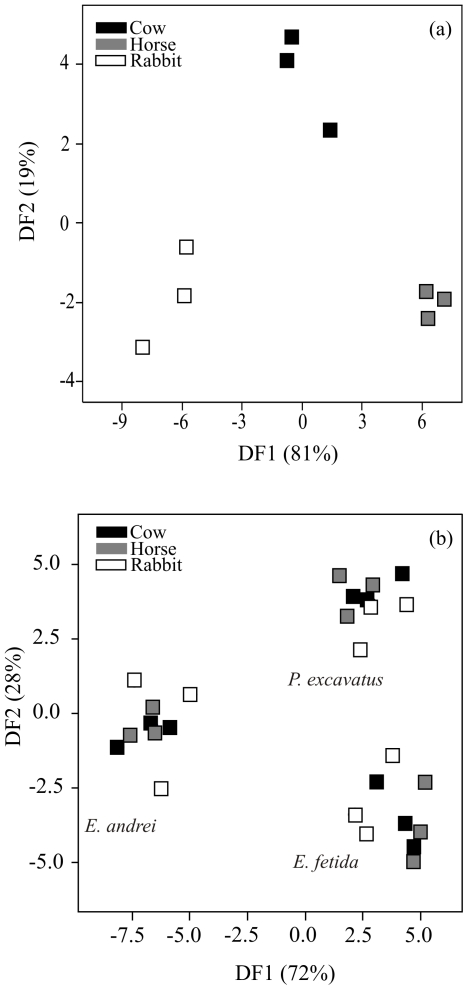
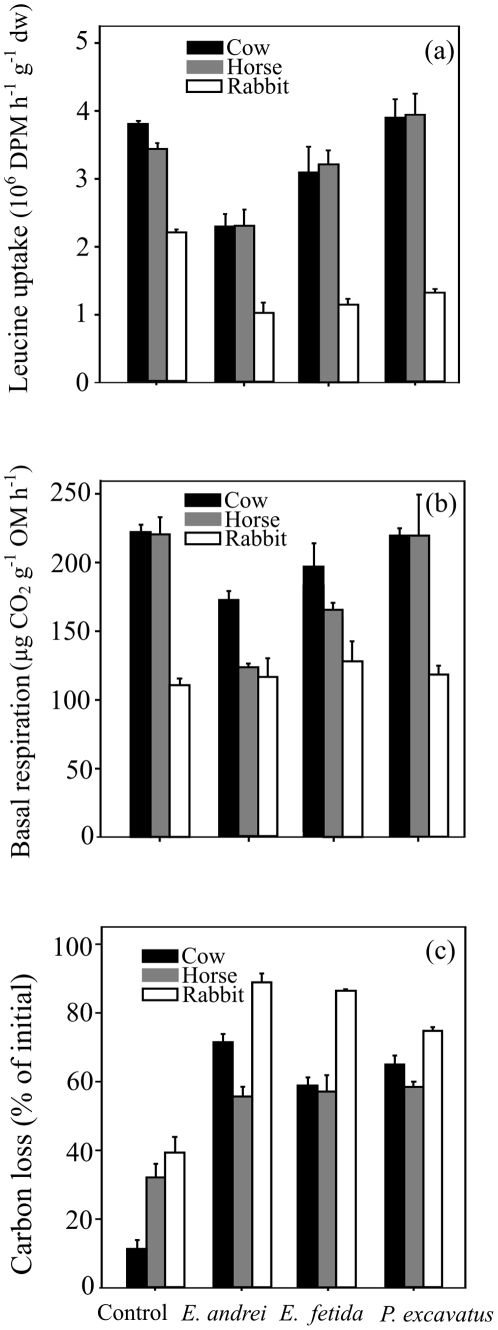
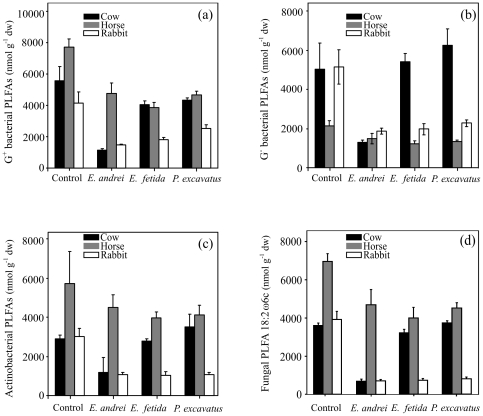
METHODOLOGY/PRINCIPAL FINDINGS: To address these questions we determined the microbial community structure (phospholipid fatty acid profiles) and microbial activity (basal respiration and microbial growth rates) of three types of animal manure (cow, horse and rabbit) that differed in microbial composition, after being processed by each species of earthworm for one month. No differences were found between earthworm-worked samples with regards to microbial community structure, irrespective of type of manure, which suggests the existence of a bottleneck effect of worm digestion on microbial populations of the original material consumed. Moreover, in mesocosms containing cow manure the presence of E. andrei resulted not only in a decrease in bacterial and fungal biomass, but also in a reduced bacterial growth rate and total microbial activity, while no such reduction was found with E. fetida and P. excavatus.
CONCLUSIONS/SIGNIFICANCE: Our results point to the species of earthworm with its associated gut microbiota as a strong determinant of the process shaping the structure of microbial communities in the short-term. This must nonetheless be weighed against the fact that further knowledge is necessary to evaluate whether the changes in the composition of microbiota in response to the earthworm species is accompanied by a change in the microbial community diversity and/or function.
由于与微生物的相互作用,表栖蚯蚓是有机物质分解的关键生物。蚯蚓种类、质量和/或基质可用性预计将是影响这些相互作用结果的主要因素。在这里,我们测试了广泛用于蚯蚓堆肥的表栖蚯蚓赤子爱胜蚓、威廉环毛蚓和苏氏尾鳃蚓是否以及在何种程度上能够在短期内改变新鲜有机物质的微生物特性。我们还质疑蚯蚓对微生物群落的诱导改变是否取决于所摄取基质的类型。
方法/主要发现:为了解决这些问题,我们确定了三种类型的动物粪便(牛、马和兔)在经过一个月的每种蚯蚓处理后微生物群落结构(磷脂脂肪酸谱)和微生物活性(基础呼吸和微生物生长速率)。无论粪便类型如何,蚯蚓处理后的样本之间在微生物群落结构方面没有差异,这表明存在蚯蚓消化对原始材料消耗的微生物种群的瓶颈效应。此外,在含有牛粪的中观模型中,赤子爱胜蚓的存在不仅导致细菌和真菌生物量减少,而且导致细菌生长速率和总微生物活性降低,而威廉环毛蚓和苏氏尾鳃蚓则没有发现这种减少。
结论/意义:我们的结果表明,蚯蚓种类及其相关肠道微生物群是短期内塑造微生物群落结构的过程的一个强有力的决定因素。然而,必须考虑到,需要进一步的知识来评估对蚯蚓种类的反应而改变的微生物群落组成是否伴随着微生物群落多样性和/或功能的改变。