Gao Guodong Gordon, McCullough Jeffrey S, Agarwal Ritu, Jha Ashish K
Center for Health Information and Decision Systems, Robert H Smith School of Business, University of Maryland, College Park, MD 20742, USA.
J Med Internet Res. 2012 Feb 24;14(1):e38. doi: 10.2196/jmir.2003.
Americans increasingly post and consult online physician rankings, yet we know little about this new phenomenon of public physician quality reporting. Physicians worry these rankings will become an outlet for disgruntled patients.
To describe trends in patients' online ratings over time, across specialties, to identify what physician characteristics influence online ratings, and to examine how the value of ratings reflects physician quality.
We used data from RateMDs.com, which included over 386,000 national ratings from 2005 to 2010 and provided insight into the evolution of patients' online ratings. We obtained physician demographic data from the US Department of Health and Human Services' Area Resource File. Finally, we matched patients' ratings with physician-level data from the Virginia Medical Board and examined the probability of being rated and resultant rating levels.
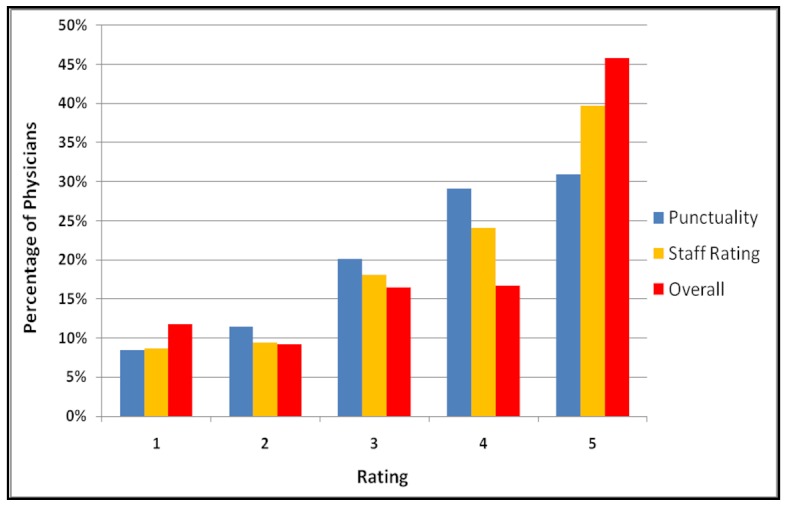
We estimate that 1 in 6 practicing US physicians received an online review by January 2010. Obstetrician/gynecologists were twice as likely to be rated (P < .001) as other physicians. Online reviews were generally quite positive (mean 3.93 on a scale of 1 to 5). Based on the Virginia physician population, long-time graduates were more likely to be rated, while physicians who graduated in recent years received higher average ratings (P < .001). Patients gave slightly higher ratings to board-certified physicians (P = .04), those who graduated from highly rated medical schools (P = .002), and those without malpractice claims (P = .1).
Online physician rating is rapidly growing in popularity and becoming commonplace with no evidence that they are dominated by disgruntled patients. There exist statistically significant correlations between the value of ratings and physician experience, board certification, education, and malpractice claims, suggesting a positive correlation between online ratings and physician quality. However, the magnitude is small. The average number of ratings per physician is still low, and most rating variation reflects evaluations of punctuality and staff. Understanding whether they truly reflect better care and how they are used will be critically important.
美国人越来越多地发布并参考在线医生排名,但我们对这种新出现的公众医生质量报告现象了解甚少。医生担心这些排名会成为心怀不满的患者发泄的途径。
描述患者在线评分随时间变化以及跨专业的趋势,确定哪些医生特征会影响在线评分,并研究评分价值如何反映医生质量。
我们使用了RateMDs.com的数据,其中包括2005年至2010年超过38.6万条全国性评分,从而深入了解患者在线评分的演变情况。我们从美国卫生与公众服务部的地区资源文件中获取了医生的人口统计学数据。最后,我们将患者评分与弗吉尼亚州医学委员会的医生层面数据进行匹配,并研究被评分的概率以及由此产生的评分水平。
我们估计,到2010年1月,美国每六名执业医生中就有一名收到在线评价。妇产科医生被评分的可能性是其他医生的两倍(P <.001)。在线评价总体上相当积极(1至5分制下平均为3.93分)。基于弗吉尼亚州的医生群体,毕业时间久的医生更有可能被评分,而近年来毕业的医生获得的平均评分更高(P <.001)。患者对获得委员会认证的医生(P =.04)、毕业于评分高的医学院的医生(P =.002)以及没有医疗事故索赔的医生(P =.1)的评分略高。
在线医生评分迅速流行并变得普遍,没有证据表明它们被心怀不满的患者主导。评分价值与医生经验、委员会认证、教育程度和医疗事故索赔之间存在统计学上的显著相关性,表明在线评分与医生质量之间存在正相关。然而,这种相关性的程度较小。每位医生的平均评分数量仍然较低,而且大多数评分差异反映的是对准时性和工作人员的评价。了解它们是否真的反映了更好的医疗服务以及它们是如何被使用的将至关重要。