Arizona Cancer Center, the University of Arizona, Tucson, Arizona 85724, USA.
Clin Cancer Res. 2012 Apr 15;18(8):2210-9. doi: 10.1158/1078-0432.CCR-11-2413. Epub 2012 Feb 28.
Aurora A and B are oncogenic serine/threonine kinases that regulate mitosis. Overexpression of Auroras promotes resistance to microtubule-targeted agents. We investigated mechanistic synergy by inhibiting the mitotic spindle apparatus in the presence of MLN8237 [M], an Aurora A inhibitor with either vincristine [MV] or docetaxel [MD] in aggressive B-cell non-Hodgkin lymphoma (B-NHL). The addition of rituximab [R] to MV or MD was evaluated for synthetic lethality.
Aggressive B-NHL cell subtypes were evaluated in vitro and in vivo for target modulation and anti-NHL activity with single agents, doublets, and triplets by analyzing cell proliferation, apoptosis, tumor growth, survival, and mechanisms of response/relapse by gene expression profiling with protein validation.
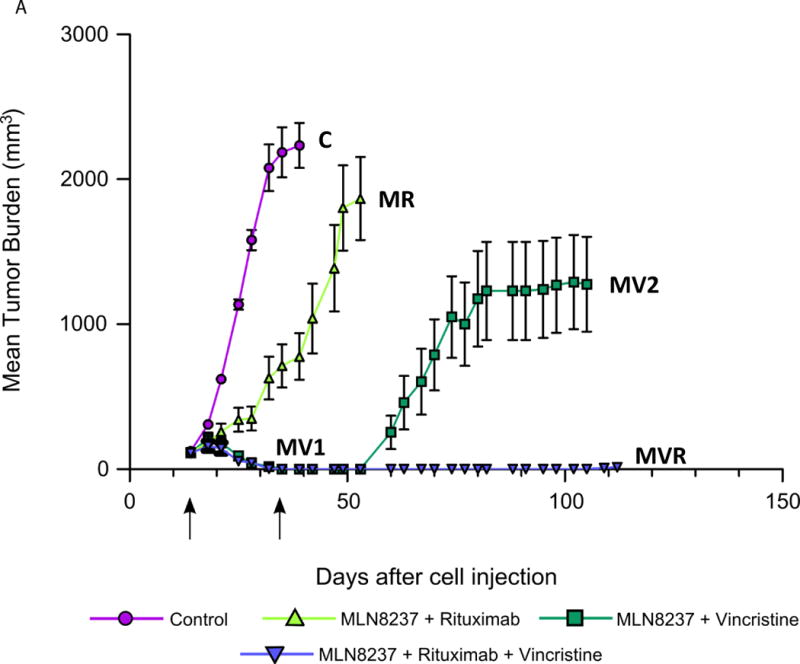
MV is synergistic whereas MD is additive for cell proliferation inhibition in B-NHL cell culture models. Addition of rituximab to MV is superior to MD, but both significantly induce apoptosis compared with doublet therapy. Mouse xenograft models of mantle cell lymphoma showed modest single-agent activity for MLN8237, rituximab, docetaxel, and vincristine with tumor growth inhibition (TGI) of approximately 10% to 15%. Of the doublets, MV caused tumor regression, whereas TGI was observed with MD (approximately 55%-60%) and MR (approximately 25%-50%), respectively. Although MV caused tumor regression, mice relapsed 20 days after stopping therapy. In contrast, MVR was curative, whereas MDR led to TGI of approximately 85%. Proliferation cell nuclear antigen, Aurora B, cyclin B1, cyclin D1, and Bcl-2 proteins of harvested tumors confirmed response and resistance to therapy.
Addition of rituximab to MV is a novel therapeutic strategy for aggressive B-NHL and warrants clinical trial evaluation.
极光 A 和 B 是致癌丝氨酸/苏氨酸激酶,可调节有丝分裂。极光的过度表达促进了对微管靶向药物的耐药性。我们研究了在存在 Aurora A 抑制剂 MLN8237 [M] 的情况下抑制有丝分裂纺锤体装置的机制协同作用,该抑制剂与长春新碱 [MV] 或多西他赛 [MD] 联合用于侵袭性 B 细胞非霍奇金淋巴瘤(B-NHL)。评估利妥昔单抗 [R] 与 MV 或 MD 的联合使用是否具有合成致死性。
在体外和体内评估侵袭性 B-NHL 细胞亚型的靶标调节和抗 NHL 活性,方法是通过分析细胞增殖、凋亡、肿瘤生长、生存和通过基因表达谱进行反应/复发机制的蛋白验证,使用单药、双药和三药。
MV 对 B-NHL 细胞培养模型的细胞增殖抑制具有协同作用,而 MD 则具有相加作用。与 MD 相比,利妥昔单抗与 MV 的联合使用具有更好的效果,但与双药治疗相比,均能显著诱导凋亡。套细胞淋巴瘤的小鼠异种移植模型显示 MLN8237、利妥昔单抗、多西他赛和长春新碱的单药活性较弱,肿瘤生长抑制(TGI)约为 10%-15%。在双药中,MV 引起肿瘤消退,而 MD(约 55%-60%)和 MR(约 25%-50%)则观察到 TGI。尽管 MV 引起肿瘤消退,但停药后 20 天小鼠复发。相比之下,MVR 是治愈性的,而 MDR 导致 TGI 约为 85%。采集的肿瘤的增殖细胞核抗原、极光 B、细胞周期蛋白 B1、细胞周期蛋白 D1 和 Bcl-2 蛋白证实了对治疗的反应和耐药性。
在 MV 中加入利妥昔单抗是侵袭性 B-NHL 的一种新的治疗策略,值得进行临床试验评估。