Department of Immunology, Mayo Clinic, Rochester, Minnesota, USA.
PLoS Pathog. 2012 Feb;8(2):e1002541. doi: 10.1371/journal.ppat.1002541. Epub 2012 Feb 23.
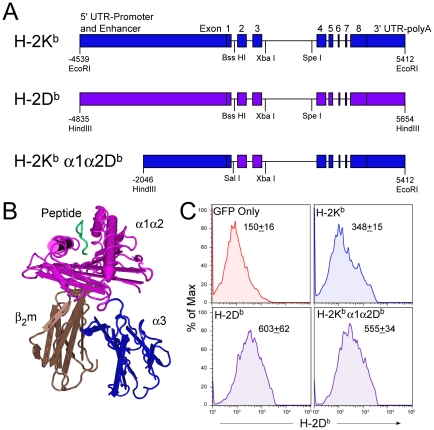
Structural diversity in the peptide binding sites of the redundant classical MHC antigen presenting molecules is strongly selected in humans and mice. Although the encoded antigen presenting molecules overlap in antigen presenting function, differences in polymorphism at the MHC I A, B and C loci in humans and higher primates indicate these loci are not functionally equivalent. The structural basis of these differences is not known. We hypothesize that classical class I loci differ in their ability to direct effective immunity against intracellular pathogens. Using a picornavirus infection model and chimeric H-2 transgenes, we examined locus specific functional determinants distinguishing the ability of class I sister genes to direct effective anti viral immunity. Whereas, parental FVB and transgenic FVB mice expressing the H-2K(b) gene are highly susceptible to persisting Theiler's virus infection within the CNS and subsequent demyelination, mice expressing the D(b) transgene clear the virus and are protected from demyelination. Remarkably, animals expressing a chimeric transgene, comprised primarily of K(b) but encoding the peptide binding domain of D(b), develop a robust anti viral CTL response yet fail to clear virus and develop significant demyelination. Differences in expression of the chimeric K(b)α1α2D(b) gene (low) and D(b) (high) in the CNS of infected mice mirror expression levels of their endogenous H-2(q) counterparts in FVB mice. These findings demonstrate that locus specific elements other than those specifying peptide binding and T cell receptor interaction can determine ability to clear virus infection. This finding provides a basis for understanding locus-specific differences in MHC polymorphism, characterized best in human populations.
在人类和小鼠中,冗余的经典 MHC 抗原呈递分子的肽结合位点的结构多样性受到强烈选择。尽管编码的抗原呈递分子在抗原呈递功能上重叠,但人类和高等灵长类动物 MHC I A、B 和 C 基因座的多态性差异表明这些基因座在功能上并不等同。这些差异的结构基础尚不清楚。我们假设,经典的 I 类基因座在指导针对细胞内病原体的有效免疫方面存在差异。我们使用微小核糖核酸病毒感染模型和嵌合 H-2 转基因,研究了区分 I 类姐妹基因指导有效抗病毒免疫能力的基因座特异性功能决定因素。虽然表达 H-2K(b)基因的亲本 FVB 和转基因 FVB 小鼠在中枢神经系统内对持续性口蹄疫病毒感染和随后的脱髓鞘非常敏感,但表达 D(b)转基因的小鼠清除了病毒并免受脱髓鞘影响。值得注意的是,表达主要由 K(b)组成但编码 D(b)肽结合域的嵌合转基因的动物产生了强大的抗病毒 CTL 反应,但未能清除病毒并发生明显的脱髓鞘。感染小鼠中枢神经系统中嵌合 K(b)α1α2D(b)基因(低水平)和 D(b)(高水平)的表达差异反映了它们在 FVB 小鼠中内源性 H-2(q)对应物的表达水平。这些发现表明,除了指定肽结合和 T 细胞受体相互作用的那些之外,基因座特异性元件可以决定清除病毒感染的能力。这一发现为理解 MHC 多态性的基因座特异性差异提供了基础,这种差异在人类群体中表现得最为明显。